Can a college student get a credit card in India? Yes, usually via an FD-backed card or an add-on card. Eligibility, FD sizes, fees and mistakes, as of November 2026.
Quick Verdict
Yes, an adult college student can get a credit card in India, but usually not by the normal route.Most issuers want proof of income, and a student has none. The realistic routes are a card backed by a fixed deposit (FD), or an add-on card on a parent's account.
This guide on acredit card for students in Indiais as of November 2026. It covers what is possible, what each route costs, and what to avoid. It is written for first-timers with no credit history.
Route | Income proof needed? | Typical entry cost | Best for |
|---|---|---|---|
FD-backed card (IDFC FIRST WOW!) | No income proof or credit history | FD of ₹20,000 or more; card is lifetime free | Students aged 18+ who can park an FD |
FD-backed card (Kotak 811 #DreamDifferent) | No; needs an eligible Kotak FD | FD amount not stated on pages read; card is lifetime free | Students who already bank with Kotak |
FD-backed card (ICICI Instant Platinum) | No; FD-based | FD of ₹50,000 or more, tenure 180 days or more | Students whose family keeps an ICICI FD |
Add-on card on a parent's card | No; parent is the principal holder | Often nil; check the issuer | Students under 18, or anyone who wants no FD |
Regular income-based card | Yes | Varies by bank | Students with a stipend or part-time income |
The simple rule: if you are 18 or older and can lock up an FD, an FD-backed card is the cleanest start. If you are under 18, or have no FD, ask a parent for an add-on card.
Can a College Student Get a Credit Card in India?
Yes, if the student is an adult and the issuer can see a way to recover its money. A salary slip does that for a working person. An FD does that for a student.
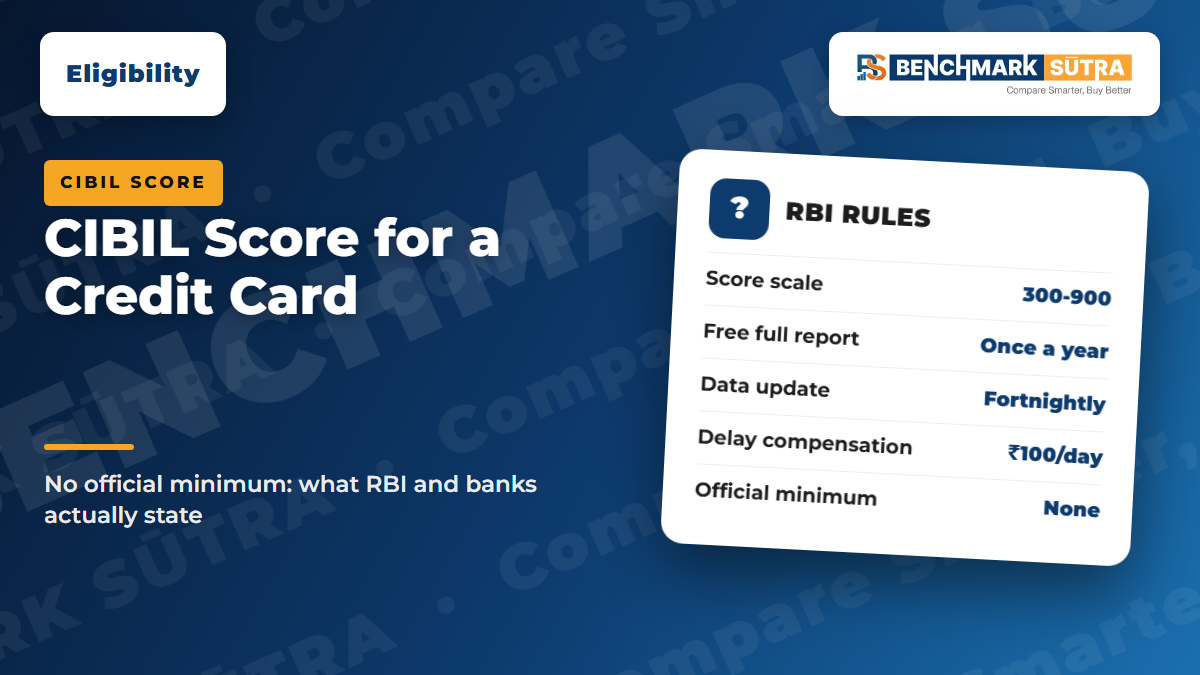
RBI sets the framework. Its Credit Cards and Debit Cards (Issuance and Conduct) Directions, 2025, for commercial banks (RBI/DOR/2025-26/155, 28 November 2025), do not set a minimum cardholder age in the text we checked. Each issuer sets its own rules, commonly 18 years and above. Always read the age line on the issuer's product page.
Two other RBI points matter to students. Add-on cards go only to people the principal cardholder names, and the principal cardholder carries the liability. And issuers must publish the payment modes they accept, so you know where to pay.
For how issuers judge applicants in general, read7 hacks to boost approval with low income. For why applications fail, see5 common reasons a credit card is rejected.
What Are the Credit Card Options for Students With No Income?
1. FD-backed cards
You open an FD with the bank. The bank gives you a card with a limit set as a share of that FD. If you do not pay, the bank recovers from the FD, so it does not need income proof. Your FD keeps earning interest, but you cannot withdraw it while it secures the card.
Card | Age | FD needed | Fees | Forex markup |
|---|---|---|---|---|
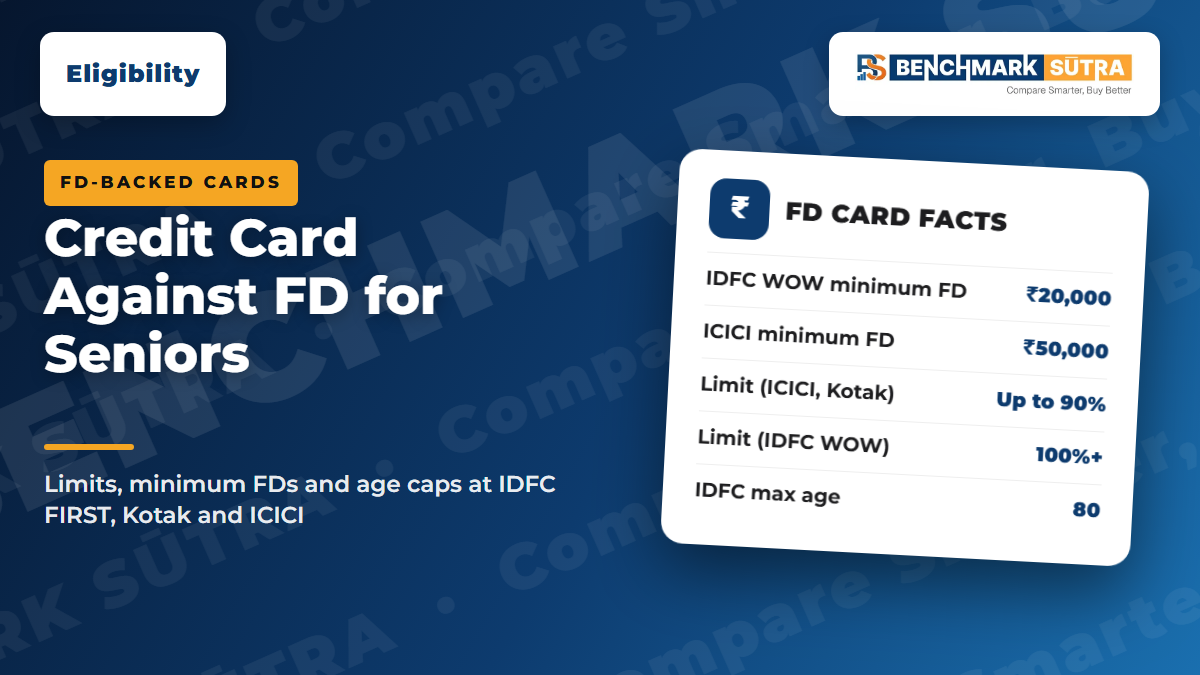
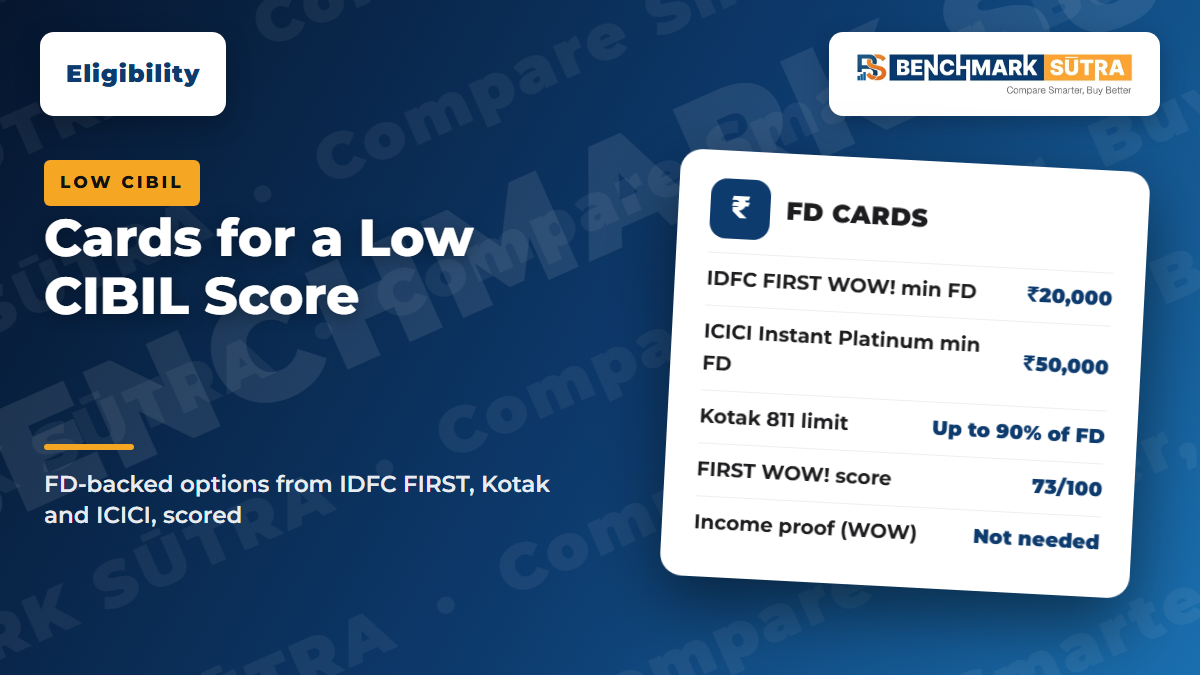
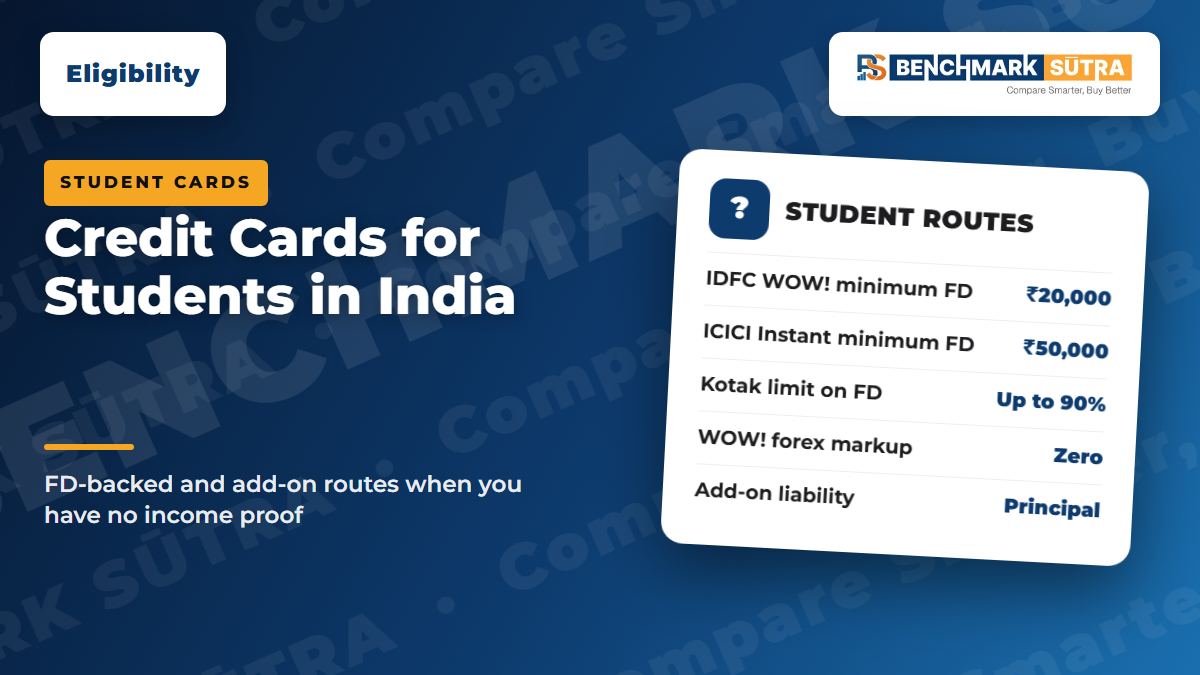
IDFC FIRST WOW! | 18 to 80 | ₹20,000 or more | Lifetime free; optional UPI digital card ₹199 + GST a year | Zero |
Kotak 811 #DreamDifferent | 18 to 75, resident | Eligible Kotak FD; amount not stated on pages read | No joining or annual fee | 4% |
ICICI Instant Platinum (against FD) | Check ICICI page | ₹50,000 or more, 180-day minimum tenure | No joining or annual fee | Not confirmed |
Details from each issuer's official page. IDFC FIRST WOW! gives a limit of at least 100% of the FD; Kotak gives up to 90% of the FD lien amount. Benchmarksutra Scores: WOW! 73/100 (B Tier), Kotak 811 60/100 (C Tier), ICICI Instant Platinum 57/100 (Avoid unless niche use case). The score reflects rewards and perks, not whether the card is a good starter. Seehow we score cards.
For a student, WOW! is the strongest fit on paper: lowest FD, zero forex, no income proof. Kotak's own FAQ shows a 3.50% monthly interest illustration. That is a spend-and-repay-in-full card, not a loan.
2. Add-on card on a parent's card
A parent holds the main card and adds you. You get your own card and PIN, but the parent is liable for every rupee. This is the only route for most students under 18. Learn the rules inadd-on credit cards explained.
The upside is low cost at many banks and a limit shared with the parent. The downside is that it may build no credit history of your own, because the principal holder owns the account. Check how the issuer reports it.
3. Regular cards with a stipend or part-time income
If you have a stipend, a paid internship or freelance income, some issuers may consider you. Eligibility varies and the bank decides. Readhow to get a credit card as a freelancerfor the proof usually asked for. We could not confirm a card built specifically for students on an issuer's official page, so we do not name one.
How Much Does a Student Credit Card Really Cost?
The fee is usually zero. The cost is in two places: money locked in an FD, and interest if you slip. Here is a worked example with a ₹20,000 FD on the IDFC FIRST WOW! route. These are our illustrative numbers, not offers.
Item | Amount | What it means |
|---|---|---|
FD locked | ₹20,000 | Not available while the card is active |
Card limit | At least ₹20,000 | At least 100% of the FD, per IDFC FIRST |
Monthly spend plan | ₹4,000 | 20% of the limit, a healthy ratio |
Interest if paid in full by due date | ₹0 | You stay in the interest-free window |
A 3.50% monthly rate (Kotak's FAQ illustration) on ₹4,000 unpaid for a month | ₹140 | Illustration only; rates vary by issuer |
Using more than about 30% of the limit can hurt a young score. Test it with ourcredit utilisation calculator. Missing a payment is the bigger risk. Readwhy paying only the minimum is dangerous.
Checklist
Confirm you meet the issuer's minimum age on its own product page
Decide how much you can lock in an FD for at least a year, and do not borrow it
Ask the bank whether the FD stays in your name and how the limit is set
Set up auto-debit for the total due, not the minimum
Keep the monthly spend under about 30% of the limit
Check the forex markup before using the card for foreign apps or fees
Read the schedule of charges and the MITC before signing
Never share your OTP, CVV or card photo with anyone
Common Mistakes to Avoid
Applying to many banks at once.Each application can add a hard enquiry. Seehard vs soft enquiry.
Treating the limit as spending money.A ₹20,000 limit is borrowed money, not income.
Paying only the minimum.Interest runs on the unpaid balance.
Using the card for cash withdrawals.Fees and interest can begin at once.
Breaking the FD early.That can close or cut the card.
Lending your card to friends.You are liable for every charge.
Want a wider start? ReadCredit Card 101, and seebest credit cards for a low or no CIBIL score. Avoid the traps incredit card mistakes beginners should avoid.
Related on benchmarksutra
FAQs
Can a college student get a credit card in India?
Yes, if the student is an adult and the issuer accepts the application. Without income proof, the usual routes are an FD-backed card or an add-on card on a parent's account.
What is the minimum age for a credit card in India?
The RBI directions we checked do not set a minimum cardholder age. Issuers set their own, commonly 18 years and above. Check the age line on the issuer's official page.
Can I get a credit card without income proof?
Yes, through an FD-backed card. IDFC FIRST says its WOW! card needs no income proof or credit history, only an FD of ₹20,000 or more.
Is an FD-backed card good for a student?
It can be. The FD secures the card, so approval is easier and fees can be nil. The cost is that your money stays locked while the card is active.
Do add-on cards build my credit score?
Not reliably. The principal cardholder owns the account and bears the liability, so ask the issuer how an add-on is reported before you count on it.
How much credit limit will a student get?
On FD-backed cards the limit is a share of the FD. IDFC FIRST says at least 100% for WOW!, and Kotak says up to 90% for 811 #DreamDifferent.
Should a student use a credit card at all?
Only if you can pay the full bill every month. If your spending is uncertain, a debit card or UPI is safer.
Official Sources and Editorial Note
Data checked as of: 9 November 2026
RBI Credit Cards and Debit Cards (Issuance and Conduct) Directions, 2025
https://www.rbi.org.in/Scripts/BS_ViewMasDirections.aspx?id=13155
IDFC FIRST Bank WOW! Credit Card
https://www.idfcfirst.bank.in/credit-card/wow
Kotak 811 #DreamDifferent Credit Card FAQs
https://www.kotak.bank.in/en/personal-banking/cards/credit-cards/811-dream-different-credit-card/811-dream-different-credit-card-faqs.html
Kotak 811 eligibility and application
https://www.kotak.bank.in/en/help-center/credit-card/811-dream-different-credit-card/eligibility-and-application-process/q2.html
ICICI Bank credit card against fixed deposit
https://www.icicibank.com/personal-banking/cards/credit-card/credit-card-against-fixed-deposit
Editorial note:
Eligibility, FD limits and fees change. Confirm current terms with the issuer before you open an FD or apply. The ₹20,000 example is illustrative.
This article is written from official sources and does not rely on third-party wording.