How benchmarksutra rates laptops: seven ratings, five buyer profiles, India prices and warranty, and a worked example. Researched, not hands-on tested.
Quick Verdict
The benchmarksutra Laptop Score turns official specifications, the India price and the India warranty into a score out of 100. It is built the same way as our mouse and keyboard scores: seven ratings out of 10, weighted for five kinds of buyer. It is our own scoring system and does not reuse any other site's scores, tests, tables or charts.
Researched, not hands-on tested.November 2026 (prices checked 6 November 2026). Scores are our editorial assessment of the makers' published specifications, India prices and India warranty terms. We did not run benchmarks, battery tests or screen measurements, and battery hours appear only as the maker states them.
Prices change frequently. The prices on this page were correct when we wrote and checked it, but they may have changed by the time you read this. Check the current price on the retailer's page before you buy.
Step 1: seven ratings
Each rating applies to the exact configuration the price refers to: CPU, GPU, RAM and SSD. A laptop sold with 8 GB and with 16 GB is two different entries.
Row | What we rate | Main inputs |
|---|---|---|
Performance | How much work and play it can take | CPU class and cores, GPU and its published power (W), RAM, SSD |
Display | How good the screen is on paper | Panel type, resolution, refresh rate, brightness (nits), colour gamut |
Build & portability | How easy it is to carry and how solid it is | Weight, chassis material, thickness, MIL-STD claims |
Battery | Time away from the charger | Battery Wh, maker-rated hours and their basis, charger, USB-C charging |
Keyboard & ports | Daily usability | Backlight, numpad, USB-C/Thunderbolt/USB4, HDMI, RJ45, card reader |
Software & support | Living with it | OS, India warranty years and type, accidental-damage cover, upgrade slots |
India value | What an Indian buyer pays and gets | Price against the other six rows and the same money elsewhere in its band |
Step 2: weights by buyer
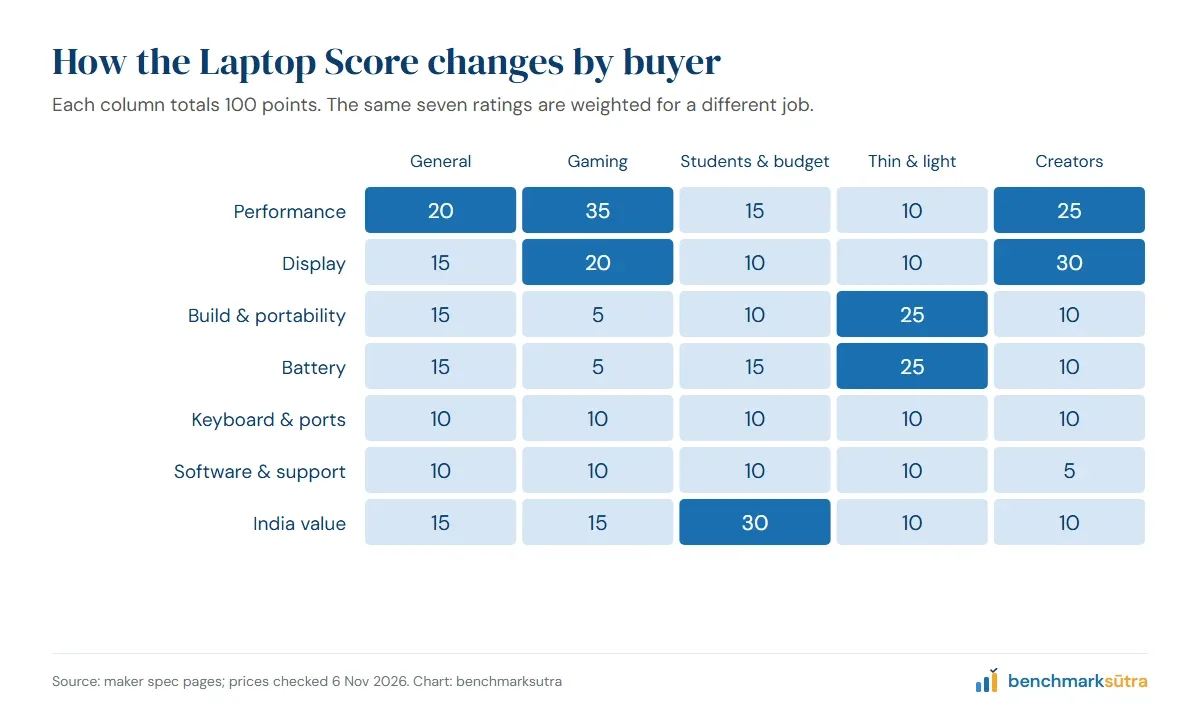
The same seven ratings are weighted differently for each profile. Each column totals 100, so the score is the sum of rating × weight divided by 10, rounded to a whole number.
Row | General | Gaming | Students & budget | Thin & light | Creators |
|---|---|---|---|---|---|
Performance | 20 | 35 | 15 | 10 | 25 |
Display | 15 | 20 | 10 | 10 | 30 |
Build & portability | 15 | 5 | 10 | 25 | 10 |
Battery | 15 | 5 | 15 | 25 | 10 |
Keyboard & ports | 10 | 10 | 10 | 10 | 10 |
Software & support | 10 | 10 | 10 | 10 | 5 |
India value | 15 | 15 | 30 | 10 | 10 |
Who goes in which list:Generalis every laptop;Gamingis laptops with a discrete NVIDIA GPU;Students & budgetis laptops at ₹80,000 or below;Thin & lightis laptops without a discrete GPU and with an official weight of 1.6 kg or less;Creatorsneeds a Display rating of 7.5+ and a Performance rating of 7+.
Worked example: ASUS Zenbook A14 OLED
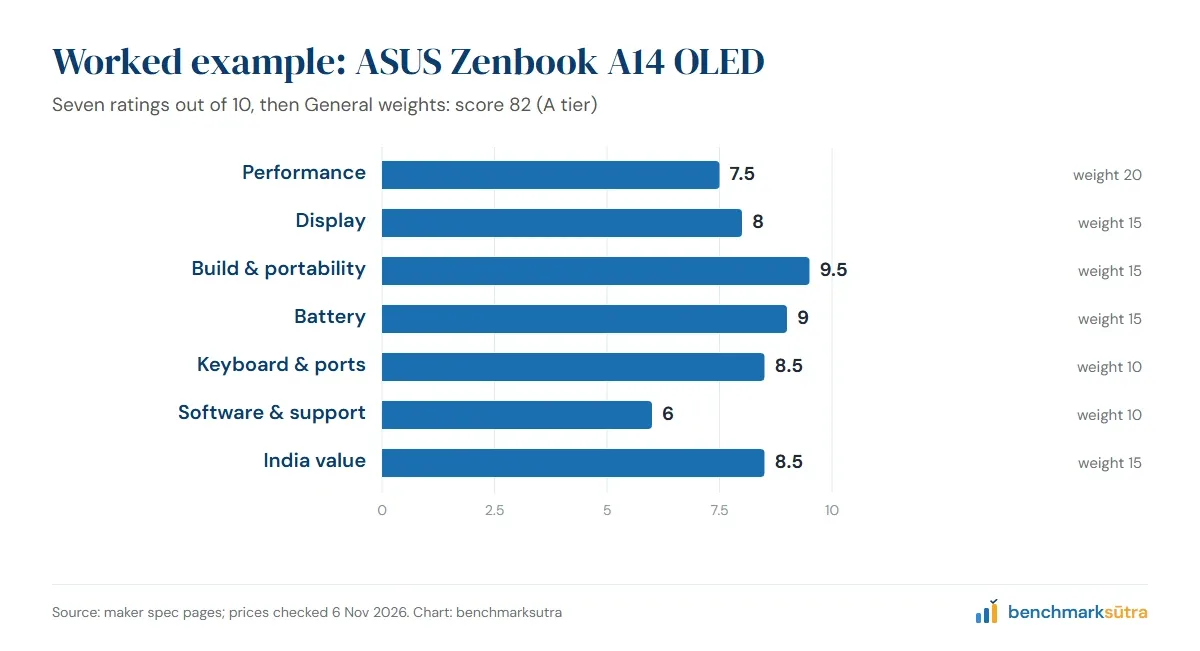
The ASUS Zenbook A14 OLED (Snapdragon X, 16 GB, 512 GB, ₹82,281) gets these ratings from its published specification: 0.98 kg, a 14-inch OLED panel with 100% DCI-P3 coverage, a 70 Wh battery, two USB4 ports and a one-year onsite warranty. Windows on Arm lowers its Software & support rating by half a point, because some apps and games do not run natively.
Row | Rating (out of 10) | General weight | Points |
|---|---|---|---|
Performance | 7.5 | 20 | 15 |
Display | 8 | 15 | 12 |
Build & portability | 9.5 | 15 | 14.25 |
Battery | 9 | 15 | 13.5 |
Keyboard & ports | 8.5 | 10 | 8.5 |
Software & support | 6 | 10 | 6 |
India value | 8.5 | 15 | 12.75 |
Sum: 7.5×20 + 8×15 + 9.5×15 + 9×15 + 8.5×10 + 6×10 + 8.5×15 = 820, divided by 10 gives 82, rounded to82 (A tier). Under the Thin & light weights the same ratings give 85, because weight and battery count for 25% each.
How a rating is set
Each row has written rules, so two people with the same data reach the same rating. A few examples from the rules:
Performance:Apple M5 or M6 class rates 9 to 9.5; an RTX 5060 at 115 W with an HX or 8-core H CPU rates 9 to 9.5; an RTX 3050 at 75 W rates 7; a Ryzen 5 7530U or Core i5 U-series rates 6 to 6.5; a Celeron or Intel N-series chip rates 2 to 3. An unpublished GPU power limit never earns the top of a range, and 8 GB of RAM on Windows costs half a point.
Display:a Mini-LED panel at 1,000 nits and 120 Hz rates 10; a 2.5K to 3K OLED, or a 2.5K IPS at 120 Hz or more with DCI-P3, rates 9.5; Full HD IPS at 45% NTSC rates 5 to 6; a 1366x768 TN panel rates 2.5.
Build & portability:under 1.0 kg rates 9.5 to 10, 1.3 to 1.6 kg in metal rates 7 to 8, and over 2.5 kg rates 4.5. A MIL-STD-810H claim adds half a point within the band.
Battery:a maker rating of 20 hours or more rates 10. Between 40 and 50 Wh rates 5.5 to 6. Gaming laptops are rated separately: 80 to 90 Wh rates 6.5 and under 60 Wh rates 4.5 to 5.5.
Software & support:one year carry-in rates 6, two years onsite 7 to 7.5 and three years onsite 8.5. Bundled accidental-damage cover, Windows 11 Pro or upgrade slots add half a point; Windows on Arm subtracts half a point.
Tiers
S is 90 and above, A is 80–89, B is 70–79, C is 60–69 and D is below 60 (avoid unless you have a niche use case). The same tiers are used across every benchmarksutra score.
India price bands
Our guides use four bands: under ₹40,000, ₹40,000–70,000, ₹70,000–1,00,000 and above ₹1,00,000. In our sample no Windows laptop under ₹40,000 has a current-generation CPU, 8 GB or more of RAM and a Full HD IPS screen, and gaming laptops with an RTX 3050 start near ₹87,000.
What we use, and what we do not
Specificationscome from the maker's India page first (Apple India, Lenovo PSREF, ASUS India, MSI, Dell India, HP India, Acer, Samsung), then global official pages and manuals. Where a maker page would not load we used the retailer's specification table and mark the entry accordingly.
Pricesare the retailer's selling price before bank or card offers, with retailer, product link and date: 6 November 2026. We use the lowest price for the exact configuration at an allowed retailer.
Warrantyis the India warranty stated by the maker or the retailer's listing. Where they differ, we note the conflict.
Battery hoursappear only as the maker rates them, with the test basis, and are never our own numbers.
Lab measurements: none. We do not run benchmarks, time battery or measure brightness. Every post carries the labelResearched, not hands-on tested.
Missing data
When a spec is not published, the rating uses what is published and the post says so. We never guess silently. An unpublished GPU power limit never earns the top of a performance range, and unpublished panel details cap the display rating at 6.
Related on benchmarksutra
Frequently asked questions
Why do you publish the weights?
So you can check the maths and change it. If battery matters more to you than our Thin & light profile assumes, apply your own weights to the seven ratings in each post.
Why are ratings editorial?
We do not measure anything, so a rating is a judgment made from published numbers under written rules. That is why every post carries the Researched, not hands-on tested label.
Is this a review?
No. It is research: we compare official specifications, India prices and warranty terms. We did not test any of the laptops.
Why is a laptop in some lists and not others?
Each profile has an eligibility rule, such as a discrete GPU for Gaming or a price cap for Students. A laptop appears in every list it qualifies for.
Why do scores change between profiles?
The ratings stay the same. The weights change, so weight and battery count more for Thin & light and performance counts more for Gaming.
How often are prices checked?
This series uses prices checked on 6 November 2026. Each post shows that date next to the table.
Can makers influence the scores?
No. Makers and retailers do not see or edit the scores, and the ratings follow written rules.
Related laptop guides
MacBook Air 13 M5 vs Lenovo Yoga Slim 7 Aura: Which Ultraportable?
ASUS TUF Gaming A15 vs MSI Katana 15: Which RTX 3050 Laptop?
Official Sources
See alsohow we review products.