
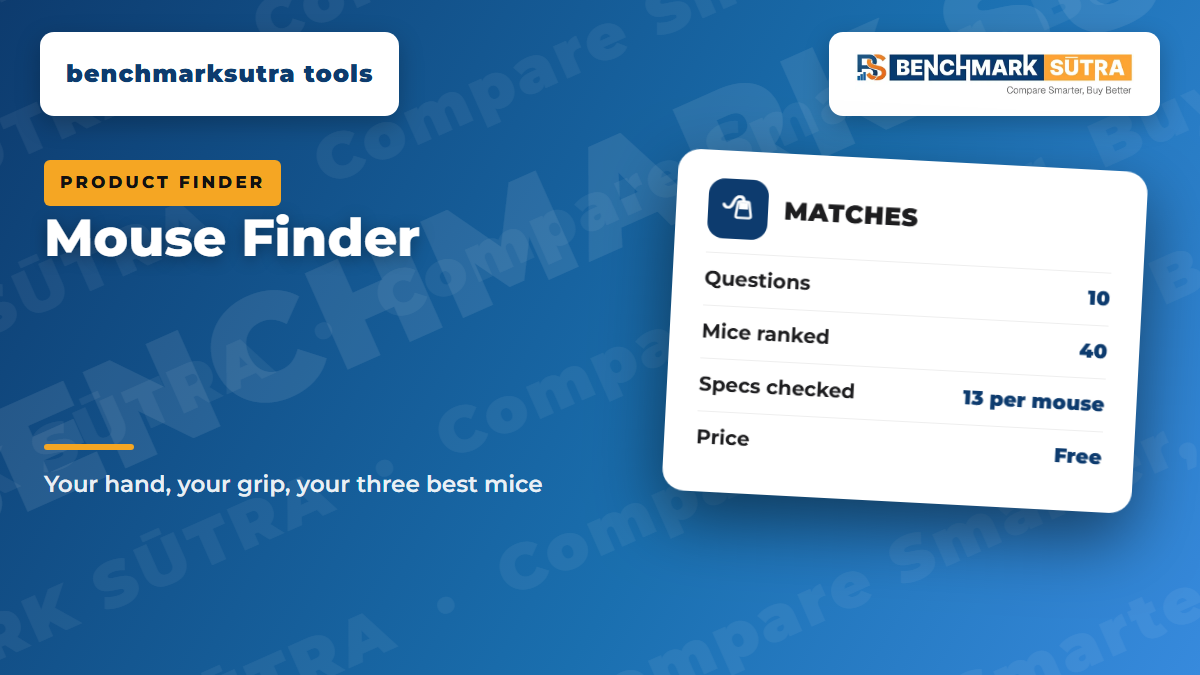
Tell us your hand size, grip, weight preference and must-haves, and get the three best-matched mice from our scored rankings.
Quick answer
Not sure which mouse to buy? Tell us how you hold a mouse, how big your hand is, the weight you like and what you cannot do without. The finder checks every mouse we have scored against its full spec sheet and shows the three best matches, each linked to our full ranking.
How the Mouse Finder chooses
Every mouse starts with its benchmarksutra Mouse Score for your main use: office, gaming, wireless, ergonomic or wireless gaming. Your other answers then remove mice that do not fit and move the rest up or down. If too few mice pass every answer, the finder relaxes the soft preferences and says so above the results. Your budget, wireless choice and left-hand choice are never relaxed.
Fit: hand size, grip and shape
Fit matters more than any spec on this page. A mouse that is too long or too short for your hand tires it out within an hour.
Measure your hand from the crease of your wrist to the tip of your middle finger. As a rule of thumb, a medium hand (17 to 19.5 cm) suits a mouse about 124 mm long for a palm grip, 120 mm for a claw grip and 114 mm for a fingertip grip. Take about 10 mm off for a small hand and add 7 to 8 mm for a large one.
The finder compares each mouse's published length with that ideal. It also marks down flat mice for a palm grip and uses the brand's own grip guidance where one is published. Vertical mice and trackballs are matched to palm grip only.
Left-handed users see ambidextrous mice, mice sold in a left-handed version, and symmetrical gaming shapes. On a symmetrical shape the side buttons sit under your little finger, and each result says so.
Weight
Under 65 g is ultralight, the choice for fast, wide flicks in shooters. A mouse of 65 to 89 g is mid-weight, a balance most people like. One of 90 g or more is heavy, which feels steady for office work and slow, precise aim.
Sensor, DPI, IPS, acceleration and lift-off
We do not filter on maximum DPI, also called CPI. Every current sensor goes far beyond the 800 to 3,200 DPI most people use, so a bigger number does not make a mouse better.
What separates sensors is tracking under fast movement:
- IPS: inches per second, the top speed before tracking breaks.
- Acceleration: in g, how hard a flick it can follow.
Flagship sensors reach 650 IPS or more. Lift-off distance is how high you can lift the mouse before the cursor stops. A low or adjustable lift-off stops the cursor drifting when you reposition.
Polling rate and latency
Polling rate is how often the mouse reports to the PC. A rate of 1,000 Hz is plenty for most players. A rate of 4,000 to 8,000 Hz helps only on a high-refresh monitor and uses more CPU and battery.
We do not rate click latency directly. Brands do not publish it, and we use only figures we can verify, so polling rate, wireless technology and switch type stand in for it.
Scroll wheel, switches and power
A notched wheel scrolls in steps you can feel. A free-spin wheel glides through long pages and spreadsheets, and switchable wheels do both.
Optical and inductive switches register a click with light or magnetism instead of metal contacts, so they do not develop the double-click fault that wears out mechanical switches. Silent switches cut click noise for shared rooms.
For power, rechargeable mice charge over USB-C. AA and AAA mice run for months and take a fresh cell in seconds.
What the results show
Each pick lists its key specs: shape, weight class, sensor, polling, lift-off, wheel, switches and battery. It also gives the reasons it matched you and the price on Indian retailers on the date we checked. Where a brand does not publish a figure, we leave it out rather than guess. Prices change often, so check the current price before you buy.
Full rankings: best mouse in India, best gaming mouse, best wireless mouse, best ergonomic mouse and best wireless gaming mouse.