What are the ways to pay a credit card bill in India? UPI, app, NEFT, auto-debit, platforms, cheque and cash compared on speed and cost, as of November 2026.
Quick Verdict
You can pay a credit card bill in India by UPI, the issuer's app or netbanking, NEFT or IMPS from your bank, auto-debit, a bill-payment platform, a cheque, or cash at a branch.For most people the best way is auto-debit for the total due, with UPI or netbanking as a backup a day before the due date.
This guide showshow to pay a credit card billthrough every common method, what each one costs and how fast it reaches your card, as of November 2026. Timings and fees vary by bank, so check your issuer's page.
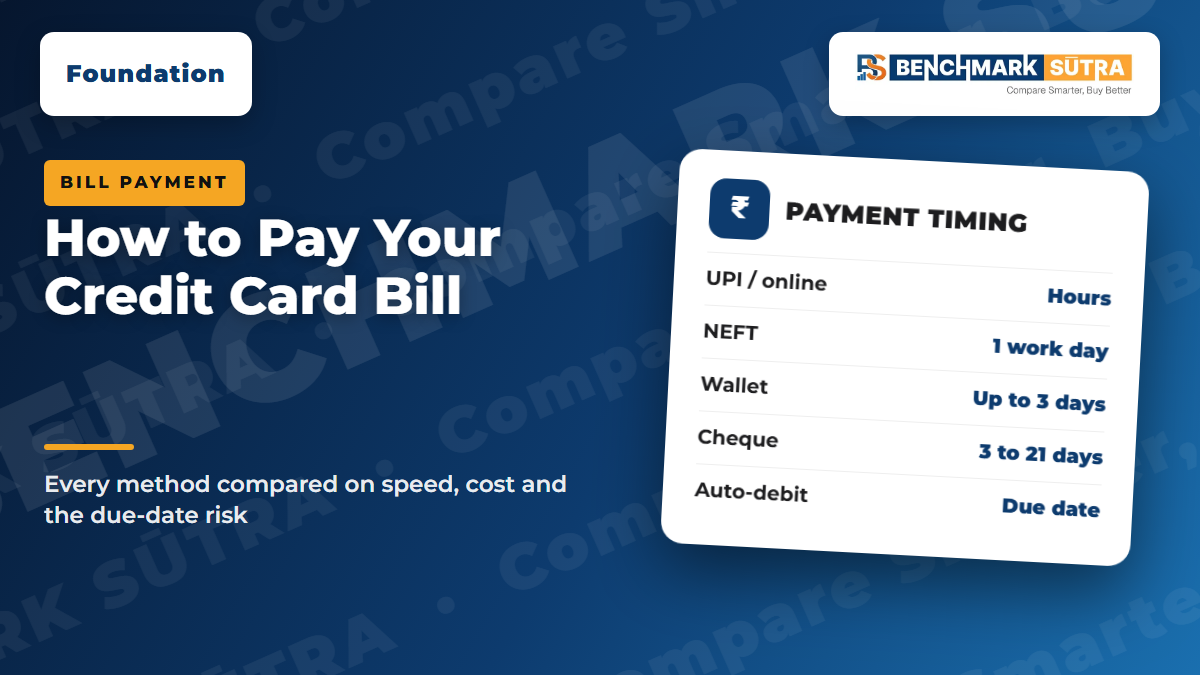
Method | Speed | Typical cost | Best for |
|---|---|---|---|
UPI | Usually instant to a few hours | Nil on most issuer pages | Quick last-day payment |
Issuer app or netbanking | Usually instant | Nil | Everyday payer |
NEFT / IMPS from your bank | Same day to next working day | Your bank's transfer charge, if any | Paying from a bank account without the issuer app |
Auto-debit (e-mandate) | On the due date | No charge for the e-mandate per RBI; return charges if it fails | Never missing a due date |
Bill-payment platform or wallet | Can take up to 3 working days | Check for convenience fees | Paying several bills in one place |
Cheque | 3 to 21 working days on ICICI's clearing table | Nil, but slowest | People who must use paper |
Cash at a branch | Within one working day on ICICI's page | ICICI lists ₹100 to ₹150 + GST | Last resort |
The simple rule: pay the total amount due, not the minimum, and pay at least one working day early. A late payment costs far more than any method fee.
What Are the Ways to Pay a Credit Card Bill in India?
Under RBI's Credit Cards and Debit Cards (Issuance and Conduct) Directions, 2025 (RBI/DOR/2025-26/155, 28 November 2025), card issuers must publish the payment modes they accept on their website and in your statement. They must also advise you not to pay through other modes. So your statement is the master list.
Here is what each method looks like in practice.
1. UPI
Open any UPI app, choose credit card bill payment or scan the issuer's QR, and pay. ICICI Bank's FAQ says a successful online payment usually reflects instantly or within a few hours, and in some cases may take up to one working day. It advises waiting up to 24 hours before contacting customer care about a missing payment.
2. The issuer's app or netbanking
Log in, open the card, choose Pay Bill and select total due, minimum due or a custom amount. This is the most direct route and the one most issuers list first.
3. NEFT, IMPS or RTGS from your bank
Add your credit card as a beneficiary with the card number and IFSC the issuer gives. ICICI's older mailer asks customers to make NEFT payments at least one day before the due date. Check the issuer's beneficiary details every time; the wrong IFSC delays payment.
4. Auto-debit
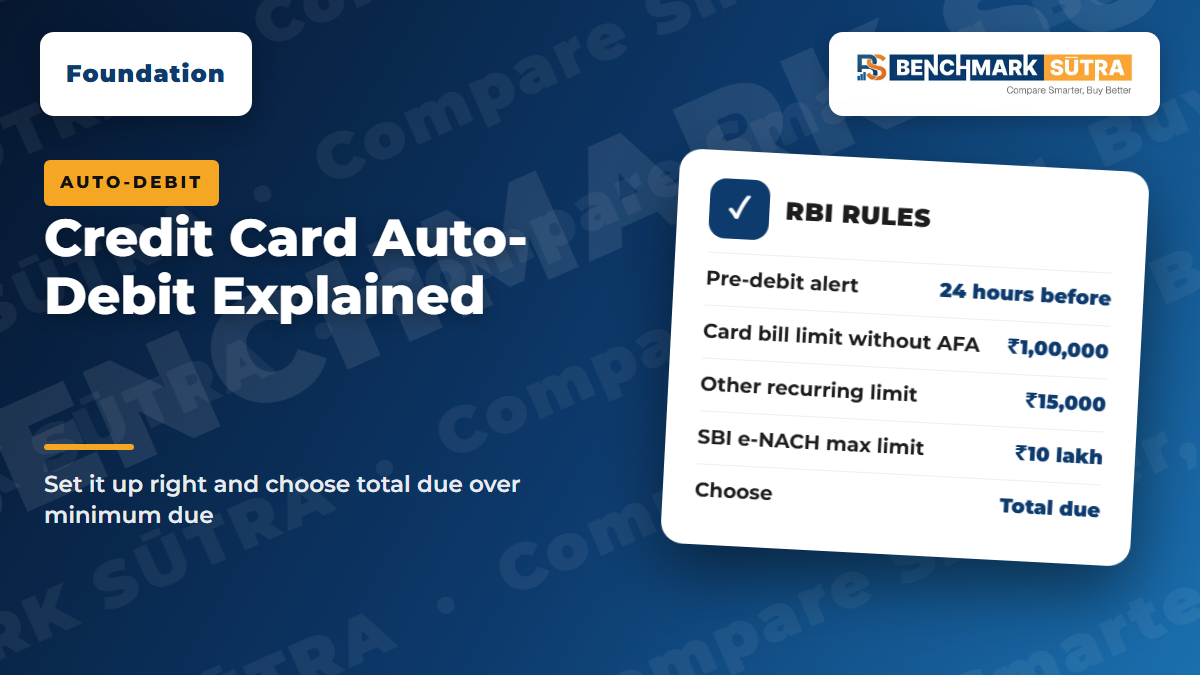
You give a standing instruction so the issuer debits your bank account on the due date. It can run on an issuer facility, NACH or UPI AutoPay. RBI's E-mandate Framework, 2026 says no charge may be levied for using the facility, requires a pre-debit alert at least 24 hours before each debit, and lets you withdraw the mandate at any time. Read our full guide:auto-debit for credit card bills explained.
Choose the total due. HDFC Bank's page says autopay on the minimum due instead of the total is treated as not following the total-due instruction. It also lists autopay return charges of 2% of the payment amount, subject to a minimum of ₹450; check the MITC for the latest.
5. Bill-payment platforms and wallets
Many apps let you pay a card bill alongside other bills. ICICI's page says a wallet payment will be credited within three working days, so do not use this route on the last day. RBI's directions say convenience fees on certain transactions must be disclosed up front. Look for that line before you confirm.
6. Cheque and cash
ICICI's mailer lists clearing windows of 3 working days for an ICICI cheque, 5 for another bank's cheque, 12 for an outstation cheque at an ICICI branch and 21 for an outstation cheque at a non-ICICI branch. Cash at a branch is credited within one working day, per the same mailer, and ICICI's pages quote a ₹100 to ₹150 + GST fee that differ between pages. This mailer is old, so confirm today's terms.
How Long Does a Credit Card Payment Take to Reflect?
It depends on the rail and the issuer's cut-off. The figures below come from ICICI Bank's own pages, shown as an example. Other issuers publish their own.
Method | ICICI Bank says | What to do |
|---|---|---|
UPI / online | Instant to a few hours; up to one working day in some cases | Pay one working day before the due date |
NEFT | Credited within 1 working day (older mailer) | Pay at least 1 day early |
Wallet | Within 3 working days | Do not use near the due date |
Cheque | 3 to 21 working days by type | Pay far ahead of the due date |
Cash at a branch | Within 1 working day | Pay at least 1 day early |
The due date is printed on your statement. Readstatement date vs due dateandbilling cycle explainedto see how the dates are set. RBI says a cardholder must get at least a fortnight to pay before interest is charged, and you can ask your issuer to change your billing cycle date at least once.
Should You Pay the Total Due or the Minimum Due?
Pay the total. RBI's directions define the interest-free period as the time from the transaction to the due date, available only if the full outstanding is paid by the due date. Partial or late payment loses it, and interest then runs from the transaction date on the outstanding amount.
What you pay | Interest-free period | What happens |
|---|---|---|
Total amount due by the due date | Kept | No interest on those purchases |
Minimum amount due only | Lost | Interest runs on the unpaid balance from the transaction date |
Nothing by the due date | Lost | Late charges can apply; RBI ties late charges and credit bureau reporting to being past due for more than three days |
Do not treat the three-day line as a free grace. Your issuer's terms decide the charge. Learn the difference intotal amount due vs minimum amount dueand seehow the grace period works. To size the cost, use ourcredit card interest calculator.
Checklist
Find the due date on your latest statement
Set auto-debit for the total due, with a limit above your usual bill
Keep balance in the debit account a day before the due date
Pay manually one working day early if you use NEFT, wallets or cash
Save the payment reference or screenshot
Check the next statement to confirm the payment posted
Pay only through modes listed on your statement or issuer site
Compare cards on payment features inhow to compare credit cards in India
Common Mistakes to Avoid
Paying on the due date itself.A slow rail can push it past the date.
Choosing the minimum due by default.It keeps the account current but interest keeps running.
Using an unlisted payment mode.RBI wants issuers to tell you which modes are valid.
Forgetting auto-debit fails on low balance.Return charges can apply.
Paying through an unknown link or number.Pay only inside your bank app or a known platform.
Ignoring convenience fees on third-party apps.Read the final screen.
Related on benchmarksutra
FAQs
What are the ways to pay a credit card bill in India?
You can pay by UPI, the issuer's app or netbanking, NEFT or IMPS, auto-debit, a bill-payment platform, a cheque or cash at a branch. Your issuer lists the modes it accepts on its website and in your statement.
What is the fastest way to pay a credit card bill?
UPI or the issuer's own app is usually fastest. ICICI Bank says online payments usually reflect instantly or within a few hours, and sometimes take up to one working day.
Can I pay a credit card bill with another credit card?
Do not assume so. RBI asks issuers to publish authorised payment modes, so check your issuer's list. Paying one card with another can also add fees and interest.
How early should I pay my credit card bill?
At least one working day before the due date for UPI or NEFT, and several days before for cheques or wallets. Slower modes can take up to 3 to 21 days.
Does RBI allow auto-debit for credit card bills?
Yes. RBI's E-mandate Framework, 2026 covers it. Registration needs additional authentication, you get a pre-debit alert 24 hours ahead, and no charge may be levied for the facility.
What happens if I pay only the minimum amount due?
You lose the interest-free period and interest runs on the unpaid balance. Pay the total due to avoid it.
Is there a fee to pay a credit card bill?
Usually not for UPI or the issuer's app. Cash at a branch, auto-debit returns and some third-party platforms can carry charges, so read the fee line first.
Official Sources and Editorial Note
Data checked as of: 9 November 2026
RBI Credit Cards and Debit Cards (Issuance and Conduct) Directions, 2025
https://www.rbi.org.in/Scripts/BS_ViewMasDirections.aspx?id=13155
RBI Digital Payments E-mandate Framework, 2026
https://www.rbi.org.in/Scripts/BS_ViewMasDirections.aspx?id=13374
ICICI Bank credit card bill payment
https://www.icici.bank.in/personal-banking/payments/credit-card-bill-payment
ICICI Bank credit card FAQs
https://www.icici.bank.in/personal-banking/cards/credit-card/faqs
ICICI Bank payment options
https://www.icici.bank.in/personal-banking/debt-service/hassle-free-payment-options
HDFC Bank auto-debit instruction for credit card payments
https://www.hdfcbank.com/personal/useful-links/important-messages/auto-debit-instruction-for-credit-card-payments
NPCI NACH
https://www.npci.org.in/product/nach/about-nach
Editorial note:
Payment modes, fees and posting times differ by issuer and change over time. ICICI Bank is used as an example because its pages were available. Confirm your own issuer's terms.
This article is written from official sources and does not rely on third-party wording.