How a credit card balance transfer works, what SBI Card charges, a worked Rs. 50,000 example, and what RBI rules say, written for professionals.
Quick Verdict
A credit card balance transfer moves what you owe on one bank's credit card to another bank's card, so you repay the new card at a lower rate or on an instalment plan. In the case we read, SBI Card pays the old card by NEFT within 3 to 4 working days, and you then owe SBI Card instead.
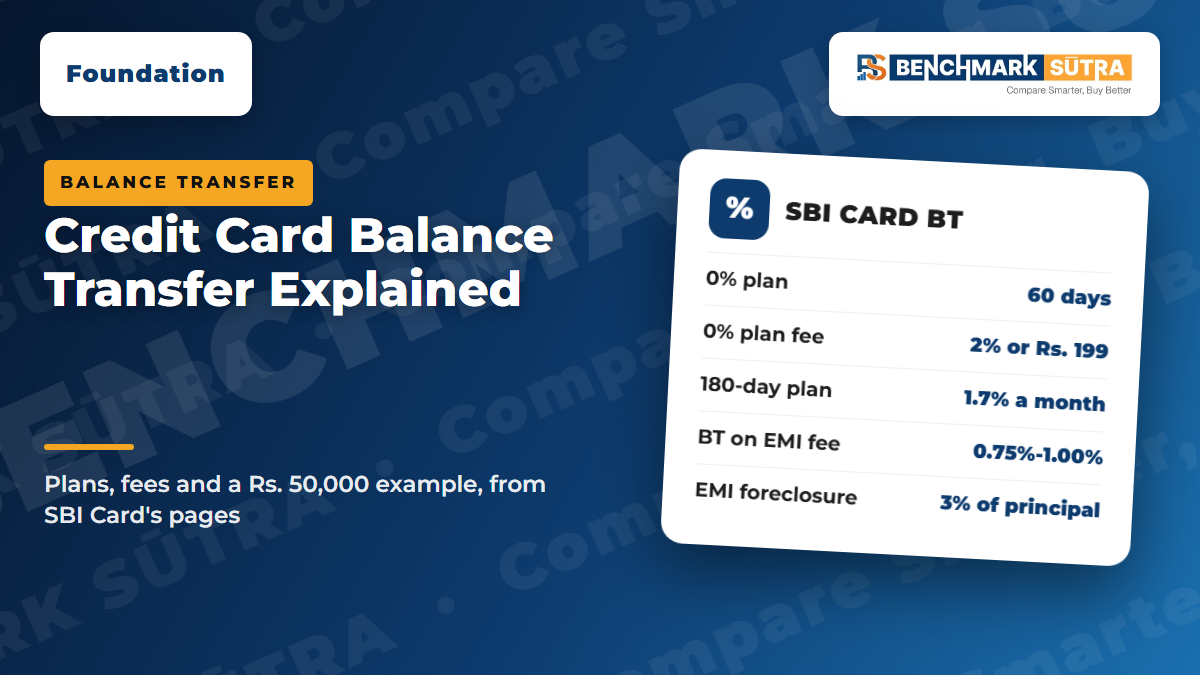
Our view: acredit card balance transferis a rate game with a fee attached, and the fee is where people lose. SBI Card's 0% plan runs for only 60 days and carries a processing fee of 2% or Rs. 199, whichever is higher, according to its page. The 180-day plan charges 1.7% a month (20.4% a year) with no processing fee. Neither plan is free money. It only helps if you will clear the balance inside the window. We have researched this from RBI and SBI Card's own pages. We have not tested a transfer, and other banks' terms differ.
For a CA, lawyer or doctor whose receipts arrive in lumps, a transfer is a bridge to a known payment date, such as a client payment or a quarterly fee. It is a poor tool if you have no date on which the balance will be gone.
Plan (SBI Card, as per its pages) | Rate | Processing fee |
|---|---|---|
Balance Transfer, 60 days | 0% interest for 60 days | 2% or Rs. 199, whichever is higher |
Balance Transfer, 180 days | 1.7% a month (20.4% a year) | Zero |
Balance Transfer on EMI, 3 months | 0.83% to 1.46% a month (10.00% to 17.50% a year) | 0.75% to 1.00%, one time |
Balance Transfer on EMI, 6 months | 1.04% to 1.67% a month (12.50% to 20.00% a year) | 0.75% to 1.00%, one time |
Taxes on fees may apply; the pages do not spell this out, so check your offer. As of November 2026, confirm every rate on the bank's page before you book.
Try it with your own numbers:Credit Card Payoff Calculator
How Does a Credit Card Balance Transfer Work?
You do not move the card. You move the debt. The steps, as described on SBI Card's pages:
You pick a plan and book it on the new card's website, app, SMS or helpline.
You enter the other bank's card details and the amount to transfer.
The new bank pays the old card's account by NEFT, in about 3 to 4 working days.
The amount now shows on the new card. You repay it on the plan's terms: interest-free for a set period, a monthly rate, or fixed instalments.
The transferred amount comes from the new card's limit. SBI's pages do not say how much limit is blocked or which balances cannot be moved, so check the terms.
SBI Card states that the transfer is from a credit card issued by a different bank. A balance on a card from the same bank is not covered by that page.
There are two product types worth separating. A plain balance transfer is a short window, either a 0% period with a fee or a longer period at a monthly rate. A balance transfer on EMI converts the amount to instalments over 3 or 6 months. Both cost money. They are not a free pause.
What Does a Balance Transfer on EMI Cost in Rupees?
SBI Card publishes the monthly instalment per Rs. 1,000. That lets us work out a clean example for a Rs. 50,000 balance. The figures below come from SBI Card's per-Rs. 1,000 instalments; the processing fee is the one-time 0.75% to 1.00%. Taxes are not included.
Plan | Monthly instalment | Total paid | Interest portion | Processing fee |
|---|---|---|---|---|
3-month BT on EMI | Rs. 16,950 to Rs. 17,150 | Rs. 50,850 to Rs. 51,450 | Rs. 850 to Rs. 1,450 | Rs. 375 to Rs. 500 |
6-month BT on EMI | Rs. 8,650 to Rs. 8,850 | Rs. 51,900 to Rs. 53,100 | Rs. 1,900 to Rs. 3,100 | Rs. 375 to Rs. 500 |
The range reflects the rate band: SBI Card's page gives a band, not a single rate, so your own offer may sit anywhere inside it. Add the fee to the interest to get your real cost, so the 3-month plan could cost about Rs. 1,225 to Rs. 1,950 on Rs. 50,000, and the 6-month plan about Rs. 2,275 to Rs. 3,600.
Foreclosure matters too. SBI Card's page says a fee of 3% is levied on the outstanding principal if you close the EMI early. On a Rs. 30,000 outstanding principal that is Rs. 900. The page adds that you continue to enjoy the interest-free period on purchases with BT on EMI.
Now compare with the 0% plan. On Rs. 50,000, 2% is Rs. 1,000, which is higher than Rs. 199, so the fee is Rs. 1,000. If you can clear Rs. 50,000 within 60 days, Rs. 1,000 is your whole cost. If you cannot, the page does not tell us the rate after day 60. Ask before booking. For smaller balances the Rs. 199 minimum applies, as 2% of Rs. 5,000 is only Rs. 100.
Run your own numbers in thecredit card payoff calculatorand thecredit card interest calculatorbefore you book anything.
What Do RBI Rules Say About Balance Transfers?
RBI's RBI, Credit Cards and Debit Cards: Issuance and Conduct Directions, 2025 (updated as on 1 October 2026) does not set separate balance transfer rules in the text we read. It mentions balance transfer only when it asks issuers to quote the Annualised Percentage Rate (APR) for different situations, such as retail purchases, balance transfer and cash advances. The general rules still protect you:
The APR must be shown with clear examples, and the annual fee with equal prominence.
A one-page Key Fact Statement, including the rate of interest and charges, must come with the application.
The MITC must be provided at onboarding and when a condition is modified.
The interest-free credit period is suspended if any balance of the previous bill is outstanding. Plan for that before you move a balance.
Interest is levied only on the outstanding amount, adjusted for payments, refunds and reversed transactions.
The minimum amount due must be set so there is no negative amortisation, and statements must warn that paying only the minimum stretches repayment over months or years.
On EMI conversions, issuers must ensure complete transparency. Interest-bearing EMIs shall not be camouflaged as zero-interest or no-cost EMI.
Read the interest basics inevery credit card fee explained, and see how the due date works ingrace period explained.
When Does a Balance Transfer Make Sense?
Situation | Balance transfer? | Why |
|---|---|---|
You have a client payment due in 45 days | Possibly, with a 0% plan | The fee is the whole cost if you clear it inside the window |
You need 3 or 6 months to repay a known amount | Possibly, BT on EMI | Fixed instalments, but interest plus a processing fee |
You have no date on which the balance will be gone | No | The rate after the window may be higher than your old card's |
Your old card's interest is the issue and you can pay in full next month | Maybe no need | A full payment next bill may cost less than any fee |
You plan to keep spending on both cards | No | Two bills, two due dates, more risk of a late fee |
Remember that a transfer does not reduce what you owe. It moves it. If the problem is that your balance keeps rolling over, readwhy paying the minimum is dangerousandtotal amount due vs minimum amount duefirst.
Checklist: Before You Book a Balance Transfer
Write down the exact outstanding on the old card and the date by which you will clear it.
Check the new bank's current rate and processing fee on its own page. Rates are shown as bands.
Work out the total cost: interest plus processing fee plus any taxes. Compare with paying the old card in full.
Ask what rate applies after the 0% period ends.
Check the foreclosure fee if you plan to close early (SBI Card: 3% of outstanding principal for BT on EMI).
Check the transfer limit and which balances are not allowed.
Keep paying the old card's minimum due until the NEFT reaches it, so you do not miss a payment in the 3 to 4 working days.
Confirm the old card's balance has actually dropped before you consider closing it.
Common Mistakes to Avoid
Seeing 0% and ignoring the fee.The fee on Rs. 50,000 can be Rs. 1,000.
Ignoring what happens after the 0% window.Day 61 can be expensive if you still owe money.
Stopping payment on the old card too early.The NEFT takes about 3 to 4 working days. A missed minimum due in that gap can add late charges.
Treating a transfer as debt relief.The debt only moves. It still has to be paid.
Using the new card for fresh purchases on top.The interest-free period on purchases is suspended if a previous balance is outstanding, per RBI.
Comparing only the rate.Compare the total rupee cost, including the processing fee.
Related on benchmarksutra
FAQs
How does a credit card balance transfer work?
You ask the new bank to pay your outstanding on another bank's credit card. The new bank pays the old card (SBI Card says by NEFT within 3 to 4 working days), and you repay the new bank on the plan's terms.
Is a balance transfer free?
No. SBI Card's 0% plan carries a processing fee of 2% or Rs. 199, whichever is higher. Its BT on EMI plan carries a one-time processing fee of 0.75% to 1.00%. Its 180-day plan shows zero processing fee but charges 1.7% a month.
What happens after the 0% period ends?
SBI Card's page does not say what rate applies after the 60 days. Ask the bank before you book.
Can I transfer a balance within the same bank?
SBI Card's page describes transfers from a card issued by a different bank. Do not assume a same-bank transfer is covered.
Does RBI have special rules for balance transfers?
The card Directions we read mention balance transfer only where they require issuers to quote APR for different situations. The general rules on Key Fact Statement, MITC and minimum due still apply.
Is balance transfer on EMI different from a plain balance transfer?
Yes. BT on EMI converts the amount to fixed instalments over 3 or 6 months at a published rate band, plus a one-time fee. A plain balance transfer is a short window with its own rate and fee.
Can I close a balance transfer EMI early?
SBI Card's page says a 3% fee is levied on the outstanding principal if you foreclose. Check your own terms.
Official Sources and Editorial Note
This article is written from official sources and does not rely on third-party wording.