On a ₹2 lakh trip, a 3.5% markup card costs ₹8,260 extra; a nil-markup card costs ₹0. Forex card fees, TCS rules and when each one wins abroad.
Quick Verdict
Carry a low- or zero-forex credit card as your main way to pay abroad, and a forex card only if your card charges 3.5% or you need a fixed budget in one currency. A credit card gives you credit, rewards and strong fraud protection. A forex card locks your exchange rate when you load it and limits your loss to its balance.
The real credit card vs forex card question is cost. On a ₹2 lakh trip, a card with a 3.5% markup costs about ₹8,260 in markup and GST. A card with nil markup costs nothing extra. A forex card sits in between: lower markup, but its own exchange-rate margin, fees and GST on conversion. As of November 2026, here is how they compare.
Factor | Credit card | Forex card |
|---|---|---|
Exchange rate | Network rate on the settlement date | Locked when you load |
Markup | Nil to 3.5% plus GST, depending on card | Built into the load rate; 2% cross-currency fee on some cards |
Fees | Annual fee; cash withdrawal is costly | Issuance fee (sometimes waived), reload and ATM fees |
Rewards | Usually yes; some cards exclude foreign spends | Not a reward product |
Credit | Yes, with an interest-free period | No, prepaid |
TCS | Overseas card spends not counted under LRS | Loads count under LRS; TCS can apply above the threshold |
Fraud protection | RBI liability rules for unauthorised transactions | Loss limited to the card balance |
Apply with Axis: Check Axis credit cards
Disclosure: this is an affiliate link. BenchmarkSutra may earn a commission if you apply through it, at no extra cost to you. It does not change our analysis.
Apply with HDFC: Check HDFC credit cards
Disclosure: this is an affiliate link. BenchmarkSutra may earn a commission if you apply through it, at no extra cost to you. It does not change our analysis.
Apply with BOBCARD: Check the BOBCARD Etihad Guest credit card
Disclosure: this is an affiliate link. BenchmarkSutra may earn a commission if you apply through it, at no extra cost to you. It does not change our analysis.
How Does a Credit Card Charge You Abroad?
When you pay in a foreign currency, your bank converts the amount to rupees at the card network's rate and adds a foreign currency markup. HDFC's MITC says the conversion rate "as on settlement date" applies, so the rate is not fixed on the day you swipe.
GST is normally charged on the markup too. Markups vary widely by card:
Card | Forex markup (before GST) |
|---|---|
Scapia Axis Bank | Nil (Axis lists foreign currency fee and DCC as nil) |
BOBCARD Etihad Guest Premium | Nil |
HDFC Regalia Gold | 2% |
Axis Magnus | 2% |
Axis Atlas | 3.5% |
HSBC Taj | 3.5% |
Always pay in the local currency
Abroad, a card machine may offer to charge you in rupees. This is Dynamic Currency Conversion (DCC), and banks charge for it. HDFC levies a 1.75% markup on such rupee transactions abroad on Regalia Gold and Diners Club Privilege from 15 May 2026, and Axis raised My Zone's DCC markup to 3.5% from 28 August 2026. Choose the local currency every time.
Network acceptance also matters abroad. See Visa vs Mastercard vs RuPay vs Amex.
How Does a Forex Card Charge You?
A forex card is a prepaid card loaded with foreign currency before you travel. HDFC Bank's ForexPlus range is a good official example of the costs, as of November 2026.
Cost | HDFC ForexPlus example |
|---|---|
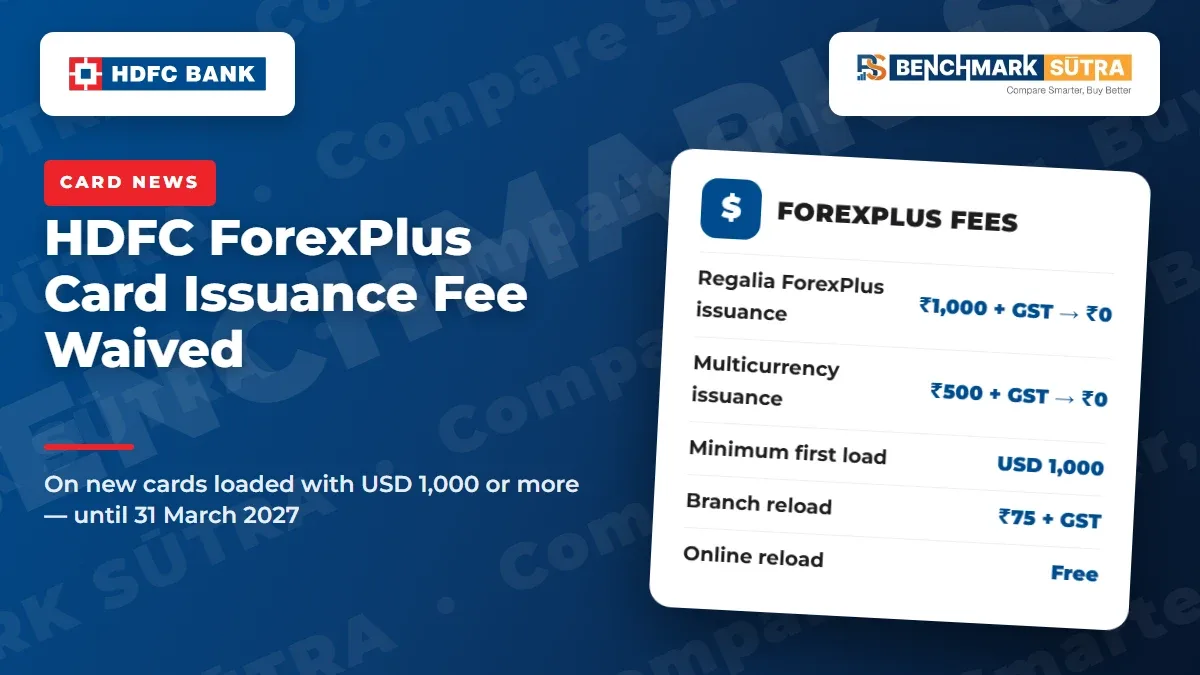
Issuance fee | ₹200 to ₹1,000 + GST by card; waived on new online applications loading USD 1,000 or more, until 31 March 2027 |
Reload fee | ₹75 + GST at a branch; nil through the online portal |
ATM withdrawal | USD 2.00 per withdrawal on the Multicurrency card; USD 4.00 on Regalia ForexPlus |
Cross-currency markup | 2% on the Multicurrency card if you pay in a currency not loaded; nil on Regalia ForexPlus |
GST on conversion | 0.18% of value up to ₹1 lakh (minimum ₹45); ₹180 + 0.09% from ₹1 lakh to ₹10 lakh |
TCS | Applies under the Finance Act; loads count towards the LRS limit |
There is one more cost that is easy to miss: the exchange rate the bank uses when you load includes its own margin. Compare the load rate with the day's reference rate before you buy. Full details of the current waiver are in our HDFC ForexPlus fee waiver explainer.
Do TCS Rules Treat Them Differently?
Yes, and this is a real difference.
Credit card spends abroad: the Finance Ministry's June 2023 clarification says transactions through international credit cards while overseas would not be counted under the Liberalised Remittance Scheme (LRS), and so would not attract Tax Collected at Source (TCS).
Forex card loads: these are remittances under LRS. HDFC's forex pages say TCS applies under the Finance Act, and loads count towards the LRS limit of USD 2,50,000 a financial year. Budget 2025-26 raised the TCS threshold for LRS remittances to ₹10 lakh a financial year.
TCS is not a final cost; it is credited against your income tax. But it blocks cash until you file. Tax rules change, so check the current rates before a large load.
Credit Card vs Forex Card: Worked Example on a ₹2 Lakh Trip
Say a family spends ₹2,00,000 on a European holiday, all by card, with no cash withdrawals.
Option | Markup | GST on markup or conversion | Total extra cost |
|---|---|---|---|
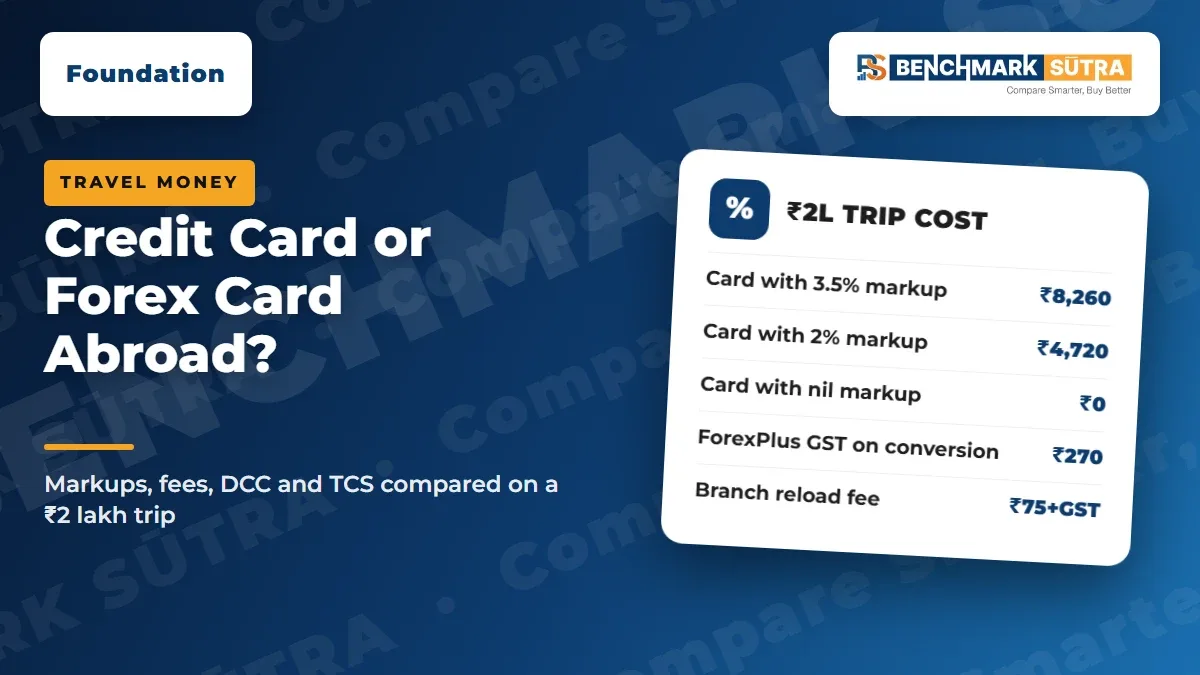
Credit card, 3.5% markup | ₹7,000 | ₹1,260 | ₹8,260 |
Credit card, 2% markup | ₹4,000 | ₹720 | ₹4,720 |
Credit card, nil markup | ₹0 | ₹0 | ₹0 |
HDFC Multicurrency forex card, loaded online with USD 1,000+ | Bank's load-rate margin | ₹270 GST on conversion | ₹270 plus the rate margin |
GST on the markup is shown at 18%. The forex card's margin is not published as a percentage, so compare live rates. The credit card rows also earn rewards, unless your card excludes foreign spends.
When Does a Credit Card Win?
You hold a card with nil or 2% markup.
You want credit and an interest-free period for big bookings.
You want reward points or miles on foreign spends. Read Reward Points 101 for travel redemptions.
You want to avoid TCS on the trip budget.
You need a card for hotel or car-rental deposits.
A zero-markup card is the cleanest option. Our Scapia card review covers what "0% forex" does and does not include.
When Does a Forex Card Win?
Your only credit card charges 3.5% and you will spend a lot abroad.
You want to lock today's rate for a fixed budget, such as a student's semester costs.
You want a hard spending cap, for a teenager or an elderly parent travelling alone.
You need cash abroad: forex card ATM fees are fixed, while credit card cash withdrawals carry a cash advance fee and interest from day one.
Many travellers carry both: a low-markup credit card for most payments and a small forex card or cash for ATMs.
Checklist
Check your credit card's forex markup and DCC fee in its MITC.
Turn on international usage only for your travel dates.
Always pay in local currency, never in rupees.
If buying a forex card, compare the load rate with the reference rate.
Load every currency you will use on a multicurrency card.
Reload online to avoid branch fees.
Plan for TCS on large forex loads.
Carry a backup card on a different network.
Save your bank's 24x7 helpline number before you fly.
Common Mistakes to Avoid
Mistake 1: Accepting payment in rupees
DCC adds a markup of up to 3.5% on some cards. Choose the local currency.
Mistake 2: Withdrawing cash on a credit card
Cash advances carry a fee and interest from the day of withdrawal, with no interest-free period.
Mistake 3: Ignoring GST on the markup
A 3.5% markup costs 4.13% once 18% GST is added.
Mistake 4: Over-loading a forex card
Refunding unused balance converts it back, with GST on that conversion too. Load close to what you will spend.
Mistake 5: Assuming every card earns rewards abroad
Some travel cards earn nothing on international spends. Check the reward terms before you rely on points.
FAQs
Should I carry a credit card or a forex card abroad?
Carry a low- or zero-markup credit card as your main payment method. Add a forex card only if your card charges about 3.5% or you want a locked budget.
Is a forex card cheaper than a credit card?
It is cheaper than a 3.5% markup card in most cases, but not cheaper than a nil-markup card. Forex cards have their own load-rate margin, ATM fees and GST on conversion.
Is TCS charged on credit card spends abroad?
The Finance Ministry's June 2023 clarification says international credit card spends while overseas are not counted under LRS and do not attract TCS.
Is TCS charged on forex card loads?
Forex card loads count under LRS, and TCS can apply above the threshold. Budget 2025-26 set that threshold at ₹10 lakh a financial year.
What is dynamic currency conversion?
It is when a foreign merchant charges you in rupees. Banks add a DCC markup, such as 1.75% on HDFC Regalia Gold, so always pay in the local currency.
Can I use a credit card to withdraw cash abroad?
You can, but it is costly: a cash advance fee plus interest from the day of withdrawal. A forex card's fixed ATM fee is usually cheaper.
Official Sources and Editorial Note
Data checked as of: 5 November 2026
Ministry of Finance (PIB): changes to LRS and TCS, June 2023
https://www.pib.gov.in/PressReleasePage.aspx?PRID=1936105
Ministry of Finance (PIB): direct tax proposals in Union Budget 2025-26
https://www.pib.gov.in/PressReleasePage.aspx?PRID=2098362
HDFC Bank forex cards (fees, GST on conversion, TCS)
https://www.hdfc.bank.in/forex-cards
HDFC Bank Multicurrency Platinum ForexPlus fees and charges
https://www.hdfc.bank.in/forex-cards/multicurrency-platinum-forexplus-chip-forex-card/fees-and-charges
HDFC Bank Regalia ForexPlus Card
https://www.hdfc.bank.in/forex-cards/regalia-forex-plus-card
HDFC Bank SmartBuy forex card issuance fee waiver terms
https://offers.smartbuy.hdfc.bank.in/offer_details/forex-card-offers/10366
HDFC Bank Credit Card MITC, updated 31 October 2026 (conversion rate, DCC)
https://www.hdfc.bank.in/content/dam/hdfcbankpws/in/en/personal-banking/discover-products/cards/credit-cards/personal-mitc/mitc-in-english.pdf
Scapia Axis Bank Credit Card
https://www.axis.bank.in/cards/credit-card/scapia-axis-bank-credit-card
Axis Bank Atlas Credit Card
https://www.axis.bank.in/cards/credit-card/axis-bank-atlas-credit-card
Axis Bank Magnus Credit Card
https://www.axis.bank.in/cards/credit-card/axis-bank-magnus-credit-card
Axis Bank revision of My Zone Credit Card terms (DCC markup)
https://campaign.axis.bank.in/generic/terms-and-conditions-myzone.pdf
BOBCARD Etihad Guest Premium
https://bobcard.co.in/credit-card-types/bobcard-etihad-guest-premium
HSBC Taj Important Terms and Conditions (MITC)
https://www.hsbc.bank.in/content/dam/hsbc/in/documents/credit-cards/taj/hsbc-taj-important-terms-and-conditions.pdf
This article is written from official sources and does not rely on third-party wording.
Editorial note:
The ₹2 lakh trip is illustrative and assumes 18% GST on markups. Forex card exchange-rate margins are not published as a percentage, so they are not quantified here. Tax rules on LRS and TCS change with each Finance Act; confirm current rates before a large load.