Forex markup is the extra percentage your bank adds on foreign-currency spends. See how 0% to 3.5% plus 18% GST changes your trip cost, with ₹ examples.
Quick Verdict
Aforex markup on a credit cardis the extra percentage your bank adds on top of the exchange rate whenever you pay in a foreign currency. It is charged on every rupee you spend abroad or on an overseas website, and GST at 18% is added on the markup itself.
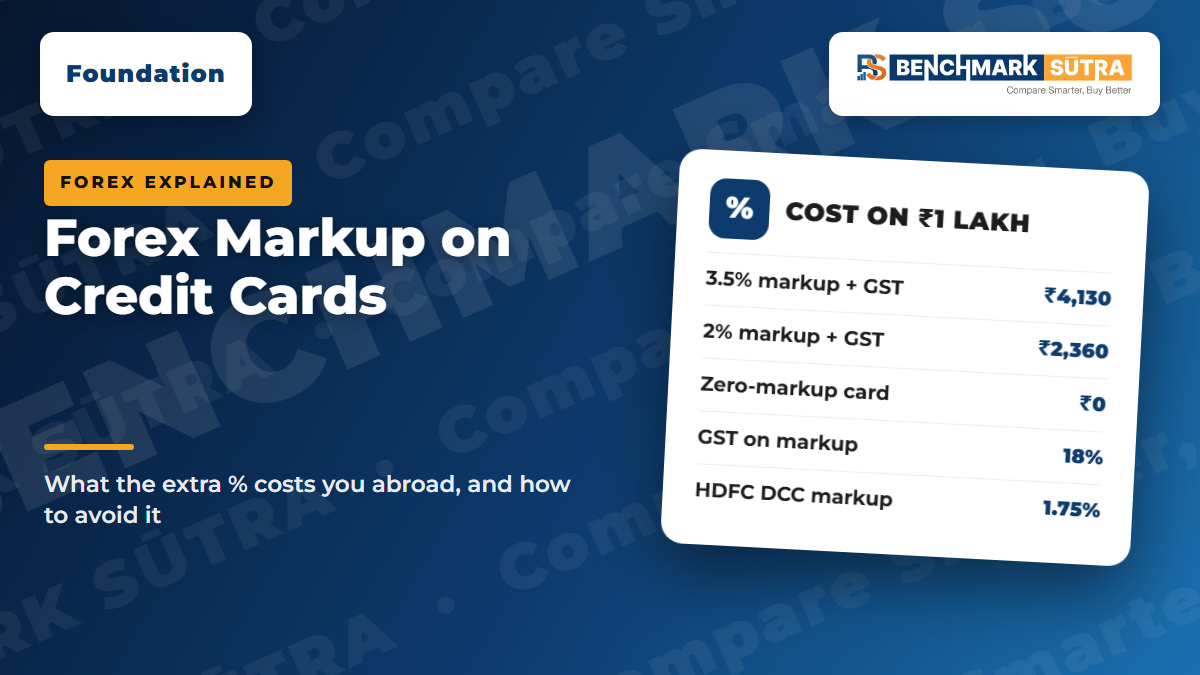
As of November 2026, Indian credit cards range from zero markup to 3.5%. On ₹1,00,000 of foreign spend, a 3.5% card costs about ₹4,130 extra, a 2% card about ₹2,360, and a zero-markup card nothing.
Item | What to know |
|---|---|
What it is | A bank fee, shown as a percentage, on foreign-currency spends |
Typical range on cards we checked | 0% to 3.5% |
Tax on top | GST at 18% on the markup |
Cost of 3.5% on ₹1,00,000 | ₹3,500 + ₹630 GST = ₹4,130 |
Cost of 2% on ₹1,00,000 | ₹2,000 + ₹360 GST = ₹2,360 |
Separate trap | Dynamic currency conversion (DCC), when a merchant bills you in rupees |
Before you travel or shop on a foreign site, check:
the forex markup on your card, in its fees and charges page or MITC
whether the card also charges a separate DCC fee
whether the transaction is in a foreign currency or in rupees
whether rewards are earned on foreign-currency spends, because some cards exclude them
How Does a Forex Markup Work?
When you swipe a card abroad, the transaction is in a foreign currency. The card network converts it to rupees, and your bank then adds its markup on the converted amount. The bank then adds GST on that markup. The markup is also called a cross-currency markup or foreign currency transaction fee.
The markup is charged whether you tap at a restaurant in another country or buy from an overseas website while sitting in India. If the bill is in a foreign currency, the markup applies.
Indian banks publish this number in the fees section of the card page or in the Most Important Terms and Conditions (MITC) document. Read the exact line, because one bank can have different markups on different cards.
Forex Markup on Popular Indian Credit Cards
These are the markups we confirmed on official issuer pages as of November 2026. Banks change them, so verify before you travel.
Card | Forex markup | Source |
|---|---|---|
HDFC Bank Regalia Gold | 2% | HDFC fees and charges page |
HDFC Bank Diners Club Privilege | 3.5% | HDFC fees and charges page |
ICICI Bank Coral, Rubyx, Sapphiro | 3.5% | ICICI card pages |
ICICI Bank Amazon Pay | 1.99% | ICICI Amazon Pay page |
ICICI Bank MakeMyTrip | Nil | ICICI MakeMyTrip page |
IDFC FIRST Bank credit cards | Zero | IDFC FIRST forex page |
Scapia Federal | Zero | Scapia card page |
Zero markup does not mean zero cost everywhere. Some cards that charge no markup still exclude foreign-currency spends from reward points. Scapia, for example, lists forex transactions among spends that do not earn Scapia Coins. OurScapia card reviewcovers that catch.
How Much Does a Forex Markup Cost? Worked Examples
GST at 18% applies to the markup, so the real cost is about 1.18 times the headline percentage. A 3.5% markup works out to roughly 4.13%.
Foreign spend | 3.5% markup + GST | 2% markup + GST | Zero markup |
|---|---|---|---|
₹50,000 | ₹2,065 | ₹1,180 | ₹0 |
₹1,00,000 | ₹4,130 | ₹2,360 | ₹0 |
₹3,00,000 | ₹12,390 | ₹7,080 | ₹0 |
Try your own numbers in ourcredit card forex markup calculator.
When does a higher annual fee pay for itself?
Take HDFC Regalia Gold: it charges ₹2,500 + GST (₹2,950) and a 2% markup. Against a 3.5% card, it saves 1.5% plus GST, or about 1.77% of foreign spend. You would need roughly ₹1.67 lakh of foreign spend a year for that saving alone to cover the fee. Other benefits change the maths, so use ourannual fee breakeven calculatorfor the full picture.
What Is Dynamic Currency Conversion (DCC)?
DCC is when a foreign merchant or card machine offers to bill you in rupees instead of the local currency. It looks convenient but the merchant sets the exchange rate, and your bank may add a separate DCC fee on top.
Banks publish DCC charges separately. HDFC Bank's MITC lists a 1.75% markup if you pay in rupees at a foreign merchant. ICICI Bank's notice of changes, effective 15 January 2026, lists DCC markups of 1.49% on Times Black, 2% on Emeralde cards, 0.99% on MakeMyTrip ICICI Bank, 1.99% on Amazon Pay ICICI Bank and 3.5% on all other ICICI cards.
The simple rule: when the terminal asks "pay in INR or local currency?", choose local currency.
Is There Tax on Foreign Card Spends (TCS)?
The Ministry of Finance clarified in June 2023 that transactions through international credit cards while overseas are not counted under the Liberalised Remittance Scheme, so they do not attract Tax Collected at Source. Rules on TCS have been revised in budgets since, so check the Income Tax Department's current guidance before a large booking. Note that this is separate from GST on the markup.
Which Type of Traveller Should Care Most?
Frequent flyers:markup is a recurring cost. A zero-markup card or a lounge-rich travel card usually wins. Seebest credit cards for international travel in India.
Occasional holidaymakers:one trip a year. A 3.5% card costs more than many fees, so check the maths for your trip budget.
Online shoppers on foreign sites:subscriptions and overseas orders are billed in a foreign currency and attract the markup.
Students and families abroad:regular monthly spend makes a low markup important. Compare with other options such asHDFC ForexPlus cardstoo.
Forex Markup Checklist
Find the markup in the card's MITC or fees page and note the date you checked it.
Check whether DCC has a separate charge.
Check whether foreign-currency spends earn rewards or are excluded.
Add 18% GST to the markup when you calculate the cost.
Choose local currency at the terminal, never rupees.
Confirm that your card network is accepted where you travel. SeeVisa vs Mastercard vs RuPay vs Amex.
Set a travel notice or enable international transactions in the bank app if your bank requires it.
Common Mistakes to Avoid
Assuming every premium card has a low markup. Several premium cards still charge 3.5%.
Choosing "pay in INR" at a foreign terminal and paying DCC.
Forgetting the GST on the markup.
Treating zero markup as zero cost when the card gives no rewards on forex spends.
Using old blog numbers. Markups change, so read the bank's current page.
Ignoring how basics work. New to cards? Start withCredit Card 101.
Related on benchmarksutra
Credit cards in India: every benchmarksutra guide in one place
Credit Card Insurance in India: What's Covered and How to Claim
FAQs
What is forex markup on a credit card?
It is a fee, shown as a percentage, that your bank adds on top of the exchange rate when you pay in a foreign currency. GST at 18% is charged on the markup.
How much is the forex markup on Indian credit cards?
It ranges from zero to 3.5% on the cards we checked as of November 2026. Entry and mid-range cards often charge 3.5%; some travel cards charge 2% or nothing.
Does forex markup apply to online purchases from foreign websites?
Yes. If the transaction is billed in a foreign currency, the markup applies even when you are in India.
Is GST charged on forex markup?
Yes. GST at 18% is charged on the markup, so a 3.5% markup costs about 4.13% in total.
What is the difference between forex markup and DCC?
Forex markup applies when you pay in the foreign currency. DCC applies when a merchant bills you in rupees and your bank may add a separate DCC charge.
Which Indian credit cards have zero forex markup?
IDFC FIRST Bank says all its credit cards have zero forex markup, and Scapia Federal advertises the same. ICICI Bank MakeMyTrip lists nil forex. Verify on the issuer page before relying on it.
Is TCS charged on international credit card spends?
A June 2023 Ministry of Finance clarification said card spends overseas are outside the Liberalised Remittance Scheme and do not attract TCS. Check the current Income Tax Department guidance, as rules change.
Official Sources and Editorial Note
Data checked as of: 9 November 2026
ICICI Bank upcoming changes to credit card features and charges
Press Information Bureau, Ministry of Finance clarification (June 2023)
This article is written from official sources and does not rely on third-party wording.
Editorial note: markups, GST and TCS rules can change. Confirm the current terms with your bank before you travel.