
Yes, with the right setup. RBI card controls, fraud liability limits, safer setups for retirees, and what to do in the first hour after fraud, as of November 2026.
Quick Verdict
Yes, a credit card can be safe for a senior citizen, and in some ways safer than a debit card, provided three habits are in place: card controls switched on, the full bill paid automatically every month, and no OTP ever shared with a caller. The real risks are fraud through phone calls and messages, and interest if the bill is not paid in full.
So is a credit card safe for senior citizens? The rules are on your side. RBI requires new cards to work only at ATMs and shops in India until you switch on online, international or tap-to-pay use. It limits your liability for fraud you report quickly. And it bans banks from sending cards or raising limits without your consent. This guide uses only RBI and bank sources, as of November 2026.
Risk | How serious for a retiree | Main protection |
|---|---|---|
Phone, SMS and link fraud | High: the most common route to loss | Never share OTP, PIN or CVV; report within hours |
Interest on unpaid bills | High if only the minimum is paid | Auto-debit for the full amount due |
Card used abroad or online by someone else | Medium | Keep online and international use off unless needed |
Lost or stolen card | Medium | Block at once through the app or 24x7 helpline |
Unsolicited card or limit hike | Low to medium | RBI consent rules; do not activate |
Is a Credit Card Safer Than a Debit Card for Seniors?
In one important way, yes. When someone misuses your debit card, money leaves your savings account straight away, and you wait for the bank to put it back. When someone misuses your credit card, the spend sits on the card account. Your pension and savings stay where they are while the dispute is checked.
RBI's credit card directions add that no charges can be levied on a transaction you dispute as fraud until the dispute is resolved. For a pensioner whose monthly budget depends on the savings balance, that matters.
The trade-off is debt. A debit card cannot run up interest. A credit card can, if the bill is not paid in full. Compare both in Credit Card vs Debit Card.
What Protections Does RBI Give Cardholders?
Cards start "domestic and contact only"
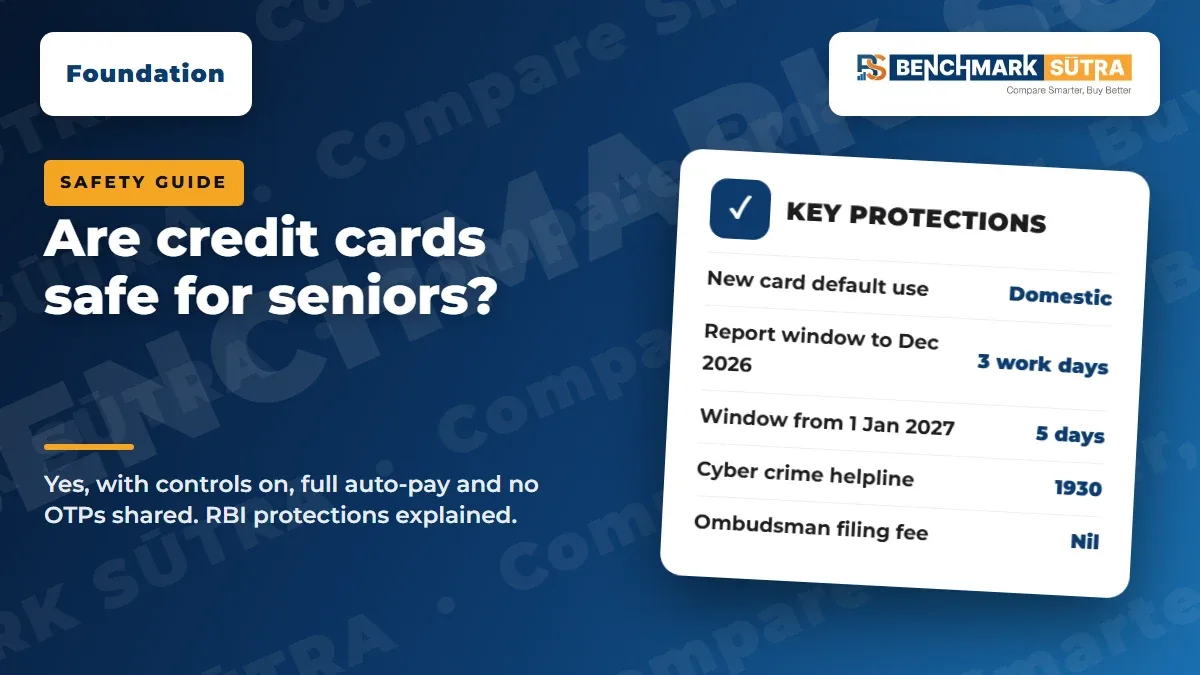
RBI's circular on enhancing security of card transactions, effective 16 March 2020, says all new and reissued cards must be enabled only for contact-based use in India, meaning ATMs and shop terminals. Online, international and contactless use must be switched on separately by you. Banks must let you switch each type on or off and set limits, 24x7, through several channels, and must alert you by SMS or email when anything changes.
For many seniors, the safest setup is simple: leave international use off, switch online use on only when you need it, and set a low daily limit.
Your fraud liability is limited if you report quickly
For card transactions up to 31 December 2026, you have zero liability for a third-party breach if you report it within three working days of the bank's alert. From 1 January 2027, RBI's new rules set the window at five calendar days from the transaction. If the loss is the bank's fault, your liability is zero either way. The full table is in RBI Credit Card Rules Explained.
No card or higher limit without your consent
Banks cannot issue a card, upgrade one or raise your limit without explicit consent. If you are billed for a card you never asked for, the bank must reverse the charges and pay you twice that amount. Do not activate a card you never asked for, and do not share an OTP to "receive" one.
Clear costs before you sign
Every application must come with a one-page Key Fact Statement showing the interest rate and charges. The bank must send the Most Important Terms and Conditions at onboarding, preferably in English, Hindi and the local language. Ask for the language you read best.
Where Seniors Actually Lose Money
1. Calls and messages that ask for an OTP
Fraud calls often claim to be from the bank, a reward-points desk, a KYC team or a courier. They create panic ("your card will be blocked today") or excitement ("claim your points before they expire"). Any request for an OTP, PIN, CVV or card number on a call, SMS or WhatsApp is a red flag. Your bank does not need these to help you.
2. Paying only the minimum amount due
RBI requires every statement to warn that paying only the minimum stretches repayment over months or years with compounded interest. Once you pay less than the full amount, you also lose the interest-free period on new spends.
3. Fees you did not notice
Annual fees, late fees, cash withdrawal fees and forex markup add up. Our guide to Every Credit Card Fee Explained lists what to look for on a statement.
4. Cash withdrawals on the card
Cash from an ATM on a credit card usually attracts a fee and interest from the day you withdraw it. Use your debit card for cash.
Which Setup Is Safest for You?
Retirees use credit cards in different ways. Pick the setup that matches how much help you want.
Your situation | Safer setup | Why |
|---|---|---|
Comfortable with apps, pay bills online | Own card, online use on, international off, low per-day limit | You get rewards and full control |
Prefer not to use apps | Own card used only at shops; online use off; auto-debit set up at the branch | Contact-only use is the RBI default for new cards |
Want a family member to watch spending | Add-on card on your son's or daughter's account | The main cardholder sees every spend and is liable for dues |
No income proof, or worried about overspending | Card against a fixed deposit with a small FD | The limit is tied to the FD, so it stays small |
Rarely need credit at all | Debit card or UPI only | No bill to pay and no interest risk |
Add-on cards are issued only to people the main cardholder names, and RBI says liability rests with the main cardholder. See Add-On Credit Cards Explained. For age limits and FD-backed cards, read Can Pensioners Get a Credit Card?
What to Do in the First Hour After Fraud
Block the card in the bank's app, by SMS, or through the 24x7 helpline printed on the back of the card. RBI requires banks to block a lost card as soon as you report it.
Report the fraud to the bank and note the complaint number and time.
Call 1930, the National Cyber Crime Helpline, or file at cybercrime.gov.in.
Do not delete the SMS, call log or link. They are your evidence.
Escalate to the RBI Ombudsman at cms.rbi.org.in if the bank does not reply within 30 days. Filing is free.
Checklist
Set auto-debit for the full Total Amount Due from your pension account.
Keep international use off; switch online use on only when needed.
Set a daily spend limit you are comfortable losing in the worst case.
Register your current mobile number and email for alerts.
Save the bank's official helpline in your phone; never call numbers from SMS links.
Never share OTP, PIN or CVV, even with someone who says they are from the bank.
Read the Key Fact Statement before you sign.
Check each statement for spends, fees or insurance you do not recognise.
Common Mistakes to Avoid
Mistake 1: Trusting the caller ID
Numbers can be made to look official. Hang up and call the number on the back of your card.
Mistake 2: Keeping every feature switched on
If you never shop abroad, international use is only a risk. Switch it off.
Mistake 3: Writing the PIN near the card
Many fraud cases start with a lost wallet and a PIN on a slip of paper.
Mistake 4: Waiting a day to report
Your zero-liability protection depends on how fast you report. Report within hours.
Mistake 5: Letting a helper hold your card and phone
If someone else needs to pay for you, an add-on card on a family member's account is safer than sharing your card and OTPs.
FAQs
Is it safe for a senior citizen to use a credit card?
Yes, with card controls on, the full bill on auto-debit and no OTPs shared. RBI rules limit fraud liability and require new cards to start with online and international use switched off.
Is a credit card safer than a debit card for elderly people?
For fraud, often yes, because misuse hits the card account rather than your savings. But a credit card can build interest if the bill is not paid in full.
How do I stop my card from being used online or abroad?
Use the card controls in your bank's app, net banking or helpline. RBI requires banks to let you switch online, international and contactless use on or off, 24x7.
What should a senior do if credit card fraud happens?
Block the card, report to the bank and note the complaint number, then call 1930 or file at cybercrime.gov.in. Speed protects your zero-liability rights.
Can my son or daughter control my spending?
With an add-on card on their account, they see every spend and can set limits where the bank allows. They are also liable for the dues.
Can a bank send me a card I did not ask for?
No. RBI prohibits unsolicited cards. Do not activate it; the bank must close it at no cost.
Official Sources and Editorial Note
Data checked as of: 5 November 2026
Reserve Bank of India (Commercial Banks – Credit Cards and Debit Cards: Issuance and Conduct) Directions, 2025, updated as on 1 October 2026
https://www.rbi.org.in/Scripts/BS_ViewMasDirections.aspx?id=13155
RBI circular: Enhancing Security of Card Transactions (15 January 2020)
https://www.rbi.org.in/Scripts/NotificationUser.aspx?Id=11788&Mode=0
RBI circular on limiting customer liability in unauthorised electronic banking transactions (2017)
https://www.rbi.org.in/commonman/english/scripts/Notification.aspx?Id=2336
RBI (Commercial Banks – Responsible Business Conduct) Third Amendment Directions, 2026
https://rbi.org.in/Scripts/NotificationUser.aspx?Id=13543&Mode=0
RBI FAQs on the Reserve Bank – Integrated Ombudsman Scheme, 2026
https://www.rbi.org.in/commonperson/english/scripts/FAQs.aspx?Id=3407
National Cyber Crime Reporting Portal (Government of India)
https://cybercrime.gov.in
This article is written from official sources and does not rely on third-party wording.
Editorial note:
Card controls, helplines and app features differ by bank. RBI rules set the minimum; your bank may offer more. Check your bank's current terms and keep its official helpline number saved.

