
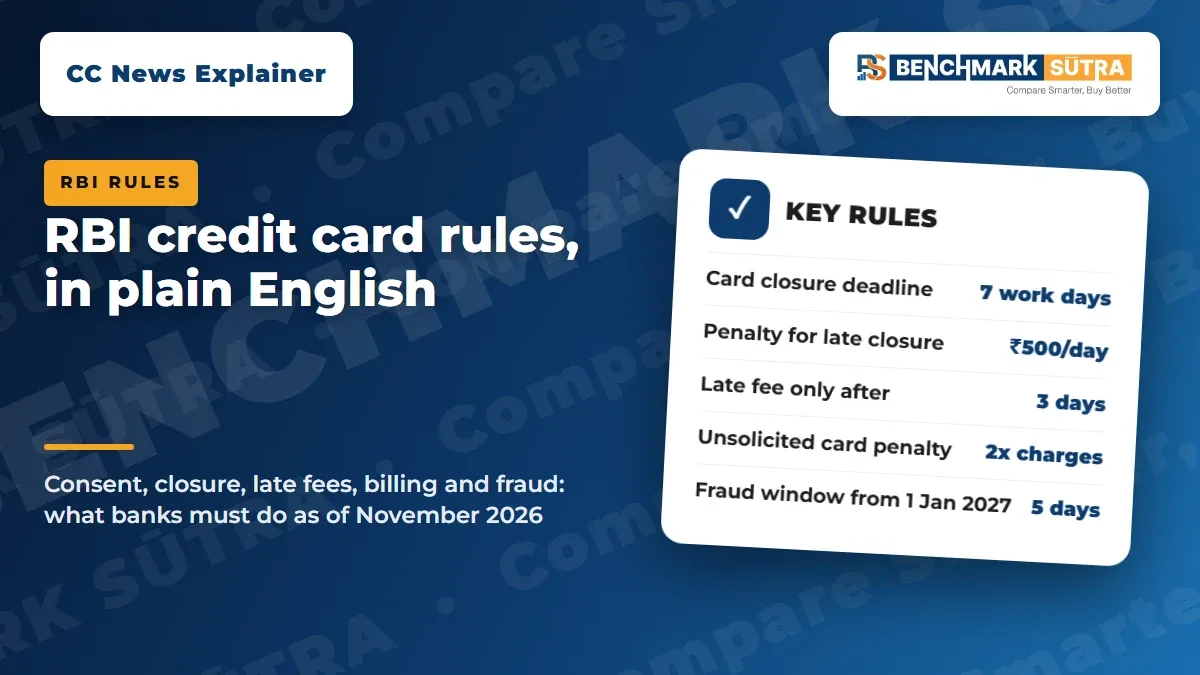
RBI's 2025 credit card directions in plain English: consent, activation, 7-day closure with ₹500 a day penalty, late fees, billing, refunds, fraud liability and complaints.
Quick Verdict
RBI credit card rules in India are set by the Reserve Bank of India's directions on credit card issuance and conduct. For banks, the current text is the Reserve Bank of India (Commercial Banks – Credit Cards and Debit Cards: Issuance and Conduct) Directions, 2025, issued on 28 November 2025 and shown on RBI's site as updated on 1 October 2026.
In plain terms, the rules say a bank cannot send you a card you did not ask for. It cannot raise your limit or upgrade your card without your consent. It must close your card within seven working days of a request, or pay you ₹500 a day. Interest and late fees must follow fixed, disclosed rules.
The 2025 Directions replaced the 2022 Master Direction for commercial banks. Small finance banks and NBFC issuers have their own versions. These are the rules as of November 2026.
Rule area | What RBI requires |
|---|---|
Before you apply | A one-page Key Fact Statement with interest and charges, and written reasons if you are rejected |
Unsolicited cards | Banned. If you are billed, the bank reverses the charges and pays you twice their value |
Activation | Not used in 30 days: the bank asks for OTP consent, then closes the card free within 7 working days if you do not reply |
Closure | Within 7 working days once dues are paid; ₹500 a day penalty for delay |
Late fees | Only after the account is more than 3 days past due, and only on the unpaid amount |
Billing cycle | You can change your billing cycle at least once |
Complaints | Go to the bank first; after 30 days, the RBI Ombudsman at cms.rbi.org.in |
Which RBI Credit Card Rules Apply to You?
RBI has moved from one Master Direction to separate directions for each type of lender. Which text applies depends on who issued your card.
Your card issuer | Directions that apply |
|---|---|
Commercial banks, including SBI and private banks | Commercial Banks – Credit Cards and Debit Cards: Issuance and Conduct Directions, 2025 |
Small finance banks | The matching Small Finance Banks directions, 2025 |
NBFC card issuers | Non-Banking Financial Companies – Credit Cards: Issuance and Conduct Directions, 2025 |
This guide quotes the commercial bank version because most cards in India come from banks.
RBI's Amendment Directions of 27 April 2026 reword the late-fee paragraph from 1 April 2027. The three-day and unpaid-amount rules stay the same.
RBI Rules Before You Get a Card
You must get a Key Fact Statement
Every application must come with a one-page Key Fact Statement. It shows the interest rate and charges. If the bank rejects you, it must tell you the specific reasons in writing.
The Most Important Terms and Conditions (MITC) must be sent at onboarding and whenever a term changes.
No card without your consent
A bank needs your explicit written or digital consent before it issues a card. Issuing an unsolicited card, or upgrading one without consent, is "strictly prohibited". If you are billed for one, the bank must reverse the charges and pay you twice that amount. You can also go to the RBI Ombudsman for more compensation.
The bank must check what you can afford
Banks must assess your "independent financial means". They must also count the limits you already have on other cards, using your own declaration or credit bureau data. This is why a second or third card can come with a lower limit.
Bank representatives may call you only between 10:00 and 19:00.
New to credit? Read Credit Card 101: A Beginner's Guide first.
RBI Rules on Activation, Limits and Upgrades
30-day activation rule: if you do not activate a new card within 30 days, the bank must ask for OTP consent. With no reply, it closes the card free of cost within seven working days.
No credit report before activation: a new card account cannot be reported to credit bureaus until you activate it.
Over-limit needs opt-in: your limit cannot be crossed without your explicit consent, and you must be able to switch over-limit on or off. Interest and fees cannot be counted when the bank checks for over-limit use.
No silent upgrades: the bank cannot upgrade your card or raise your limit on its own. If it cuts your limit, it must tell you.
For how limits are set, see Credit Limit Explained.
RBI Rules on Interest, Fees and Late Payment
This is where the rules protect your money most directly.
APR must be shown: banks must quote Annualised Percentage Rates for retail purchases, cash advances, late payment and other cases. The APR and annual fee must be shown with equal prominence.
Late fee only after 3 days: a bank can charge a late fee, or report you as past due to a credit bureau, only once the account is more than three days past the due date. The count still starts from the due date.
Late fee on the unpaid part only: late fees apply to the amount still outstanding after the due date, not the full Total Amount Due.
No interest on unpaid taxes and charges: banks cannot capitalise unpaid taxes or charges. The Minimum Amount Due must be set so the balance does not grow from unpaid interest and charges.
Minimum-due warning: every statement must warn that paying only the minimum stretches repayment over months or years with compounded interest.
Interest-free period ends on part-payment: if you pay less than the full amount, you lose the interest-free period. Interest can then run from each transaction date, on the balance after your payments and refunds.
One month's notice: charges can change only with at least a month's notice, and you can then close the card without an extra charge.
The fee details are covered in Every Credit Card Fee Explained.
RBI Rules on Bills, Refunds and Disputes
Time to pay: you must get at least a fortnight to pay after the bill reaches you, before interest starts.
Wrong bills: if you dispute a bill, the bank must explain it, with documents where applicable, within 30 days.
Disputed fraud: no charges can be levied on a transaction you dispute as fraud until the dispute is resolved.
Change your billing cycle: you can choose a different billing start or close date at least once.
Refunds before payment: a refund received before you pay must be adjusted straight away against what you owe.
Refunds after payment: a credit balance above ₹5,000 or 1% of your limit (whichever is lower) stays on the card only with your consent. On request, the bank must move it to your bank account within three working days.
RBI Rules on Closing a Credit Card
You can ask to close a card through several channels, such as the helpline, email, IVR, a website link, net banking or the app. The bank cannot insist on a letter by post.
Situation | What the bank must do |
|---|---|
You ask to close and have no dues | Close within 7 working days and confirm by email or SMS |
Closure is delayed | Pay you ₹500 for each calendar day of delay |
You still owe money | Tell you the dues at once; the 7 days run after you pay |
Card unused for over 1 year | Notify you; close after 30 days with no reply, if dues are clear |
Credit balance left after closure | Transfer it to your bank account |
RBI Rules on Credit Reports and Recovery
Before reporting you as a defaulter, the bank must follow its approved policy and tell you first. Once you settle, it must update the credit bureau within 30 days. If a dispute is pending, default information should be shared only after the dispute is settled.
Recovery agents cannot intimidate, harass or publicly shame you or your family.
RBI Rules on Fraud and Lost Cards
Banks must block a lost card as soon as you report it. They must give you 24x7 channels, such as a helpline, SMS, email, IVR, website link and app, to report fraud.
Your liability for unauthorised transactions is about to change.
Point | Transactions until 31 December 2026 | Transactions from 1 January 2027 |
|---|---|---|
Third-party breach, zero liability window | Report within 3 working days of the bank's alert | Report within 5 calendar days of the transaction |
Bank's own negligence | Zero liability | Zero liability, whether or not you report it |
Temporary credit (shadow reversal) | Within 10 working days of your report | On credit cards, within 5 calendar days of your report |
Bank's decision time | Up to 90 days | 45 days domestic, 60 days cross-border |
Small frauds due to your own negligence | No RBI compensation scheme | 85% of net loss or ₹25,000, whichever is less, once in a lifetime, for losses up to ₹50,000 reported to the bank and 1930 within 5 days |
The 2027 rules come from RBI's Responsible Business Conduct Third Amendment Directions, 2026, dated 24 June 2026. In every case, report fraud to your bank at once. Also report it to the National Cyber Crime Helpline (1930) or the cyber crime portal.
How Do I Complain About a Credit Card Under RBI Rules?
Complain to the bank first and keep the complaint number. Banks must print the grievance officer's name, phone, email and address on statements.
If the bank does not reply in 30 days, rejects you, or you are not satisfied, file with the RBI Ombudsman at cms.rbi.org.in.
You can also post a physical complaint to the Centralised Receipt and Processing Centre, RBI, Sector 17, Chandigarh.
Checklist
Read the Key Fact Statement before you sign. Note the APR and the annual fee.
Never activate a card you did not ask for, and do not share an OTP to activate it.
Keep over-limit switched off unless you truly need it.
Pay the full Total Amount Due by the due date to keep the interest-free period.
Change your billing cycle once if your salary date does not match the due date.
Report fraud within hours, not days. From 2027, five calendar days is the zero-liability window for third-party breaches.
Ask for closure in writing through an official channel, and note the date for the 7-working-day clock.
Common Mistakes to Avoid
Mistake 1: Treating the grace days as extra time
The three-day rule only delays the late fee and bureau reporting. Interest on unpaid amounts still runs from the transaction date once you miss full payment.
Mistake 2: Paying only the minimum
It avoids a late fee but not interest, and new spends lose the interest-free period.
Mistake 3: Ignoring change notices
A month's notice of new charges is your window to close the card without an extra charge.
Want to see how we check bank terms? Read Our Process for Keeping Credit Card Reviews Updated. Still deciding whether you need a card at all? Compare Credit Card vs Debit Card.
FAQs
What are the RBI rules for credit cards in India?
For banks, the rules are in the RBI Commercial Banks – Credit Cards and Debit Cards: Issuance and Conduct Directions, 2025, updated as on 1 October 2026. They cover issuance, consent, interest, fees, billing, closure, credit reporting, recovery and complaints.
How many days does a bank have to close my credit card?
Seven working days after you ask, provided all dues are paid. If it delays, it must pay you ₹500 for each calendar day.
When can a bank charge a late payment fee?
Only when the account is more than three days past the due date. The fee applies only to the amount still unpaid after the due date.
What happens if I get a credit card I never applied for?
Do not activate it. The bank must close it free of cost. If you were billed, it must reverse the charges and pay you twice their value.
How long do I have to report credit card fraud?
For transactions until 31 December 2026, zero liability for a third-party breach needs a report within three working days of the bank's alert. From 1 January 2027, the window is five calendar days from the transaction.
Where do I complain if the bank does not help?
Complain to the bank first. If there is no reply in 30 days or you are not satisfied, file with the RBI Ombudsman at cms.rbi.org.in.
Official Sources and Editorial Note
Data checked as of: 4 November 2026
RBI (Commercial Banks – Credit Cards and Debit Cards: Issuance and Conduct) Directions, 2025, updated as on 1 October 2026
https://www.rbi.org.in/Scripts/BS_ViewMasDirections.aspx?id=13155
RBI Credit Cards and Debit Cards: Issuance and Conduct – Amendment Directions, 2026 (effective 1 April 2027)
https://www.rbi.org.in/Scripts/NotificationUser.aspx?Id=13388&Mode=0
RBI (Commercial Banks – Responsible Business Conduct) Third Amendment Directions, 2026, dated 24 June 2026
https://rbi.org.in/Scripts/NotificationUser.aspx?Id=13543&Mode=0
RBI circular on limiting customer liability in unauthorised electronic banking transactions (2017 framework)
https://www.rbi.org.in/commonman/english/scripts/Notification.aspx?Id=2336
RBI Complaint Management System (Ombudsman)
https://cms.rbi.org.in
Important source note:
This article is written from official sources and does not rely on third-party wording. Paragraph references follow the 2025 Directions for commercial banks. Small finance bank and NBFC directions are parallel texts, and their wording can differ in places.
Editorial note:
RBI updates its directions from time to time. This guide reflects the text as of November 2026. Check RBI's website for later amendments before relying on a specific paragraph.
