How benchmarksutra rates issuer service: app controls, grievance process, fraud channels and term changes, from official evidence only. Why most cards score 7/10.
Quick Verdict
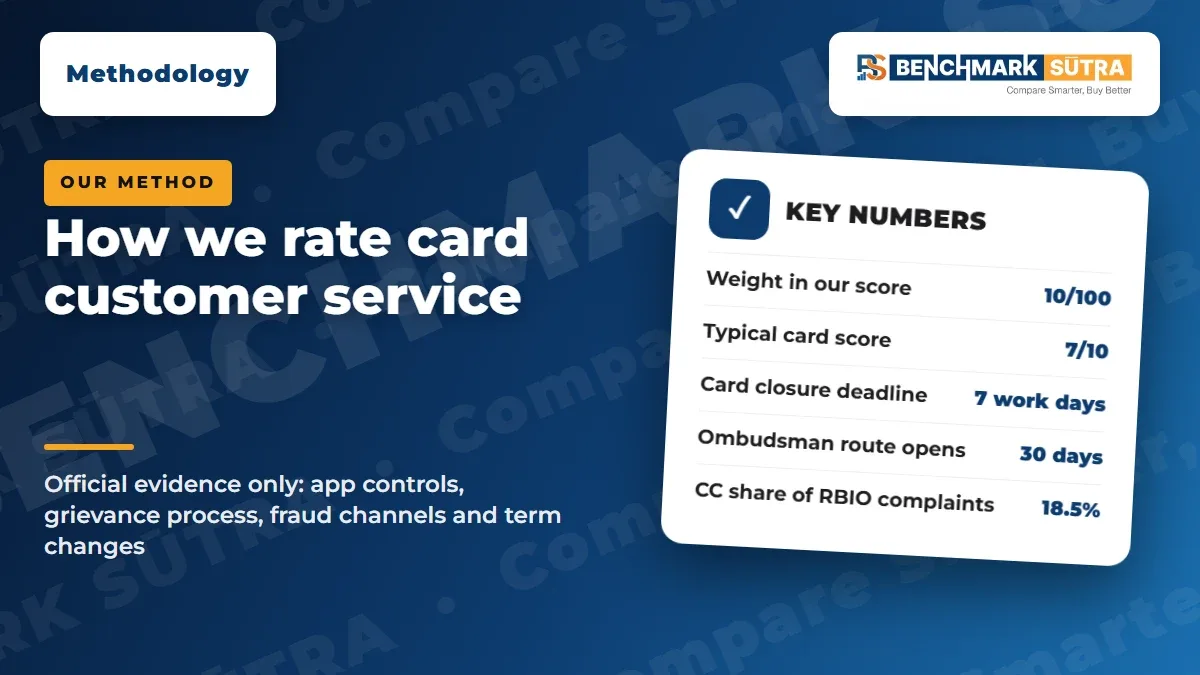
We rate a card issuer's customer service and app on official evidence, not on star ratings or social media complaints. It is one row of the Benchmarksutra Credit Card Score, "Bank & User Experience", worth 10 of 100 points.
Our credit card customer service rating checks what the issuer actually offers and publishes: app controls, a findable grievance process, 24x7 fraud reporting, clear statements and notices, and how often it changes the card's terms. RBI already requires a baseline from every bank, so meeting it earns an average mark. That is why almost every card we score lands at 6, 7 or 8 out of 10. This is our method as of November 2026.
What we check | Official evidence we use | Why it matters to you |
|---|---|---|
App and card controls | Bank's app and product pages | Turn off online or international use in seconds if a card is misused |
Grievance process | Grievance policy on the website; officer details on statements | You know who to escalate to, and when |
Fraud and loss reporting | Published 24x7 channels | Faster blocking limits your loss |
Statements and notices | MITC, Key Fact Statement, issuer notices | Clear terms mean fewer surprise charges |
Stability of terms | Dated devaluation or change notices | A card that keeps cutting benefits is harder to rely on |
Offer ecosystem | Bank's own portals and partner pages | Some value is only reachable through the bank's app or portal |
Where This Fits in the Benchmarksutra Score
The Benchmarksutra Credit Card Score uses eight fixed rows. Reward Value is worth 20 points; Fee Value and Use-Case Fit 15 each; the other five rows 10 each. Bank & User Experience is one of those 10-point rows.
It is small on purpose. A card with a good app and poor rewards is still a poor card. But for some readers, especially retirees and first-time users, service decides whether the card is usable at all. This post explains that row in detail. For the wider process, see How We Review Credit Cards.
What RBI Already Requires From Every Issuer
We start from the legal baseline. If every bank must do something, doing it does not earn extra marks. Missing it would cost marks.
RBI requirement | Source |
|---|---|
Switch online, international and contactless use on or off, and set limits, 24x7 through the app, internet banking, ATMs and IVR, with alerts | RBI circular on Enhancing Security of Card Transactions, 15 January 2020 |
New and reissued cards work only for domestic contact-based use (ATM and PoS) until you enable other channels | Same 2020 circular |
Grievance officer's name, direct number, email and postal address printed on bills and statements; policy linked from the homepage | RBI Credit Card Directions 2025, para 83 |
Multiple 24x7 channels to report unauthorised transactions: helpline, SMS, email, IVR, website, internet banking and app | Directions 2025, para 69 |
Lost card blocked immediately on being told | Directions 2025, para 68 |
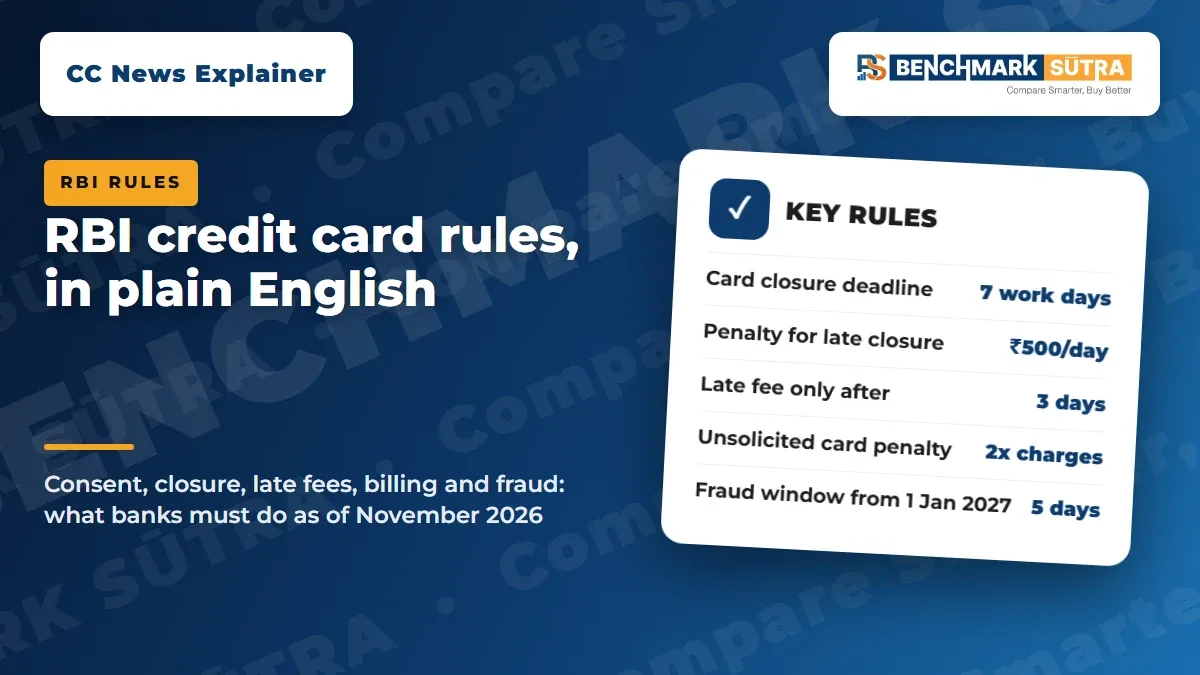
Closure within seven working days, or ₹500 a calendar day to you | Directions 2025, para 19 |
No reply within 30 days lets you go to the RBI Ombudsman | Directions 2025, para 85 |
The Directions quoted are RBI's Commercial Banks – Credit Cards and Debit Cards: Issuance and Conduct Directions, 2025, shown as updated on 1 October 2026. We explain the wider rules in RBI Credit Card Rules Explained.
How Are Credit Card Issuers Rated on Customer Service?
We score the row out of 10 against this scale.
Score | What it takes |
|---|---|
9–10 | Clear official evidence of service well above the RBI baseline. We have not yet given this mark. |
8 | Above baseline on official evidence, such as in-app switching of card features, a dedicated relationship manager on private-banking cards, or no fee to use rewards in the partner app |
7 | The normal mark: full RBI baseline, working app controls, published grievance process, terms that are clear but sometimes revised |
6 | Baseline met, but recent official notices cut value mid-term, or service is split across two apps or companies in a way that adds friction |
5 or less | Official evidence of a real problem, such as regulatory action on the card business, or terms that contradict each other with no fix |
In practice, every card we have scored so far sits at 6, 7 or 8. Most are at 7. Large issuers with good apps and a published grievance process start there, and dated notices move them up or down.
What pushes a card to 8?
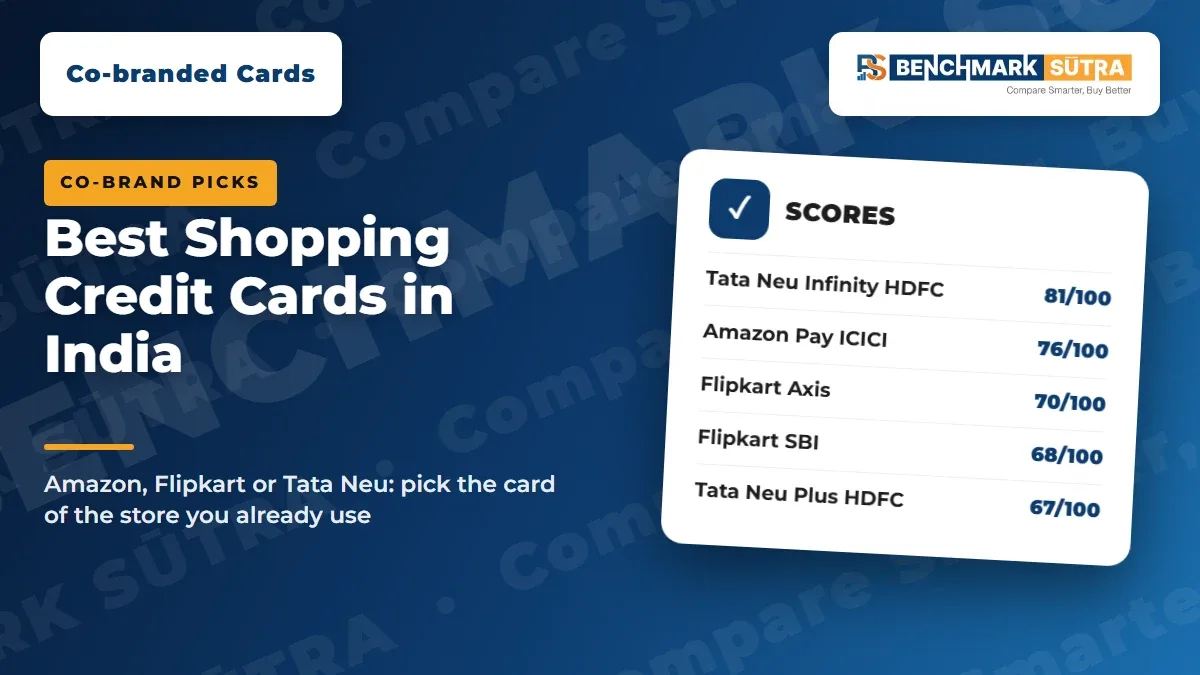
The AU LIT card scores 8 because AU's app lets you switch individual card features on and off, and AU publishes its grievance process. Tata Neu Infinity HDFC scores 8 because HDFC's MyCards controls pair with the Tata Neu app, and HDFC charges no redemption fee on Tata Neu cards.
What pulls a card to 6?
Both PhonePe SBI cards score 6. SBI Card's own devaluation notice cut their value for existing holders. A card that changes under you is a service problem, even when the app works well.
Why We Do Not Use App Store Ratings or Forum Complaints
We are often asked why we do not average app store stars or count angry posts. Three reasons:
They cannot be verified. We cannot check who wrote a review or whether the problem was the bank's fault.
They skew negative. People who had a smooth month rarely post. A large bank collects more complaints simply because it has more customers.
They go stale. An app rating can reflect a version the bank replaced months ago.
Instead, we use evidence a reader can check: the bank's own pages, its MITC, dated notices and RBI publications. Our update process is set out in Our Process for Keeping Credit Card Reviews Updated.
What Official Complaint Data Shows
RBI publishes complaint counts received by the Offices of the RBI Ombudsman. Its Financial Stability Report of June 2026 shows credit cards as the second-largest complaint category, after loans and advances.
Quarter | Credit card complaints | Share of all complaints | All complaints |
|---|---|---|---|
October–December 2025 | 17,413 | 18.9% | 92,367 |
January–March 2026 | 20,190 | 18.5% | 1,09,393 |
These are industry totals, not bank-wise figures, so we do not use them to rank one issuer above another. They tell us where the friction is, and they are why we weight a clear grievance path and clean billing in this row.
The complaint route also changed this year. The Reserve Bank – Integrated Ombudsman Scheme, 2026 came into force on 1 July 2026, replacing the 2021 scheme. RBI's FAQ says filing is free, the Ombudsman can award up to ₹30 lakh for consequential loss and up to ₹3 lakh for loss of time, expenses, harassment or mental anguish, and you must file within 90 days of the bank's deadline or its last reply.
What Retirees Should Weigh More Heavily
For senior citizens, the same row matters more, because a card is only safe if you can reach someone when it goes wrong.
Phone support: check the bank's published 24x7 helpline and its IVR for card blocking. RBI requires multiple 24x7 channels for reporting fraud.
Branch help: RBI asks banks to offer a dedicated or priority counter for senior citizens and people with disabilities, and doorstep services for customers over 70. These are rules for bank branches. Some cards, such as SBI Card and BOBCARD, are issued by separate card companies, so ask whether your branch can service the card.
Simple controls: a card that starts domestic-only and lets you switch international use on just for a trip suits a cautious user.
Stable terms: frequent benefit changes are harder to keep track of. We mark cards down for that.
If you are a pensioner choosing a first card, also read Can Pensioners Get a Credit Card?
Checklist
Find the grievance officer's details on your card statement.
Save the bank's 24x7 card-blocking number in your phone.
Open the app and find the switch for online, international and contactless use.
Keep international use off until you travel.
Read the bank's notices page once a quarter for changes to your card.
Keep complaint numbers and dates; the Ombudsman needs them.
Ask your branch whether it can service your card, if the card company is separate.
Common Mistakes to Avoid
Mistake 1: Picking a card on app store stars
Ratings mix unrelated problems and old app versions. Check the controls yourself.
Mistake 2: Going to the Ombudsman first
You must complain to the bank first. The Ombudsman route opens after 30 days without a reply, or after an unsatisfactory reply.
Mistake 3: Missing the 90-day window
Under the 2026 scheme, file with the Ombudsman within 90 days of the bank's deadline or last reply.
Mistake 4: Leaving every channel switched on
Unused online or international use is open risk. Turn it off in the app.
Mistake 5: Ignoring change notices
RBI requires a month's notice of new charges. That notice is your chance to close the card without an extra charge.
FAQs
How are credit card issuers rated on customer service?
At benchmarksutra, through the Bank & User Experience row, worth 10 of 100 points. We use official evidence: app controls, published grievance process, fraud channels, clarity of terms and recent change notices.
Why do most cards score 7 out of 10 on service?
RBI sets a common baseline for every bank, and most large issuers meet it. We move a card up or down only on official evidence.
Do you use app store ratings?
No. They cannot be verified and often reflect old app versions. We rely on bank pages, MITC, notices and RBI publications.
How many credit card complaints reach the RBI Ombudsman?
RBI's June 2026 Financial Stability Report shows 20,190 credit card complaints in January–March 2026, or 18.5% of all complaints to its Ombudsman offices.
Where do I complain about bad credit card service?
First to the bank's grievance officer, whose details are on your statement. If there is no reply in 30 days, or you are unhappy with it, file free at cms.rbi.org.in.
Can a senior citizen get help at the bank branch for a credit card?
RBI asks banks to give senior citizens a dedicated or priority counter. If the card is issued by a separate card company, ask whether the branch can service it.
Official Sources and Editorial Note
Data checked as of: 5 November 2026
RBI (Commercial Banks – Credit Cards and Debit Cards: Issuance and Conduct) Directions, 2025, updated as on 1 October 2026
https://www.rbi.org.in/Scripts/BS_ViewMasDirections.aspx?id=13155
RBI circular, Enhancing Security of Card Transactions (15 January 2020)
https://www.rbi.org.in/Scripts/NotificationUser.aspx?Id=11788&Mode=0
RBI FAQs, Reserve Bank – Integrated Ombudsman Scheme, 2026
https://www.rbi.org.in/commonperson/english/scripts/FAQs.aspx?Id=3407
RBI Financial Stability Report, June 2026, Chapter III (complaints to Offices of RBI Ombudsman)
https://www.rbi.org.in/Scripts/PublicationReportDetails.aspx?UrlPage=&ID=1326
RBI, Banking Facility for Senior Citizens and Differently abled Persons
https://www.rbi.org.in/commonman/english/scripts/Notification.aspx?Id=2647
RBI, Doorstep Banking Services for Senior Citizens and Differently abled Persons
https://www.rbi.org.in/Scripts/NotificationUser.aspx?Id=11852&Mode=0
RBI Complaint Management System
https://cms.rbi.org.in
This article is written from official sources and does not rely on third-party wording.
Editorial note:
Card scores cited here come from our published score files and reflect official terms as of November 2026. RBI rules and bank services change; check the latest text on RBI's website and your bank's pages.