
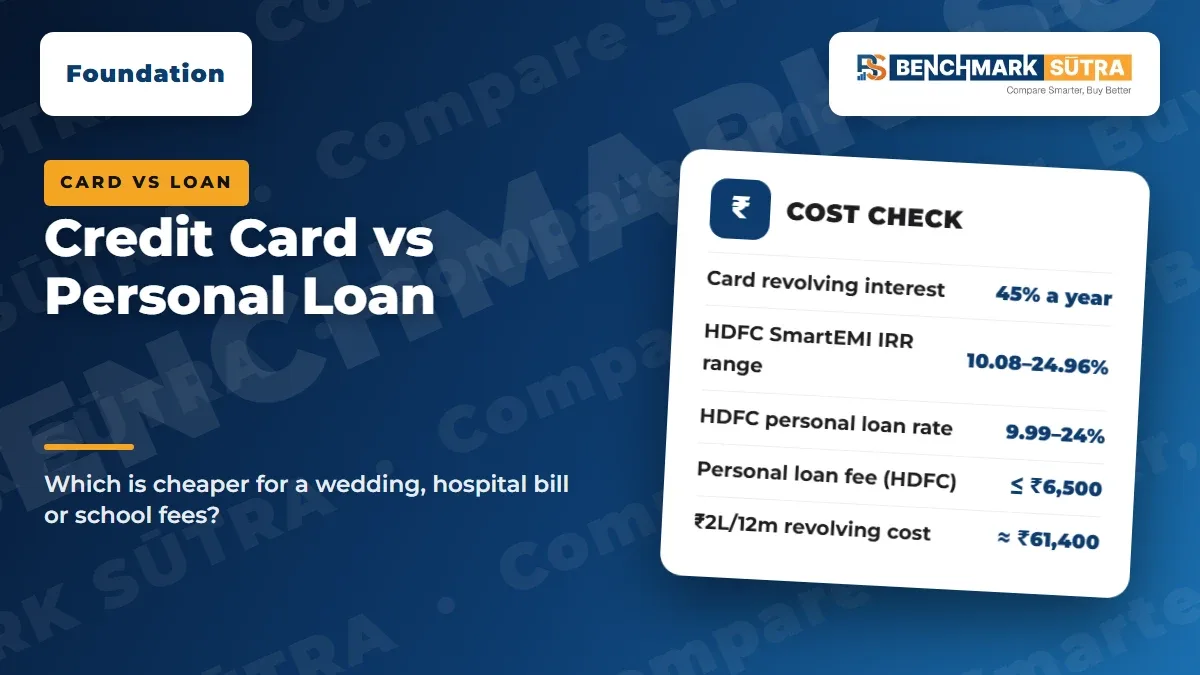
Revolving a card costs about 45% a year plus GST. We compare card EMI and personal loans on rates, fees, GST and prepayment, with ₹2 lakh and ₹5 lakh examples.
Quick Verdict
For a big expense you cannot clear within one billing cycle, a personal loan or a card EMI conversion is almost always cheaper than leaving the amount on your credit card. Revolving credit card debt costs about 45% a year plus 18% GST on the interest, while bank personal loans and card EMIs are usually priced at roughly 10% to 25% a year.
This guide on credit card vs personal loan is written for families facing a wedding, a hospital bill, a home repair or a year of school fees. The short answer depends on three things: whether you can repay before the due date, how long you need, and what each option charges on top of interest.
Option | Typical cost (official figures, as of November 2026) | Best for |
|---|---|---|
Pay card bill in full by the due date | ₹0 interest; HDFC and SBI Card list 20 to 50 interest-free days | Expenses you can clear in one cycle |
Revolve the card balance | 3.75% a month (45% a year) on most HDFC and unsecured SBI cards, plus GST | Avoid; only for a few days in an emergency |
Convert to card EMI | HDFC SmartEMI: 10.08% to 24.96% IRR (Jul–Sep 2026), fee up to ₹999 + GST | ₹50,000 to ₹3 lakh over 6 to 24 months, if your limit allows |
Personal loan | HDFC: 9.99% to 24% for salaried, fee up to ₹6,500 + GST | Larger amounts and longer tenures |
The simple rule: never let a big expense sit on your card as unpaid balance. Pick card EMI or a personal loan by comparing the all-in cost, not the headline rate.
How Each Option Actually Charges You
Revolving credit on a credit card
If you pay less than the total amount due, you lose the interest-free period. RBI's Credit Cards and Debit Cards Directions, 2025 (updated as on 1 October 2026) allow issuers to charge interest from the date of transaction on the outstanding amount once the bill is not cleared in full.
HDFC Bank's MITC (updated 31 October 2026) lists finance charges of 3.75% a month, or 45% a year, for most cards. SBI Card's MITC lists the same 3.75% a month for unsecured cards and 2.75% a month for secured cards. HDFC also says new purchases attract finance charges until the old balance is fully repaid, and GST applies on interest.
Paying only the minimum makes this worse. See why the minimum amount due is dangerous and total amount due vs minimum amount due.
Card EMI conversion
Most banks let you convert a large purchase into fixed monthly instalments. HDFC calls it SmartEMI; SBI Card calls it Flexipay. The EMI is added to your monthly bill and the amount stays blocked against your credit limit until repaid.
HDFC SmartEMI: tenures of 6 to 48 months. For July to September 2026, HDFC published a minimum IRR of 10.08%, a maximum of 24.96%, an average of 19.69%, and an APR of 23.53%. The product page lists a processing fee of up to ₹999 + GST; the MITC lists up to ₹849 + GST. Pre-closure costs 3% of the balance principal. Reward points on the converted purchase are reversed.
SBI Card Flexipay: tenures of 3 to 36 months on retail purchases of ₹500 and above, with a minimum booking of ₹2,500. SBI Card's Flexipay terms set the rate by credit score, from 10.50% to 21.25% a year. Foreclosure costs 3% of principal outstanding plus accrued interest and taxes. Reward points on converted spends are forfeited.
RBI requires the bill to show principal, interest and any discount separately, and says an EMI with interest cannot be passed off as "no-cost EMI".
Personal loan
A personal loan is a separate term loan credited to your bank account. HDFC's rates page lists a rack rate of 9.99% to 24% a year for salaried borrowers, a processing fee of up to ₹6,500 + GST, and tenures up to 84 months. For April to June 2026, HDFC reported an average IRR of 10.89% and an average APR of 11.18%.
Prepayment is the catch. HDFC charges 4% of principal outstanding to close the loan within the first 24 EMIs, 3% after 24 and up to 36 EMIs, and 2% after 36. Part prepayment is allowed only after the first EMI, up to 25% of principal, once a financial year.
RBI's Pre-payment Charges on Loans Directions, 2025 ban prepayment charges on floating-rate loans to individuals for non-business use, sanctioned or renewed on or after 1 January 2026. Fixed-rate loans are not covered by that ban, so check your sanction letter and Key Facts Statement.
Is a Credit Card or a Personal Loan Cheaper? Worked Examples
These examples are illustrative. They use HDFC's published rates and fees, monthly reducing-balance maths and 18% GST. Your offer will differ, so plug in the numbers from your own Key Facts Statement.
Example 1: ₹2 lakh wedding or hospital bill, repaid over 12 months
Route | Monthly payment | Interest | GST + fee | Total extra cost |
|---|---|---|---|---|
Revolve on card at 45% | about ₹21,000 + GST | ₹52,030 | ₹9,365 GST on interest | about ₹61,400 |
Card EMI at 19.69% (HDFC average) | ₹18,497 + GST | ₹21,967 | ₹3,954 GST + ₹1,179 fee | about ₹27,100 |
Card EMI at 10.08% (HDFC minimum) | ₹17,591 + GST | ₹11,087 | ₹1,996 GST + ₹1,179 fee | about ₹14,300 |
Personal loan at 10.89% (HDFC average) | ₹17,666 | ₹11,993 | ₹7,670 fee (₹6,500 + GST) | about ₹19,700 |
Personal loan at 24% (HDFC maximum) | ₹18,912 | ₹26,943 | ₹7,670 fee | about ₹34,600 |
Two lessons. First, revolving costs roughly two to four times the other routes. Second, on a small, short loan, the personal loan's processing fee matters. A card EMI at a low offered rate can beat a personal loan; a card EMI at the average rate usually does not.
Example 2: ₹5 lakh home repair or education cost, repaid over 36 months
Route | Monthly payment | Interest + GST + fee |
|---|---|---|
Revolve on card at 45% | about ₹25,500 + GST | about ₹4.95 lakh |
Card EMI at 19.69% | ₹18,503 + GST | about ₹1.97 lakh |
Card EMI at 10.08% | ₹16,152 + GST | about ₹97,300 |
Personal loan at 10.89% | ₹16,343 | about ₹96,000 |
Personal loan at 24% | ₹19,616 | about ₹2.14 lakh |
Over a longer tenure the processing fee fades and the interest rate decides the winner. A ₹5 lakh EMI also needs ₹5 lakh of free credit limit, which many family cards do not have. Read credit limit explained before you plan around it.
When a Credit Card Wins
You can repay within the interest-free period. Paying in full by the due date costs nothing. Read how the grace period works.
The amount is moderate and the tenure short. For ₹50,000 to ₹2 lakh over 6 to 12 months, a card EMI with a low pre-approved rate avoids a large loan processing fee.
You need money at the counter today. Hospital deposits and school fee portals take cards; conversion can happen after the purchase, within the bank's window.
A genuine no-cost or low-cost EMI is on offer. Confirm the bill shows the discount separately, as RBI requires.
When a Personal Loan Wins
The amount is large or the tenure long. Above ₹3 lakh or beyond 24 months, a personal loan at your offered rate is usually cheaper.
You need cash, not a card swipe. Contractors, caterers and many hospitals prefer bank transfers.
You want to keep your card limit free. A card EMI blocks your limit and can push up your credit utilisation.
You want one clear document. RBI's April 2024 Key Facts Statement rules require lenders to show the APR, which includes interest and all charges, on new retail term loans.
Checklist
Can you repay the full amount before the card's due date? If yes, use the card and pay in full.
Ask for the APR, not just the interest rate, for both the card EMI and the loan.
Add processing fee plus 18% GST to each option's cost.
On card EMI, add 18% GST on the interest, as HDFC's MITC applies GST on interest.
Check the prepayment or pre-closure charge in case a bonus or FD maturity lets you repay early.
Check whether your personal loan is fixed or floating rate.
Make sure the EMI fits your free credit limit and your monthly budget.
Convert to card EMI before the payment due date, or interest at the card rate may apply first.
Set up auto-debit for the full EMI and any remaining card bill.
Common Mistakes to Avoid
Mistake 1: Paying only the minimum on a big bill
Interest runs at about 45% a year from the transaction date, and new spends lose the interest-free period too.
Mistake 2: Comparing the monthly rate with the yearly rate
A card EMI quoted at "0.99% a month" is close to 12% a year before fees. Convert everything to a yearly APR first.
Mistake 3: Ignoring GST on card interest
GST of 18% on card interest raises the real cost. It does not appear in the headline rate.
Mistake 4: Taking a personal loan for a small, short need
A fee of up to ₹6,500 + GST on a ₹1 lakh, six-month loan can cost more than a low-rate card EMI.
Mistake 5: Planning to prepay without checking charges
HDFC charges up to 4% on early closure of a personal loan, and card EMI pre-closure costs 3% at HDFC and SBI Card.
Mistake 6: Converting after the due date
SBI Card's Flexipay terms say a conversion after the due date attracts card interest from the transaction date until conversion.
For all the fees a card can carry, see every credit card fee explained.
Benchmarksutra Verdict
For a big family expense, the cheapest route is to pay with a card and clear it in full by the due date. If you cannot, never revolve. Choose a card EMI when the amount is moderate, the tenure is short and your offered rate is low. Choose a personal loan when the amount is large, the tenure long, or you need cash in your bank account.
Final rule: compare APR plus fees plus GST for each option on your own offer letter, then pick the lower total.
FAQs
Is a credit card or a personal loan cheaper for a big expense?
A personal loan or card EMI is far cheaper than revolving a card balance at about 45% a year. Between card EMI and a personal loan, compare the APR, fees and GST on your own offers.
What interest do credit cards charge if I do not pay in full?
HDFC Bank and SBI Card list 3.75% a month, or 45% a year, on most unsecured cards, plus GST. Interest runs from the transaction date.
Is credit card EMI the same as a personal loan?
No. A card EMI converts a card purchase into instalments within your credit limit. A personal loan is a separate loan paid into your bank account.
Does credit card EMI attract GST?
Yes. HDFC's MITC says GST applies on all fees, interest and other charges, so GST is added to EMI interest and the processing fee.
Can I prepay a personal loan without a penalty?
For floating-rate loans to individuals for non-business use, sanctioned on or after 1 January 2026, RBI bans prepayment charges. Fixed-rate loans follow the lender's policy, which at HDFC is 2% to 4%.
Will a card EMI affect my credit limit?
Yes. The EMI amount stays blocked against your limit and is released as you pay each instalment.
Is "no-cost EMI" really free?
Only if the interest is fully offset by a discount. RBI requires the bill to show principal, interest and discount separately, so check your statement.
Official Sources and Editorial Note
Data checked as of: 4 November 2026
Reserve Bank of India (Commercial Banks – Credit Cards and Debit Cards: Issuance and Conduct) Directions, 2025, updated as on 1 October 2026
https://rbi.org.in/scripts/BS_ViewMasDirections.aspx?id=13155
RBI circular on Key Facts Statement for Loans and Advances, 15 April 2024
https://www.rbi.org.in/Scripts/NotificationUser.aspx?Id=12663&Mode=0
RBI (Pre-payment Charges on Loans) Directions, 2025, dated 2 July 2025
https://www.rbi.org.in/Scripts/NotificationUser.aspx?Id=12878
HDFC Bank Credit Card MITC, updated 31 October 2026 (finance charges, SmartEMI fee, pre-closure, GST)
HDFC MITC (PDF)
HDFC Bank SmartEMI page (tenure, IRR and APR for July to September 2026, processing fee)
https://www.hdfc.bank.in/smartemi
HDFC Bank Personal Loan interest rates and charges
https://www.hdfc.bank.in/personal-loan/interest-rates-and-charges
SBI Card Most Important Terms and Conditions (finance charges, interest-free period)
https://www.sbicard.com/en/most-important-terms-and-conditions.page
SBI Card Flexipay terms and conditions
Flexipay T&Cs (PDF)
This article is written from official sources and does not rely on third-party wording.
Editorial note:
The worked examples are illustrative, use monthly reducing-balance maths, and treat the HDFC personal loan processing fee at its ₹6,500 maximum. Real card interest is charged daily and your offered rates and fees will differ. Rates, fees and rules can change; always confirm the latest terms with your bank before borrowing.


