
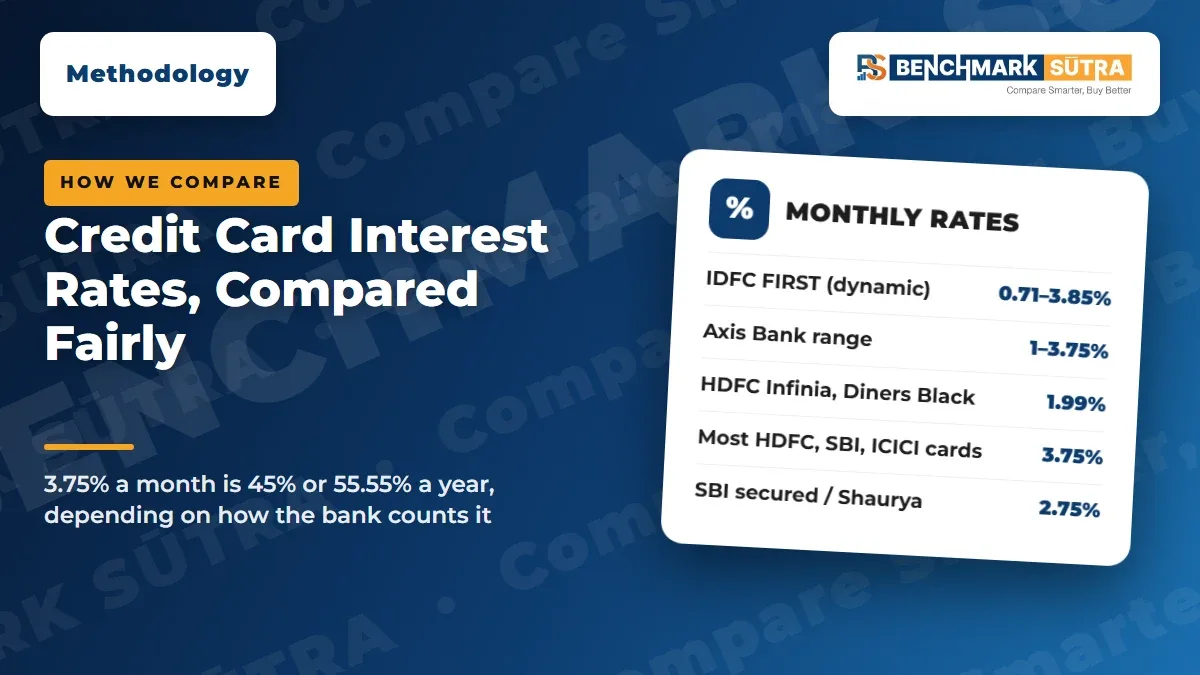
Most Indian cards charge 3.75% a month, but banks show it as 45% or 55.55% a year. How we compare interest rates, late fees and GST across HDFC, SBI, Axis, ICICI, IDFC FIRST and AU.
Quick Verdict
As of November 2026, the lowest published credit card interest rates in India sit on premium and relationship cards: IDFC FIRST Bank prices from about 0.71% a month (8.5% a year), Axis Bank says its cards range from 1% to 3.75% a month, and HDFC Infinia, Diners Black and AU Zenith+ charge 1.99% a month (23.88% a year). Most mainstream cards from HDFC, SBI Card, ICICI and Axis charge 3.75% a month, which is 45% a year on a simple basis and about 55.5% once compounded.
This guide explains our credit card interest rate comparison method: where we find the rate, how we put every bank on the same basis, and which other charges matter more than the headline number.
What we check | Why it matters | Where it is published |
|---|---|---|
Monthly finance charge | The rate you pay when you revolve | MITC and Key Fact Statement |
Annual rate basis | 45% and 55.55% can describe the same 3.75% a month | MITC (APR column) |
Fixed or dynamic | Some banks set your rate by profile | MITC, card mailer |
Late payment fee slabs | Can exceed a month's interest on small dues | Schedule of charges |
Cash advance terms | No interest-free period at all | MITC |
GST | 18% is added to interest and fees | MITC |
The short rule: the cheapest card to borrow on is the one you never borrow on. Pay the total amount due and the interest rate is zero.
Which Credit Cards Charge the Lowest Interest in India?
These are the rates the issuers publish in their own documents, checked on 4 November 2026. Rates are before 18% GST.
Issuer | Monthly rate | Annual rate as stated | Notes |
|---|---|---|---|
IDFC FIRST Bank | 0.71% to 3.85% | 8.5% to 46.2% | Dynamic, set by profile; 3.99% a month if the minimum due is missed. FIRST Private: 0.75% (9%) |
Axis Bank | 1% to 3.75% | 12.68% to 55.55% | Same rate for every customer of a given variant |
HDFC Bank | 1.99% (Infinia, Diners Black, BizBlack Metal, UPI RuPay Mega Saver); 3.75% (all other variants) | 23.88% / 45% | FD-backed cards carry the same rate as their variant |
AU Small Finance Bank | 1.99% (Zenith+); 2.99% (AU CA, AU CS); 3.75% (other retail cards) | 23.88% / 35.88% / 45% | AU CA and AU CS cards sit in the middle band |
SBI Card | 3.75% (unsecured); 2.75% (Shaurya, Defence and secured cards) | 45% / 33% | Minimum finance charge ₹25 |
ICICI Bank | 3.75% (as listed on Amazon Pay, Coral, Rubyx and Sapphiro pages) | Check the MITC for your card | Also applies to cash withdrawals |
Two things stand out. First, the low rates are tied to premium or relationship cards, or to a strong profile at IDFC FIRST. Second, for most cards an Indian professional is likely to hold, the price of revolving is the same 3.75% a month.
Our Credit Card Interest Rate Comparison Method
Step 1: Read the rate from the MITC, not the ad
We take the monthly finance charge from the bank's Most Important Terms and Conditions (MITC) or Key Fact Statement (KFS). RBI's credit card directions for banks require a one-page KFS with the application and require issuers to quote an Annualised Percentage Rate (APR) for different situations, such as purchases and cash advances.
Step 2: Put every rate on the same annual basis
Banks convert the same monthly rate in two ways. HDFC and SBI Card multiply by 12, so 3.75% a month is shown as 45% a year. Axis compounds it, so 3.75% a month is shown as 55.55% a year. Both are correct; they just measure different things.
Monthly rate | Simple annual (×12) | Compounded annual |
|---|---|---|
0.71% | 8.5% | about 8.9% |
1% | 12% | 12.68% |
1.99% | 23.88% | about 26.7% |
2.99% | 35.88% | about 42.4% |
3.75% | 45% | 55.55% |
We always compare monthly rates. If you see 45% on one card and 55.55% on another, check the monthly figure before deciding one is cheaper.
Step 3: Check whether the rate is fixed or dynamic
Axis says its rate is the same for all customers of a variant. IDFC FIRST says its rate is dynamic and depends on credit history, payment behaviour, utilisation, vintage and internal policy, and can move between about 0.71% and 3.99% a month. With a dynamic rate, the "from" figure is a floor, not a promise.
Step 4: Check what switches the interest on
The interest-free period exists only if you pay the full bill. RBI's directions say the MITC must explain that the interest-free credit period is suspended if any balance from the previous bill is unpaid. HDFC's MITC adds that once you revolve, new purchases also attract finance charges until the old balance is cleared in full.
Step 5: Add the charges around the rate
We add late payment fees, the cash advance fee, overlimit fees and 18% GST. On a small bill, a late fee can cost more than a full month of interest.
What One Missed Payment Really Costs
HDFC's own MITC gives a worked example at 3.75% a month. A ₹20,000 bill (₹15,000 on 10 April, ₹5,000 on 15 April) has a minimum due of ₹1,000. The cardholder pays ₹2,000 after the due date, spends ₹1,000 more and then pays ₹15,000.
Item | Amount |
|---|---|
Interest, calculated daily from each transaction date | ₹845.75 |
Late payment charge | ₹900 |
GST at 18% on interest and late fee | ₹314.23 |
Principal still outstanding | ₹4,000 |
Total amount due on the next statement | ₹6,059.99 |
The charges (₹2,059.98) are more than half of the ₹4,000 still owed. Interest also ran on the full ₹15,000 from the purchase date, not from the due date. Read Total Amount Due vs Minimum Amount Due to see why paying only the minimum keeps this cycle going.
Late Payment Fees: The Second Number to Compare
SBI Card publishes a clear slab table in its KFS. Other banks use similar slabs; ICICI lists ₹100 to ₹1,300, and HDFC's example above charges ₹900 on a ₹20,000 bill.
SBI Card: amount due | Late payment fee |
|---|---|
₹0 to ₹500 | Nil |
₹501 to ₹1,000 | ₹400 |
₹1,001 to ₹10,000 | ₹750 |
₹10,001 to ₹25,000 | ₹950 |
₹25,001 to ₹50,000 | ₹1,100 |
Above ₹50,000 | ₹1,300 |
SBI Card also lists a 3-day grace period after the due date for accounts that are not already overdue. RBI's directions say late payment charges apply only when an account stays past due for more than three days. See Grace Period Explained.
The RBI Rules That Protect You
RBI's Commercial Banks credit card directions of 28 November 2025 (updated as on 1 October 2026) set these limits for banks:
Interest is charged only on the outstanding amount, adjusted for payments, refunds and reversed transactions.
Banks cannot charge interest on unpaid taxes, levies or charges.
The minimum amount due must be calculated so it does not cause negative amortisation.
Changes in charges apply only with prospective effect, with at least one month's notice.
You can change your billing cycle at least once.
SBI Card is a card company rather than a bank, so it publishes its own KFS; the rates above are from that document.
For Professionals: When Revolving Is Tempting
Doctors, lawyers and chartered accountants often have uneven cash flow. Client payments arrive late, while clinic rent, staff salaries and subscriptions fall due on fixed dates. That gap is when people pay the minimum and carry the rest.
At 3.75% a month, a ₹1 lakh balance carried for one month costs about ₹3,750 in interest, plus 18% GST on it.
A card at 1.99% a month would cost about ₹1,990 on the same balance. That gap is real, but both are far costlier than paying in full.
If you know a gap is coming, set the billing cycle so your due date falls after your usual collection date.
For planned large purchases, compare the bank's EMI offer (rate, processing fee, foreclosure fee) against revolving. Axis, for example, lists balance-on-EMI rates of 12% to 30% a year plus a foreclosure fee.
Also see Every Credit Card Fee Explained.
Checklist
Find the monthly finance charge in your card's MITC or KFS.
Check whether the annual figure is simple (×12) or compounded.
Ask whether your rate is fixed for the variant or dynamic.
Note the late payment fee slab for your usual bill size.
Check the cash advance fee and that cash has no interest-free period.
Add 18% GST to every interest and fee figure.
Set your billing cycle to match your income dates.
Turn on autopay for the total amount due, not the minimum.
Common Mistakes to Avoid
Mistake 1: Comparing 45% with 55.55%
Both can mean 3.75% a month. Compare monthly rates.
Mistake 2: Treating a "from" rate as your rate
Dynamic pricing means the lowest figure goes to the strongest profiles.
Mistake 3: Thinking interest starts at the due date
Once you revolve, interest runs from each transaction date.
Mistake 4: Paying almost all of the bill
A partial payment still suspends the interest-free period on new spends.
Mistake 5: Withdrawing cash on a credit card
SBI Card charges 2.5% (minimum ₹500) plus interest from day one.
Mistake 6: Ignoring GST
18% GST on interest and fees raises the real cost.
Read Why the Minimum Amount Due Is Dangerous before you pay only the minimum.
Benchmarksutra Verdict
When we compare cards, interest is a warning sign, not a reason to pick a card. Most mainstream cards charge 3.75% a month. Lower rates exist on premium cards, some AU and HDFC variants, and on IDFC FIRST for strong profiles.
Final rule: compare monthly rates, add late fees and GST, and then plan never to pay any of them.
FAQs
Which credit card has the lowest interest rate in India?
Among the issuers we checked, IDFC FIRST publishes the lowest floor, about 0.71% a month (8.5% a year), but its rate is set by profile. Axis lists 1% a month on some variants.
What is the usual credit card interest rate in India?
3.75% a month on most mainstream cards from HDFC, SBI Card, ICICI and Axis, before GST.
Why does Axis show 55.55% when HDFC shows 45%?
Axis compounds 3.75% a month over 12 months; HDFC multiplies it by 12. The monthly rate is the same.
Is interest charged if I pay the minimum amount due?
Yes. Paying less than the total due suspends the interest-free period, and interest runs on the unpaid balance from each transaction date.
Can a bank charge interest on late fees?
No. RBI's directions bar banks from charging interest on unpaid taxes, levies or charges.
When does a late payment fee apply?
Under RBI's directions, only when the account stays past due for more than three days after the due date.
Is GST charged on credit card interest?
Yes. Banks add 18% GST to interest and fees.
Do secured or FD-backed cards charge less?
SBI Card charges 2.75% a month on secured cards. HDFC says FD-backed cards carry the same rate as their variant.
Official Sources and Editorial Note
Data checked as of: 4 November 2026
RBI (Commercial Banks – Credit Cards and Debit Cards: Issuance and Conduct) Directions, 2025
https://rbi.org.in/scripts/BS_ViewMasDirections.aspx?id=13155
HDFC Bank Credit Card MITC, updated 31 October 2026
HDFC MITC (PDF)
SBI Card Key Fact Statement
SBI Card KFS (PDF)
Axis Bank Credit Card Issuance and Conduct Policy FY 26-27
Axis credit card policy (PDF)
IDFC FIRST Bank Credit Card MITC
IDFC FIRST MITC (PDF)
AU Small Finance Bank Credit Card Schedule of Charges, updated 2 November 2026
AU schedule of charges (PDF)
ICICI Bank RuPay credit cards page (fees and 3.75% finance charge)
https://www.icici.bank.in/personal-banking/cards/credit-card/rupay-credit-card
Important source note:
This article is written from official sources and does not rely on third-party wording. Compounded annual figures other than those the banks print are our arithmetic.
Editorial note:
Interest rates and charges can change with notice. Always confirm the current rate in your card's MITC, KFS or statement before deciding to carry a balance.


