
Credit card interest runs daily from each transaction date once you miss full payment. The official formula, a ₹10,000 worked example, issuer rates and the minimum-due trap.
Quick Verdict
Credit card interest is charged only when you do not pay the full Total Amount Due by the due date. When that happens, banks calculate interest daily from each transaction date: balance × monthly rate × 12 × number of days ÷ 365, and then add 18% GST on the interest.
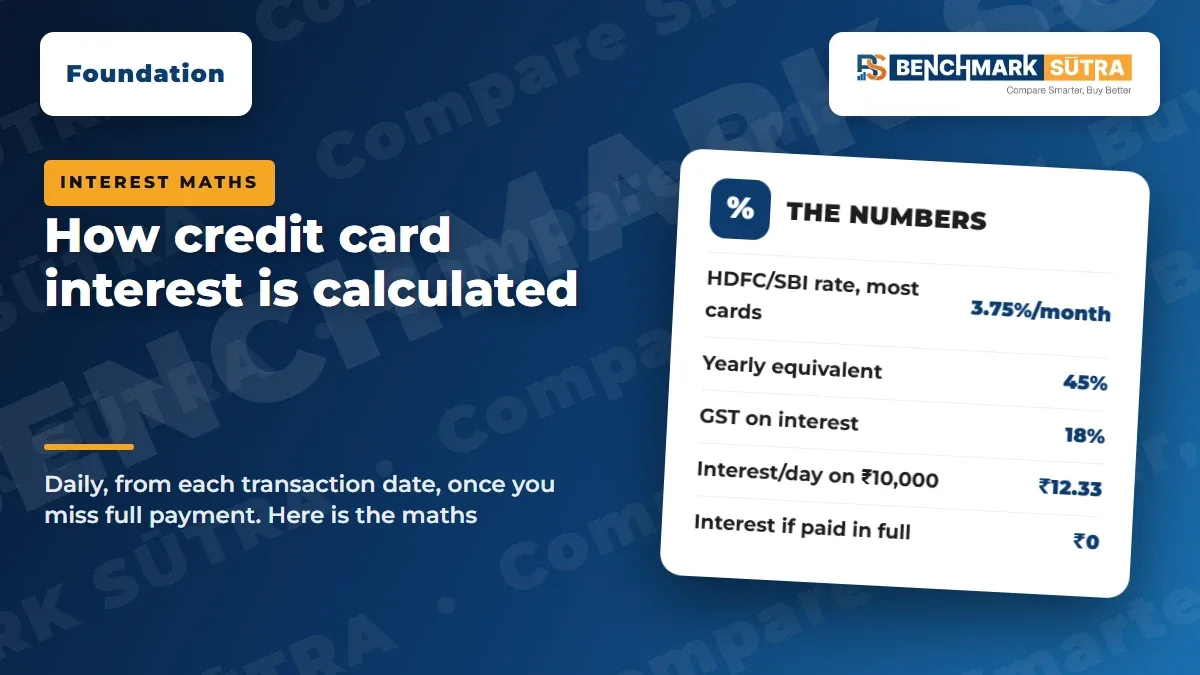
That is the credit card interest calculation method shown in the official MITC of HDFC Bank and SBI Card. At their usual rate of 3.75% a month (45% a year), a ₹10,000 balance costs about ₹12.33 a day in interest before GST. Pay the full bill and you pay ₹0.
Question | Answer |
|---|---|
When is interest charged? | When you pay less than the Total Amount Due, or take a cash advance |
From when? | From each transaction date (cash: from the withdrawal date) |
Typical rate | 3.75% a month (45% a year) at HDFC Bank and SBI Card for most cards |
Tax on interest | 18% GST, as shown in HDFC Bank's MITC illustration |
How to pay ₹0 interest | Pay the full Total Amount Due by the due date, every month |
When Do You Pay Interest on a Credit Card?
Every card gives an interest-free period on purchases. HDFC Bank and SBI Card both say it can range from 20 to 50 days, depending on when in the billing cycle you buy. A purchase just after your statement date gets the longest free period.
You keep that free period only if you pay the full bill. RBI's 2025 credit card directions say the MITC must explain that the interest-free period is suspended if any part of the previous bill is unpaid.
You pay interest in three situations:
you pay less than the Total Amount Due, even if you pay the Minimum Amount Due
you carry a balance from earlier months, so new purchases also attract interest
you withdraw cash on the card, which usually has no interest-free period
For the basics, read Grace Period Explained.
The Credit Card Interest Calculation Formula
Both HDFC Bank's MITC (version 4.18, October 2026) and SBI Card's MITC show the same daily method:
Interest = Outstanding amount × (monthly rate × 12) × Number of days ÷ 365
Three things decide the number of days:
Start: each transaction date, not the statement date
Change points: every payment or refund lowers the balance from that date
End: the next statement date, or the date you clear the balance
HDFC Bank's MITC calls this the average daily balance method. It applies to balances carried forward and to new spends.
Worked Example: Paying Only Part of the Bill
This is our own illustration, using the 3.75% monthly (45% yearly) rate from the HDFC and SBI Card MITCs. Day counts include both start and end dates, as in HDFC's illustration.
5 October: you spend ₹10,000
15 October: statement date; Total Amount Due ₹10,000
4 November: due date; you pay ₹2,000 (more than the minimum, so no late fee)
10 November: you spend ₹3,000 more
15 November: next statement
Balance | Period | Days | Interest |
|---|---|---|---|
₹10,000 | 5 Oct to 3 Nov | 30 | ₹369.86 |
₹8,000 (after paying ₹2,000) | 4 Nov to 15 Nov | 12 | ₹118.36 |
₹3,000 new spend | 10 Nov to 15 Nov | 6 | ₹22.19 |
Total interest | ₹510.41 | ||
GST at 18% | ₹91.87 | ||
Cost of carrying the balance | ₹602.28 |
Two points stand out. First, interest ran on the full ₹10,000 from 5 October, even though the bill was not due until 4 November. Second, the new ₹3,000 purchase got no interest-free period, because a balance was still unpaid.
Had you paid ₹10,000 by 4 November, the interest would have been ₹0.
An Official Example from SBI Card's MITC
SBI Card's MITC gives this case. A ₹500 annual fee and ₹90 tax are billed on 5 March, and a ₹6,000 online purchase is made on 15 March. The 2 April statement shows ₹6,590 due by 22 April.
The cardholder pays only the Minimum Amount Due of ₹710 on 22 April. SBI Card works it out as 100% of the GST, fee and finance charges plus 2% of the remaining ₹6,000. SBI Card then charges:
₹281.10 on ₹6,000 for 38 days (15 March to 21 April)
₹79.74 on ₹5,880 for 11 days (22 April to 2 May)
total interest of ₹360.84, plus applicable taxes
Note that interest is charged on the purchase, not on the fee and tax that were paid in full. That follows RBI's rule against charging interest on unpaid taxes and charges.
Credit Card Interest Rates at Major Issuers
Issuer and card type | Monthly rate | Yearly rate |
|---|---|---|
HDFC Bank, most card variants | 3.75% | 45% |
HDFC Bank Infinia, Diners Black and a few others | 1.99% | 23.88% |
SBI Card, unsecured cards | 3.75% | 45% |
SBI Card Shaurya, Defence and secured cards | 2.75% | 33% |
IDFC FIRST Millennia | Varies | APR 8.5% to 46.2% |
Rates are from each issuer's official MITC or product page as of November 2026. HDFC says its FD-backed cards carry the same rate as the matching card variant. RBI lets banks charge different rates based on your payment history, but they must be transparent about it.
Why Credit Card Interest Costs More Than It Looks
GST on top: 3.75% a month plus 18% GST is about 4.43% a month.
Interest builds on interest: unpaid interest becomes part of next month's balance. In SBI Card's MITC example, interest is charged on a carried balance of ₹656.71 that includes the earlier month's interest.
Compounded yearly cost: by our calculation, 4.43% a month carried for a full year works out to about 68% a year.
Late fee on top: if you miss even the minimum, a late fee applies once you are more than three days past due.
See every charge in Every Credit Card Fee Explained.
How Is Interest Calculated on Cash Withdrawals?
Cash withdrawals usually get no interest-free period. SBI Card charges finance charges from the date of withdrawal until full payment, plus a fee of 2.5% of the amount, with a minimum of ₹500.
Some cards differ. IDFC FIRST says its FIRST Millennia card charges 0% interest on ATM withdrawals for up to 45 days, with a ₹199 + GST fee per withdrawal. Check your own card's MITC before you withdraw.
The Minimum Amount Due Trap
Paying the Minimum Amount Due avoids a late fee. It does not stop interest.
SBI Card's MITC gives an example: on a ₹10,000 transaction, paying only the minimum every month (at least ₹200) can take up to 52 months to clear. RBI requires every statement to warn that minimum payments stretch repayment over months or years with compounded interest.
How the minimum is worked out differs by issuer:
Issuer | Minimum Amount Due formula (official MITC) |
|---|---|
SBI Card | 100% of GST, EMI, fees and finance charges, plus any over-limit amount, plus 2% of the remaining balance |
HDFC Bank | GST, EMI and 100% of fees, plus 5% of (finance charges + retail spends + cash), plus any over-limit amount. If that 5% is less than the finance charge, 100% of finance charges plus 5% of retail spends and cash |
Read Total Amount Due vs Minimum Amount Due and Why the Minimum Amount Due Is Dangerous.
What RBI Rules Say About Credit Card Interest
Banks must quote the APR for purchases, cash advances, late payment and other cases, and explain how it is calculated.
Interest is charged only on the outstanding amount, after your payments, refunds and reversals.
Banks cannot charge interest on unpaid taxes, fees or charges.
Late fees apply only after more than three days past due, and only on the unpaid amount.
Banks must show illustrative examples of finance charges, especially for part-payments.
How to Avoid Credit Card Interest
Pay the full Total Amount Due by the due date, every month.
Set an autopay for the full amount, not the minimum.
If you cannot pay in full, pay as much as you can as early as you can; every rupee paid stops interest on it from that day.
For a large purchase you cannot clear, compare the card's EMI option. RBI requires the principal, interest and any discount to be shown before conversion.
Avoid cash withdrawals on credit cards.
Checklist
Find your card's monthly and yearly rate in its MITC.
Note your statement date and due date.
Check whether last month's bill was paid in full; if not, new spends are earning interest.
Add 18% GST to any interest figure.
Read the part of your statement that shows how the interest-bearing balance was worked out; RBI requires banks to show it.
Check your card's cash withdrawal fee and interest rule.
Common Mistakes to Avoid
Mistake 1: Thinking interest starts on the due date
Once you miss full payment, interest runs from each transaction date.
Mistake 2: Paying the minimum and assuming no interest
The minimum only avoids the late fee. Interest still applies to the rest.
Mistake 3: Spending more while carrying a balance
New purchases lose the interest-free period until the old balance is cleared.
Mistake 4: Forgetting GST
18% GST on interest raises the real monthly cost from 3.75% to about 4.43%.
Mistake 5: Using the card for cash
Cash withdrawals usually attract interest from day one plus a fee.
FAQs
How is interest calculated on a credit card balance?
Banks multiply the outstanding balance by the monthly rate × 12, then by the number of days, and divide by 365. It runs from each transaction date, and 18% GST is added on the interest.
Is credit card interest charged daily or monthly?
It is worked out daily on each balance, and billed in your monthly statement.
What is the credit card interest rate in India?
For most HDFC Bank and SBI Card cards it is 3.75% a month, or 45% a year, as of November 2026. Some premium and secured cards carry lower rates.
Do I pay interest if I pay the minimum amount due?
Yes. Paying the minimum avoids a late fee, but interest is charged on the unpaid balance from each transaction date.
Is interest charged on the full bill if I pay part of it?
No. RBI rules say interest applies only to the outstanding amount, after your payments, refunds and reversals.
Is GST charged on credit card interest?
Yes. HDFC Bank's MITC illustration adds 18% GST to interest and late payment charges.
How can I avoid credit card interest completely?
Pay the full Total Amount Due by the due date every month, and avoid cash withdrawals.
Official Sources and Editorial Note
Data checked as of: 4 November 2026
HDFC Bank Credit Card MITC, version 4.18, October 2026 (rates, formula, illustration, MAD)
HDFC Bank MITC (PDF)
SBI Card Most Important Terms and Conditions (rates, examples, MAD, cash advance fee)
SBI Card MITC (PDF)
SBI Card customer notices (3.75% rate from 1 November 2024; MAD formula from 15 July 2025)
https://www.sbicard.com/en/customer-notices.page
IDFC FIRST Bank FIRST Millennia Credit Card page (APR, cash withdrawal terms)
https://www.idfcfirst.bank.in/credit-card/millennia
RBI (Commercial Banks – Credit Cards and Debit Cards: Issuance and Conduct) Directions, 2025, updated as on 1 October 2026
https://www.rbi.org.in/Scripts/BS_ViewMasDirections.aspx?id=13155
Important source note:
This article is written from official sources and does not rely on third-party wording. The October–November worked example and the 68% compounded figure are our own calculations using the issuers' published rates.
Editorial note:
Rates and formulas can change. Check your card's latest MITC and statement before relying on these figures.


