A durable guide to reading festive credit card offer terms: eligibility, minimum spend, caps, dates, credit timelines, EMI fine print and what RBI rules say.
Quick Verdict
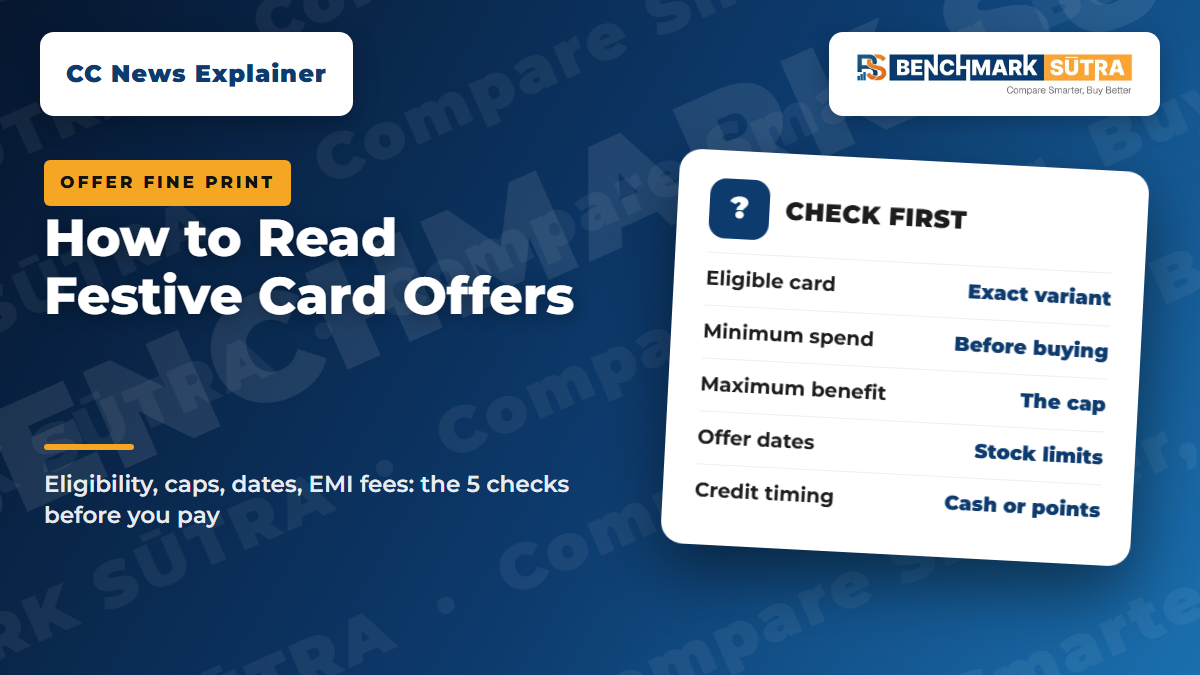
To check the terms of a festive credit card offer, find the offer's own terms and conditions page, then read five things: who is eligible, the minimum spend, the cap on the benefit, the offer dates, and how and when the benefit is credited. If any of the five is missing from the banner, the "up to" number is marketing, not a promise.
The reason this matters: a festive banner is a promotion, and its conditions usually sit one click away in a separate offer T&C, not in the card's Most Important Terms and Conditions (MITC). This guide is a method you can reuse for any credit card festive offer, so it names no current offers. It works the same in any festive season as of November 2026.
What to check | Where to look | Red flag |
|---|---|---|
Eligible cards and merchants | Offer T&C page | "Select cards" or "select products" |
Minimum transaction value | Offer T&C page | A threshold well above what you plan to spend |
Maximum benefit and per-card cap | Offer T&C page | "Up to" with the cap in fine print |
Offer period and stock | Offer T&C page | "While stocks last" or a shorter merchant window |
When and how it is credited | Offer T&C page | No credit date, or credit as points |
How Do You Read Festive Credit Card Offer Terms Step by Step?
Follow this order. It takes about ten minutes, and it is the same order every time.
Step 1: Find the real terms, not the banner
Open the offer page and look for a link labelled "Terms and conditions" or "T&C apply". Save the page or take a screenshot with the date visible. If you cannot find the terms, treat the offer as unverified. The RBI'sCredit Cards and Debit Cards: Issuance and Conduct Directions, 2025 (updated as on 1 October 2026)says discounts, cashbacks and reward points must be transparent and their details must be on the issuer's website (para 72, as numbered in that document; confirm in the current text).
Step 2: Confirm your exact card is eligible
Offers are often tied to a network, a variant or a card type such as credit versus debit. "HDFC Bank cards" or "Axis Bank cards" in a headline rarely means every card from that bank. Match the exact card name and network to the eligibility line, and check whether add-on cards qualify.
Step 3: Find the minimum spend and the cap
Every instant discount or cashback has two numbers: the minimum order value and the maximum benefit. The headline percentage is only useful once you know both. Here is an illustration with made-up numbers (not a current offer): a 10% instant discount with a ₹1,500 cap and a ₹10,000 minimum.
Cart value | 10% of cart | You actually get | Effective discount |
|---|---|---|---|
₹8,000 | ₹800 | ₹0 (below minimum) | 0% |
₹15,000 | ₹1,500 | ₹1,500 | 10% |
₹60,000 | ₹6,000 | ₹1,500 (cap) | 2.5% |
The cap makes the benefit worth most on mid-sized purchases. On a big appliance, it may be worth far less than the banner suggests.
Step 4: Check the offer dates and the merchant's own window
A bank offer and a merchant sale can have different start and end dates. Look for a limit on the number of redemptions, a per-day or per-card cap, and the phrase "while stocks last". If the offer is first-come, plan to buy at the start.
Step 5: Know how and when the benefit arrives
"Instant discount" is applied at checkout. "Cashback" arrives later, sometimes as a statement credit and sometimes as reward points. Points have their own value and expiry, so a "₹1,000 cashback" paid as points is not the same as ₹1,000 off. Our guide onhow to value a reward pointcovers the rest.
EMI Offers: Where the Fine Print Costs You Most
"No-cost EMI" is the festive offer families meet most when buying phones, TVs and appliances. The fine print to read:
Interest versus discount:in a no-cost EMI the interest is often offset by an upfront discount, so you may lose a separate instant discount.
Processing fee:look for a fee on the EMI conversion, and GST on the interest and the fee.
Foreclosure charge:check what closing the EMI early costs.
Rewards:many cards do not give reward points on EMI transactions.
Credit limit:the full purchase amount blocks your limit until you repay.
Run the numbers in ourcredit card EMI calculatorbefore you tick the box, and readcredit card EMI explainedfor the full picture.
Try it with your own numbers:Credit Card EMI Calculator
What the RBI Rules Say About Offers and Terms
We read the RBI'sCredit Cards and Debit Cards: Issuance and Conduct Directions, 2025 (updated as on 1 October 2026)for this guide. Paragraph numbers below are as they appear in that document; some paragraphs were substituted effective 1 October 2026, so confirm the current wording.
Topic | What the directions say |
|---|---|
Offers and rewards (para 72) | Discounts, cashbacks, reward and loyalty points must be transparent, with details on the website |
Partner offers (para 60) | The issuer must make sure partner-advertised cashbacks and offers are delivered on time, and is liable for delays or non-delivery |
Charges (para 76) | No charge may be levied unless it was indicated at issuance and consented to |
Changes in terms (para 79) | The issuer may alter terms but must give 30 days' notice |
Complaints (para 85) | If the issuer does not respond within 30 days of a complaint, you may approach the RBI Ombudsman |
For how fees and charges are described on the card itself, seeevery credit card fee explained.
If an Offer Does Not Arrive
Keep the order confirmation, the card statement line and the offer T&C screenshot.
Wait for the credit window stated in the terms before you complain.
Write to the bank's customer care and get a complaint number.
If there is no answer in 30 days, escalate to the grievance officer and then the RBI Ombudsman.
Our post onhow we keep reviews updatedexplains why we point to the official page for the live terms.
Checklist
Open the offer's own T&C page and save it with the date.
Match your exact card name, network and variant.
Note the minimum spend and the maximum benefit.
Check the offer dates and any redemption limit.
Confirm whether the benefit is an instant discount, a statement credit or points.
For EMI, read the interest, processing fee and foreclosure charge.
Check whether the merchant category earns normal reward points. Our note onmerchant category codesexplains why some do not.
Common Mistakes to Avoid
Trusting "up to 10%" without checking the cap.
Buying on a card that is not on the eligible list.
Stacking offers when the T&C say they cannot be combined.
Treating cashback paid as points as cash.
Converting to EMI without reading the processing fee.
Spending more than planned to hit a minimum threshold.
Related on benchmarksutra
FAQs
How do I check the terms of a festive credit card offer?
Open the offer's own T&C page and read the eligible cards, minimum spend, maximum benefit, dates and credit timeline. Save a dated copy in case of a dispute.
Where are festive offer terms published?
Usually on the bank's offer page or a linked T&C PDF, and on the merchant's page. The RBI directions require reward and offer details to be available on the issuer's website.
Can a bank change an offer after I buy?
The RBI directions require 30 days' notice for changes to a card's terms, and make the issuer responsible for delivering partner offers on time. Keep your dated copy of the terms, and raise a complaint if a promised benefit does not arrive.
Is a "no-cost EMI" really free?
Not always. The interest is often offset by a discount you then lose, and a processing fee and GST may still apply. Compare the total payable with and without EMI.
Do festive offers earn reward points as well?
Not necessarily. Some categories and EMI transactions earn no points. Check your card's reward terms and the offer's stacking rule.
What if the cashback never arrives?
Wait for the credit window in the terms, then complain with your proof. If the bank does not reply within 30 days, you can approach the RBI Ombudsman.
Official Sources and Editorial Note
This article is written from official sources and does not rely on third-party wording. Offer terms differ by bank and merchant and change often; always read the live terms before you pay.