RBI requires one month's notice for new charges and 30 days for changes in terms. What a devaluation notice means, real 2026 examples and what families should do.
Quick Verdict
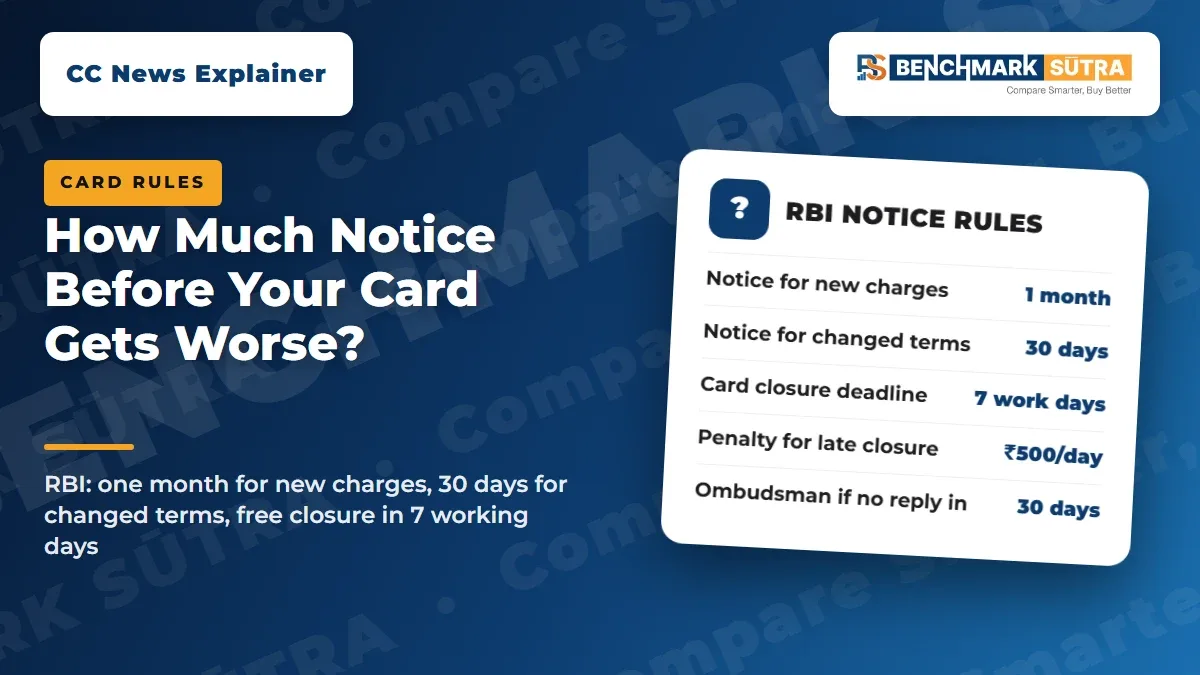
Under RBI's rules, a bank must give you at least one month's notice before it changes any charge on your credit card, and 30 days' notice before it changes the card's terms. If a fee change hurts you, you can close the card in that window without any extra closure charge, once your dues are paid.
A credit card devaluation notice is the message that tells you a benefit is being cut: fewer reward points, a new spend condition on lounges, a lower point value or a new fee. RBI's directions do not set a separate clock just for reward or lounge cuts. The closest rules are the 30-day rule for changes in terms and a rule that any withdrawal of benefits must be told to you immediately, with reasons. These are the rules as of November 2026.
What changes | What RBI requires | Your option |
|---|---|---|
A fee or charge (annual fee, forex, late fee) | At least one month's prior notice; prospective effect only | Close the card without an extra charge, after paying dues |
Terms and conditions (earn rate, caps, rules) | 30 days' notice of the change | Withdraw in the notice period; after 30 days you are deemed to accept |
Withdrawal of a benefit | Intimated immediately, with reasons, by electronic means | Ask the bank for the notice and the reason |
Updated MITC | Sent each time a condition is modified with notice | Keep a copy for disputes |
Closure request | Done within 7 working days | ₹500 a day paid to you for delay |
What Is a Credit Card Devaluation Notice?
"Devaluation" is not an RBI word. It is what cardholders call any change that makes a card worth less. Banks call these "revisions", "changes to features and charges" or "product feature changes".
Common types of devaluation in 2025 and 2026 included:
Reward rate cuts: fewer points per ₹100 or ₹200, or a lower rupee value per point.
New spend gates: lounge visits or offers that now need a minimum spend in the previous quarter.
New caps and exclusions: monthly limits on grocery, utility or insurance points, or no points on rent, fuel and wallet loads.
New or higher charges: a higher forex or currency conversion markup, a reissue fee or a fee on certain payments.
Partner changes: a hotel or airline transfer partner removed, or a transfer ratio changed.
For a family, these changes add up. A card picked for free lounge visits on the yearly holiday, or a buy-one-get-one movie offer every month, can quietly stop paying for itself.
How Much Notice Must a Bank Give?
The rules sit in the Reserve Bank of India (Commercial Banks – Credit Cards and Debit Cards: Issuance and Conduct) Directions, 2025, shown on RBI's site as updated on 1 October 2026. Four paragraphs matter most.
Changes in charges: one month
Paragraph 23(7) says changes in charges "shall be made only with prospective effect giving prior notice of at least one month". If you decide to surrender the card because the change is against you, the bank must let you close it "without levying any extra charge for such closure". You still have to clear your dues.
Changes in terms: 30 days
Paragraph 79 says the terms "may be altered by the card-issuer, but 30 days' notice of the change shall be given". You may withdraw during that period. If you do nothing, after 30 days you are treated as having accepted the new terms.
Withdrawal of benefits: told immediately, with reasons
Paragraph 67 asks banks to ensure that any "withdrawal of benefits available on any card is immediately intimated" to the cardholder, with reasons, through electronic means such as SMS or email.
A fresh MITC with every change
Paragraph 11(2) says the Most Important Terms and Conditions (MITC) must be given to you at onboarding and again each time a condition is modified with notice.
What the rules do not say
RBI does not list "reward points" or "lounge access" separately in these notice rules. Our reading: a cut to earn rates, caps or lounge conditions is a change in the card's terms, so you should expect at least 30 days' notice. If the change is a new or higher fee, the one-month rule for charges applies. This is our interpretation of the published text, not an RBI clarification.
Our wider guide to these directions is RBI Credit Card Rules Explained.
What Real Notices Looked Like in 2026
Banks publish dated change notices on their websites and in PDF mailers. Here are recent examples from official bank documents.
Bank and card | Change | Effective from |
|---|---|---|
HDFC Freedom | Points now accrue per ₹200 instead of per ₹150 | 15 May 2026 |
HDFC Regalia Gold | Earn rate revised to 5 points per ₹200; 1.75% markup on rupee payments abroad (DCC) | 15 May 2026 |
HDFC Regalia Gold and Diners Club Privilege | Domestic lounges need ₹60,000 spend in the previous calendar quarter | July–September 2026 quarter |
Axis My Zone | DCC markup up from 1.5% to 3.5%; no points on tolls | 28 August 2026 |
Axis My Zone | Movie offer needs ₹25,000 spend in the previous 3 months | 1 November 2026 |
Axis Burgundy Private | Fee if relationship value falls below ₹5 crore revised to ₹1,00,000 + GST | 1 September 2026 |
Tata Neu HDFC cards | NeuCoins must be claimed in the Tata Neu app (guide dated 21 October 2026) | 25 November 2026 |
The Tata Neu example shows the gap in practice: HDFC's updated guide is dated 21 October 2026 and the change starts on 25 November 2026, a little over a month later.
Banks also state their own notice policy in the MITC. HDFC Bank's MITC (updated 31 October 2026) says changes, other than those caused by regulatory requirements, will "normally" be made with prospective effect "giving 30 days' notice". When HDFC closed its IndiGo 6E Rewards cards, the same document says it sent 30 days' advance SMS and email to existing customers.
Not every change comes as a dated notice. Axis Bank's Travel EDGE transfer terms say the partner list can change at the bank's discretion; Club ITC left that list between August and October 2026 without a separate dated notice that we could find.
For how other recent cuts played out, read IDFC FIRST Devaluation 2026: What's Changing, HSBC Live+ Credit Card Devaluation and Yes Bank Credit Card Changes from 15 June 2026.
How Do You Read a Devaluation Notice?
A notice answers five questions. Read it in this order.
Effective date: the day the change starts. Spends and redemptions before this date usually follow the old rules. Check the notice for any exception.
Which variants: many notices cover several cards. Find your exact card name and network.
What exactly changes: earn rate, cap, eligible categories, fee or partner.
What happens to existing points: whether points already earned keep their old value.
Where the new MITC or terms are: download and save the PDF.
Then put a rupee figure on it. If your card earned 5 points per ₹150 and now earns 5 per ₹200, the same ₹30,000 monthly spend earns 750 points instead of 1,000. That is a 25% cut in rewards before any change in point value.
What Should You Do When a Notice Arrives?
Use the notice window in this order.
1. Redeem before a value cut
If the notice cuts the value of a point or removes a transfer partner, redeem or transfer before the effective date, if a good redemption is open to you. Do not redeem in a hurry for a poor catalogue item.
2. Recalculate the fee
Work out what the card returns after the change, then subtract the annual fee and GST.
3. Decide before your renewal date
If the card will no longer cover its fee, ask for closure before the next annual fee is billed. If the change was a new or higher charge, RBI says closure in response must not carry an extra charge, once dues are paid.
4. Close the right way
Ask through the bank's helpline, app, net banking or email. RBI says the bank cannot insist on a letter by post and must close the card within seven working days of your request, subject to dues. For each calendar day of delay, it must pay you ₹500.
5. Complain if the notice never came
If a benefit disappeared with no message, write to the bank and ask for the date and channel of the notice. If the bank does not reply within 30 days, or you are not satisfied, file with the RBI Ombudsman at cms.rbi.org.in.
What Families Should Watch
Middle-aged families often hold one main card, one or two add-ons, and a fixed pattern of spends: school fees, groceries, a yearly trip. That makes some changes hit harder.
Lounge gates and family trips: a new quarterly spend gate can wipe out free visits for the whole family on a holiday.
Category caps: monthly caps on groceries or utilities hurt large households first.
Education and rent exclusions: if school fees or rent were a big part of your rewards, check every notice for these categories.
Add-on cards: a change to the primary card applies to its add-ons too.
Checklist
Save every change notice and the updated MITC as a PDF.
Note the effective date in your calendar.
Check whether your exact card and network are listed.
Work out the rupee impact on your real monthly spend.
Redeem or transfer points before a value cut, if a good use exists.
Compare the card's new return with its annual fee plus GST.
Decide on closure before the next annual fee date.
If closing, ask through an official channel and note the date.
Complain to the bank first, then to the RBI Ombudsman after 30 days.
Common Mistakes to Avoid
Mistake 1: Ignoring the SMS
Banks often send the notice by SMS or email with a link. Your window to react starts when the notice goes out, not when you spot the change on a statement.
Mistake 2: Redeeming in panic
A value cut is not a reason to accept a bad redemption. Compare the post-change value of a good redemption with the pre-change value of a poor one.
Mistake 3: Paying the renewal fee first, then closing
Once the annual fee is billed, a reversal depends on the bank. Decide before the renewal date.
Mistake 4: Assuming points survive closure
Ask the bank what happens to unredeemed points before you close. Redeem first if you can.
Mistake 5: Relying on old reviews
A review written before a change can be wrong today. See How We Keep Credit Card Reviews Updated.
FAQs
How much notice must a bank give before changing card benefits?
RBI requires at least one month's notice for changes in charges and 30 days' notice for changes in terms. Any withdrawal of benefits must be told to you immediately, with reasons.
Can I close my card without a fee after a devaluation?
If the change is a new or higher charge, RBI says you can surrender the card without any extra closure charge, once you pay your dues. For other changes, check your card's MITC for any closure charge.
What happens if I do nothing after a notice?
RBI's directions say that after the 30-day notice period, you are deemed to have accepted the new terms.
Does RBI stop banks from cutting rewards?
No. Banks can change reward rates, caps and lounge rules. RBI regulates how they tell you, not whether they can make the change.
How long does the bank have to close my card?
Seven working days after your request, provided all dues are paid. If it is late, it must pay you ₹500 for each calendar day of delay.
Where do I complain if I never got a notice?
Complain to the bank first. If there is no reply in 30 days, or the reply does not satisfy you, file with the RBI Ombudsman at cms.rbi.org.in.
Official Sources and Editorial Note
Data checked as of: 5 November 2026
RBI (Commercial Banks – Credit Cards and Debit Cards: Issuance and Conduct) Directions, 2025, updated as on 1 October 2026 (paragraphs 11, 19, 23, 67, 79)
https://www.rbi.org.in/Scripts/BS_ViewMasDirections.aspx?id=13155
HDFC Bank notice of credit card changes effective 15 May 2026
https://www.hdfc.bank.in/content/dam/hdfcbankpws/in/en/personal-banking/discover-products/cards/credit-cards/generic-mailer-tnc.pdf
HDFC Bank Credit Card MITC, updated 31 October 2026 (notice policy)
https://www.hdfc.bank.in/content/dam/hdfcbankpws/in/en/personal-banking/discover-products/cards/credit-cards/personal-mitc/mitc-in-english.pdf
HDFC Bank Regalia Gold product feature change
https://www.hdfc.bank.in/content/dam/hdfcbankpws/in/en/pdf/common/Credit-Cards/Regalia-Gold-Product-feature-change.pdf
HDFC Bank Diners Club Privilege product feature change
https://www.hdfc.bank.in/content/dam/hdfcbankpws/in/en/pdf/common/Credit-Cards/Diners-Privilege-Product-Feature-Change.pdf
HDFC Bank Tata Neu credit card NeuCoins claim guide
https://www.hdfc.bank.in/content/dam/hdfcbankpws/in/en/pdfs/TataNeuCC_neucoins_Claim.pdf
Axis Bank revision of My Zone Credit Card terms
https://campaign.axis.bank.in/generic/terms-and-conditions-myzone.pdf
Axis Bank revision of Burgundy Private – The One Card terms
https://campaign.axis.bank.in/generic/terms-and-conditions-burgundy.pdf
RBI Complaint Management System (Ombudsman)
https://cms.rbi.org.in
This article is written from official sources and does not rely on third-party wording.
Editorial note:
The view that reward and lounge cuts count as changes in terms is our reading of RBI's text, not an RBI clarification. Change dates in the table come from official bank documents checked by benchmarksutra in November 2026. RBI and banks update their rules; check the latest text before relying on a specific paragraph.