What happens when a bank cuts its point transfer ratio? Same points buy fewer miles. Worked examples, real HDFC and Axis ratios, RBI notice rules and what to do.
Quick Verdict
When a bank changes its point transfer ratio, the same points buy fewer or more partner miles from the effective date. A cut means you need more points for the same award, and any transfer you have already made stays final. This is the core of anycredit card transfer ratio change, as of November 2026.
Here is our view after reading the transfer terms. A ratio is not a promise. HDFC halved the value of three partners in January 2024 with one numbered line in a rewards terms PDF, and Axis Bank's Travel EDGE terms say the partner list and grouping can change at its discretion. We read these documents; we did not transfer points ourselves. The practical lesson is simple: do not bank points for a trip two years away. Transfer when you have a booking-ready award, and treat the ratio you see today as the best you will see.
Question | Short answer |
|---|---|
What changes | Partner miles you get per bank point (for example 1:1 becomes 2:1) |
Effect on you | Same award costs more points; value per point can halve |
Past transfers | Final; Axis and HDFC say transfers cannot be reversed |
Notice | RBI expects 30 days for a change in terms; our reading, not an RBI clarification |
Best response | Run the numbers before the date; transfer only against a real award |
Try it with your own numbers:Credit Card Reward Value Calculator
What Is a Transfer Ratio and Why Does It Matter?
A transfer ratio says how many bank points become one partner point. "5:2" means 5 bank points for 2 partner miles. "1:1" means one for one. "2:1" means you give two points to get one.
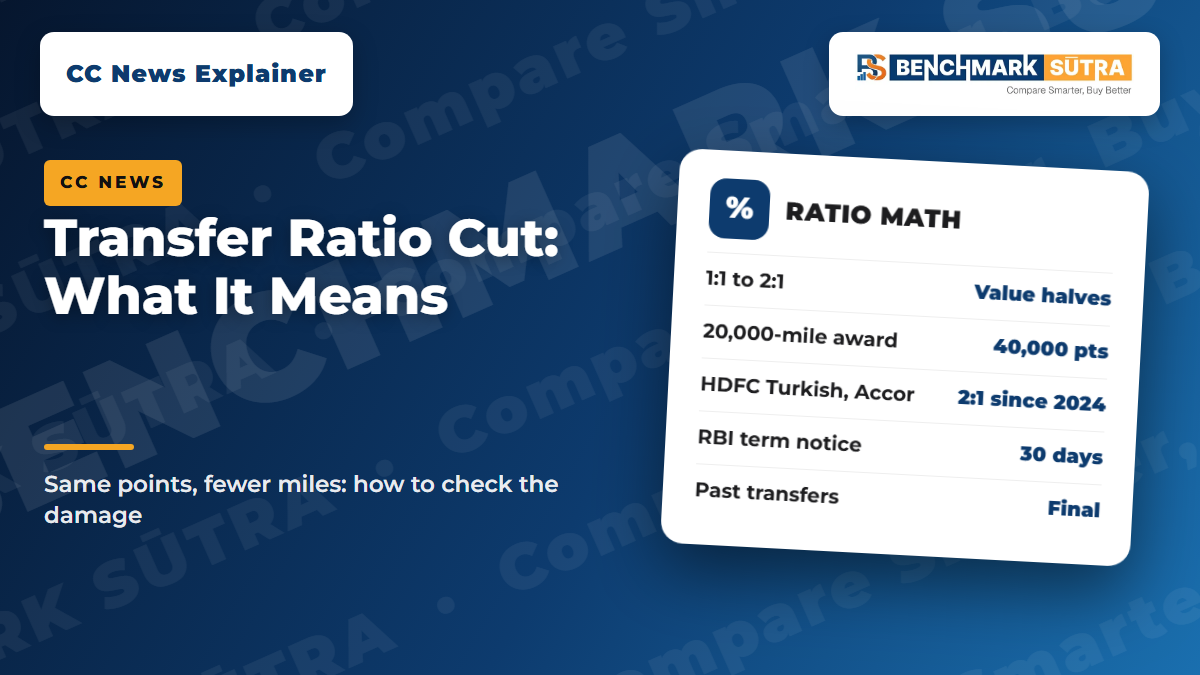
The ratio sets the price of every award. A flight that costs 20,000 airline miles costs 20,000 points at 1:1 and 40,000 at 2:1. Nothing else about the card needs to change for your trip to get twice as expensive.
For the basics of moving points, readcredit card transfer partners in India.
What Happens to Your Points When the Ratio Is Cut?
Points sitting in your account are not reduced. What changes is what they can buy at the partner. Here is the effect of a cut on a plain ₹30,000 economy fare that needs 20,000 airline miles (taxes paid in cash). The ratios are examples, not any bank's current offer.
Ratio | Points needed for 20,000 miles | Value per bank point |
|---|---|---|
1:1 (before) | 20,000 | ₹1.50 |
2:1 (after a cut) | 40,000 | ₹0.75 |
5:2 (before) | 50,000 | ₹0.60 |
5:1 (after a cut) | 1,00,000 | ₹0.30 |
Value per point is the fare divided by the points spent. A 2:1 cut halves it. The reverse also holds: a move from 5:1 to 5:2 doubles it, which is why the ratio is the first number to check before any transfer.
Use ourreward value calculatorto turn your own points balance into rupees before and after a change.
What Ratio Changes Have Real Cardholders Seen?
Bank and programme | What changed | Why it matters |
|---|---|---|
HDFC Bank (Infinia, Diners Club Black) | From 15 January 2024, 2 reward points convert to 1 loyalty point for Turkish Miles & Smiles, Accor and Avianca LifeMiles | Value per point on those three partners is half what a 1:1 rate would give |
Axis Bank (Travel EDGE) | Accor ALL returned and Club ITC left the list; Accor sits in a lower-ratio tier than most airlines | Partner lists moved without a dated notice we could find |
American Express Membership Rewards | Transfer to Etihad Guest discontinued | Readthe news post. A removed partner is an extreme ratio change |
Axis shows how tiering works. Its published Accor ratios are weaker than its airline ratios on the same card: on Reserve and Magnus, 5:1 for Accor against 5:2 for Aeroplan. On Atlas, 2:1 for Accor against 1:2. Same bank, same points, very different value per point depending on the partner.
Not every devaluation is a ratio cut. Some banks change earn rates instead. SeeIDFC FIRST devaluation 2026,HSBC Live+ devaluationandYes Bank changes from 15 June 2026. The effect on your points is the same: less for the same spend.
How Much Notice Must a Bank Give?
The rules sit in the RBI "Credit Cards and Debit Cards: Issuance and Conduct Directions, 2025 (updated as on 1 October 2026)". Two paragraphs matter.
Paragraph 79: the terms "may be altered by the card-issuer, but 30 days' notice of the change shall be given" so you can withdraw. After 30 days you are treated as having accepted the terms.
Paragraph 23(7): changes in charges need prior notice of at least one month, with prospective effect only. If a charge change hurts you, you can surrender the card without an extra closure charge once your dues are paid.
The directions do not mention transfer ratios or reward partners by name. Our reading is that a ratio is part of the reward terms, so a cut should come with the 30-day notice. A new per-transfer fee would count as a charge and need one month. This is our interpretation of the published text, not an RBI clarification. Also note that the 30-day window protects your right to leave, not your points' value.
What Should You Do When a Ratio Cut Is Announced?
Read the notice for the effective date, the exact cards and the exact partners.
Work out the new value per point with a real fare or room rate.
If you already have an award in mind, transfer before the date. Transfers cannot be reversed, so confirm award space first.
If the cut makes transfers poor, compare the bank's own portal redemption or cashback instead.
If the cut is large and you do not want the card any more, you can withdraw within the notice period. Clear dues first.
Keep a copy of the notice and the updated terms for any dispute.
Who Is Most Exposed to a Ratio Cut?
Travellers and frequent flyers who hoard points for a long-haul business-class trip. Large balances sitting on one transfer route carry the most risk, because the cut hits every point at once. If you fly one airline a few times a year, an airline co-brand or a plain cashback card removes this risk. If you do use transfers, keep the balance small and move points soon after you earn them.
Before an international trip, also check the forex cost of the card. Ourforex markup calculatorshows what a 3.5% markup adds to your spend abroad.
Checklist
Note the ratio for your exact card and partner today, with a screenshot or the terms PDF.
Check the yearly or monthly transfer cap and any per-transfer fee.
Read every devaluation notice for the effective date and the partners it covers.
Compute value per point on a real fare before and after the change.
Confirm award seats before you transfer. Transfers are final.
Check that the name on your loyalty account matches the card.
Common Mistakes to Avoid
Hoarding points for years.The ratio you see today can change; the only locked-in value is a transfer you have used.
Transferring before checking award space.The transfer cannot be undone if no seats exist.
Assuming all partners share one ratio.Banks tier partners, so compare each one.
Ignoring the notice period.You have 30 days to decide; waiting past that means you accept the new terms.
Comparing points, not rupees.A bigger points total means nothing without the value per point.
Related on benchmarksutra
FAQs
What happens when a bank changes its point transfer ratio?
You get a different number of partner points for each bank point from the effective date. A cut means the same award needs more of your points. Points already in your account stay, and completed transfers are final.
Will the bank tell me before it cuts a transfer ratio?
RBI's directions require 30 days' notice of a change in terms and one month for a change in charges. Partner lists, however, can move without a dated notice, as Axis's own terms allow.
Can I reverse a transfer if the ratio worsens?
No. Axis and HDFC both say transfers cannot be reversed or cancelled. Move points only when you have confirmed the award you want.
Can I close my card if the ratio is cut?
Yes. RBI lets you withdraw within the notice period. For changes in charges, the bank must not levy an extra closure fee, subject to clearing your dues.
Is a transfer ratio cut the same as a devaluation?
It is one kind of devaluation. Others are lower earn rates, new caps, spend gates for lounges and new fees. All reduce what your spending earns.
How do I find out my current transfer ratio?
Open your bank's transfer terms or rewards portal and find your exact card and partner. For example, HDFC sets 2:1 for Turkish, Accor and Avianca, while Axis lists different ratios by card and partner.
Should I transfer points now if I fear a cut?
Only if you have a specific award to book. Transferring early without a plan locks your points into one partner and cannot be undone.
Official Sources and Editorial Note
Data checked as of: November 2026
RBI Credit Cards and Debit Cards: Issuance and Conduct Directions, 2025 (updated as on 1 October 2026)
https://www.rbi.org.in/Scripts/NotificationUser.aspx?Id=13155&Mode=0
HDFC Bank rewards points programme terms (Infinia)
HDFC Infinia rewards terms (PDF)
Axis Bank Travel EDGE terms and conditions
https://traveledge.axis.bank.in/travel/common/termsandcondition
This article is written from official sources and does not rely on third-party wording.
Editorial note:We are researchers, not testers; we did not transfer points ourselves. Ratios in the worked tables are examples. Axis's terms page did not render for us today, so the Axis ratios and partner-list wording come from our earlier reads of its Travel EDGE terms; check the live page. Fees, partners and ratios can change.
Related reading:Credit card transfer partners in India