
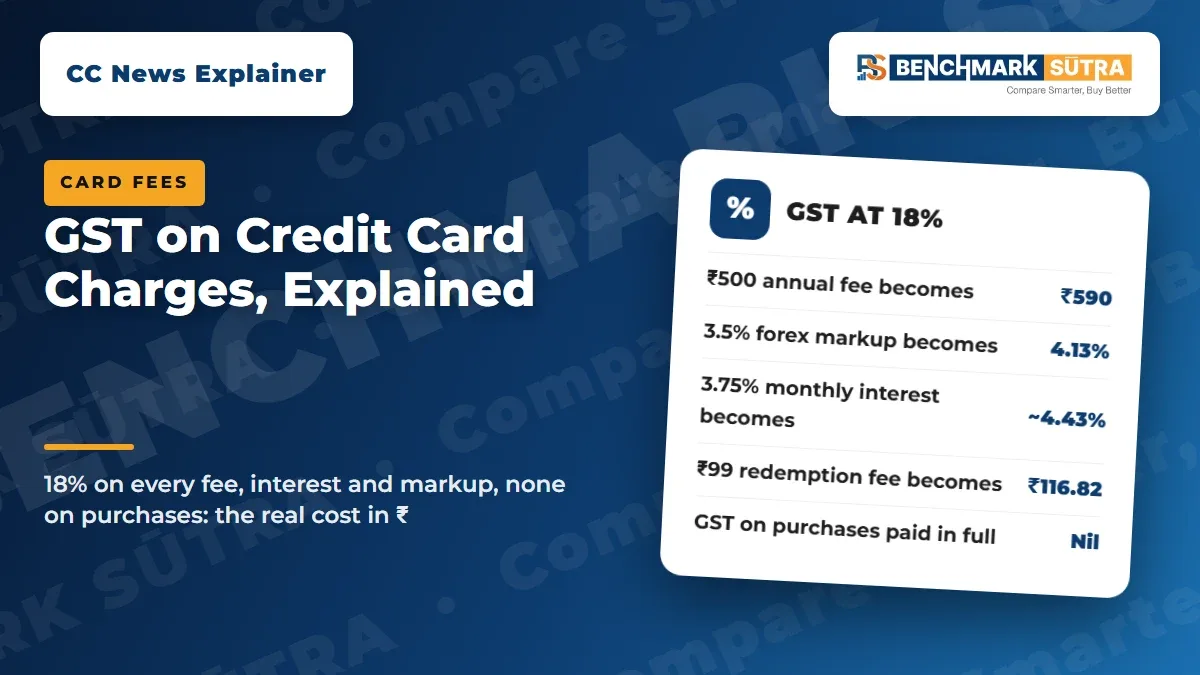
Banks add 18% GST to every card fee, interest charge and markup, but not to your purchases. See the real cost of each fee, how GST shows on your bill, and the input tax credit angle.
Quick Verdict
Credit card issuers charge 18% GST on every fee, interest charge and other charge they bill you. GST is not charged on the purchase amount itself, so a ₹10,000 shopping bill paid in full by the due date carries no GST from your bank.
That is the short answer on GST on credit card charges. The rate comes from the issuers' own Most Important Terms and Conditions (MITC). HDFC Bank's October 2026 MITC says GST is "applicable on all Fees, Interest, and other Charges". SBI Card's MITC says the old 15% service tax was replaced by GST at 18% from 1 July 2017.
Question | Short answer (as of November 2026) |
|---|---|
GST rate on card charges | 18% |
Charged on purchases you pay in full? | No |
Charged on interest? | Yes, on finance charges and EMI interest |
Charged on fees? | Yes: annual, late, cash advance, forex markup, rent, utility, redemption and others |
Reversed if you dispute a fee? | HDFC says GST is not reversed on disputes over fees or interest |
Can the bank charge interest on unpaid GST? | No. RBI rules ban interest on unpaid taxes and charges |
For professionals and business owners, there is one extra step worth taking: on a business card, ask the bank to link your GSTIN so the GST you pay can count towards your input tax credit.
How Does GST on Credit Card Charges Work?
A credit card is a financial service. When your bank charges you for that service, it collects GST on the charge, just as a CA collects GST on professional fees.
The key line is between your spend and the bank's charge:
Your spend: the ₹4,000 you paid at a restaurant or the ₹60,000 laptop. The merchant handles any GST on the goods or service. The card bank adds nothing.
The bank's charge: annual fee, interest, late fee, cash withdrawal fee, forex markup and so on. The bank adds 18% GST to each.
Axis Bank's own guide on the topic lists late payment charges, interest, foreign exchange markup, and membership, annual or joining fees as items that attract GST. It also notes that GST applies to both the interest and the processing fee when you convert a purchase into EMI.
CGST plus SGST, or IGST?
The total is always 18%. Only the split changes. HDFC Bank's MITC says the split depends on the place of provision and place of supply: if both are in the same state you pay CGST and SGST (or UTGST); otherwise, IGST.
SBI Card spells out its own rule. If your state of residence in its records is Haryana, you pay 9% Central Tax and 9% State Tax. Anywhere else, you pay 18% Integrated Tax.
How Much GST Is Charged on Each Credit Card Fee?
Here is what 18% GST adds to common charges. Fee amounts are from SBI Card's and HDFC Bank's MITC as of November 2026. The bill amounts are examples.
Charge | Example | Charge before GST | GST at 18% | You pay |
|---|---|---|---|---|
Annual fee | ₹500 card fee | ₹500 | ₹90 | ₹590 |
Late payment fee (SBI Card) | Total due of ₹1,001 to ₹10,000 | ₹750 | ₹135 | ₹885 |
Cash advance fee (2.5%, minimum ₹500) | ₹10,000 ATM withdrawal | ₹500 | ₹90 | ₹590, plus interest from day one |
Forex markup (3.5%) | ₹50,000 spent abroad | ₹1,750 | ₹315 | ₹2,065 (4.13% of spend) |
Rent fee (SBI Card) | Any rent payment | ₹199 | ₹35.82 | ₹234.82 |
Rent fee (HDFC, 1%) | ₹30,000 rent | ₹300 | ₹54 | ₹354 |
Reward redemption fee | One redemption | ₹99 | ₹17.82 | ₹116.82 |
Interest at 3.75% a month | ₹20,000 carried for 30 days | ₹739.73 | ₹133.15 | ₹872.88 |
Two numbers stand out. A 3.5% forex markup is really about 4.13% once GST is added. And a card advertised at 3.75% a month in interest really costs about 4.43% a month on the charge itself once GST is included.
For what each fee means and when it applies, read Every Credit Card Fee Explained.
An Official Example: GST in HDFC Bank's MITC
HDFC Bank's MITC (version 4.18, October 2026) includes a worked bill. The cardholder runs up ₹845.75 of interest and a ₹900 late payment charge. HDFC then adds "GST @ 18% of interest and late payment charges", which comes to ₹314.23.
So a missed payment in that example cost ₹2,059.98 in charges, of which ₹314.23 was tax. None of the GST is refundable later, even if you pay the full balance the next month.
To see how the interest part is built up day by day, read How Credit Card Interest Is Calculated.
Which Card Charges Attract GST, and Which Do Not?
Attracts 18% GST | No GST from the card issuer |
|---|---|
Joining, annual and renewal fees | Purchase amounts you pay in full |
Finance charges (interest) on revolved balances | The principal of an EMI |
EMI interest and EMI processing fees | Bill payments where you pay no card fee |
Late payment charges | Cashback and reward credits |
Cash advance fees | Annual fees that are waived |
Forex markup and dynamic currency conversion fees | Refunds from merchants |
Rent, utility, education, wallet and gaming fees | |
Reward redemption fees, card reissue and over-limit fees |
One special case is fuel. The 1% surcharge at petrol pumps is levied by the acquiring bank, along with GST on it. HDFC Bank and SBI Card both say the 1% fuel surcharge waiver excludes the GST. HDFC adds that "GST on Fuel surcharge will not be reversed." So even on a card with a fuel waiver, you pay a little GST on each fuel swipe.
How GST Shows Up on Your Statement
Three rules decide when and how GST hits your bill.
1. It can appear one month late
HDFC Bank's MITC says GST on fees, charges or interest billed on the statement date will show in the next month's statement. If you close your card right after paying a fee, expect one more small GST line.
2. It sits at the top of the payment queue
SBI Card's MITC says your payments are adjusted first against 100% of GST, then 100% of EMI, then fees, then finance charges, then retail spends. The Minimum Amount Due also includes 100% of GST. See Total Amount Due vs Minimum Amount Due.
3. It is not refunded on a fee dispute
HDFC Bank says GST levied "will not be reversed on Any dispute on Fee & Charges / interest". If you get a late fee waived as a goodwill gesture, ask specifically whether the GST on it will also be credited.
What RBI says about unpaid GST
RBI's Credit Cards and Debit Cards Directions, 2025 (updated as on 1 October 2026) say card issuers "shall not capitalize i.e., levy interest or any other charges, on the unpaid taxes/levies/charges." So if your GST stays unpaid, the bank cannot charge interest on that GST.
Can Professionals Claim Input Tax Credit on Card GST?
This matters for CAs, lawyers, doctors and other GST-registered professionals who use a card for practice expenses.
The GST a bank charges on card fees and interest is tax on a service. Whether you can claim it as input tax credit depends on the GST law and your own facts, so confirm with your tax adviser. On the card side, the practical issue is getting a tax invoice that carries your GSTIN.
Business cards: HDFC Bank's Biz First, Biz Grow and Biz Power pages say you can "Get GST Invoice for availing Input Tax Credit". To link your GSTIN, HDFC asks you to email [email protected] and share your PAN and GST documents.
Disputes about tax: SBI Card's MITC says any dispute on input tax credit or other tax matters must reach it within 30 days of the statement date.
Personal cards: issuers rarely publish a GSTIN linking process for personal cards. Ask your bank before assuming you can claim the credit.
If you are weighing a business card for this reason, check whether the issuer offers GSTIN linking before you apply.
How to Keep GST on Your Card Close to Zero
Because GST is a percentage of charges, the way to cut it is to avoid the charges.
Pay the total amount due, every month. No interest, no late fee, no GST. Use the interest-free period well: see Grace Period Explained.
Never live on the minimum. Interest plus 18% GST on it compounds your cost. Read Why Paying Only the Minimum Is Dangerous.
Hit the fee waiver. A waived ₹500 fee also saves you the ₹90 GST.
Do not withdraw cash on a card. You pay the fee, GST on the fee, interest from day one, and GST on that interest.
Use a low or zero forex card abroad. The 18% GST sits on top of the markup.
Redeem points in fewer, bigger batches. Each ₹99 redemption fee costs ₹116.82 with GST.
Checklist
Open your issuer's MITC and note every fee you are likely to pay.
Add 18% to each fee to see its real cost.
Multiply the monthly interest rate by 1.18 to see the true monthly cost of revolving.
Check whether your fuel surcharge waiver excludes GST (most do).
Look for GST lines on next month's statement after any fee or interest charge.
On a business card, ask the bank to link your GSTIN to your card account.
Raise any tax dispute within 30 days of the statement (SBI Card's timeline).
Confirm input tax credit eligibility with your tax adviser before claiming.
Common Mistakes to Avoid
Comparing the headline rate only. 3.5% forex is 4.13% with GST. 3.75% monthly interest is about 4.43% with GST.
Thinking GST applies to your purchases. It applies to the bank's charges, not the price of what you bought.
Expecting GST back after a goodwill waiver. HDFC says GST is not reversed on fee or interest disputes. Ask before you accept a partial waiver.
Paying only the fee and not the GST. GST sits first in the payment queue at SBI Card and is part of the minimum due.
Using a personal card for practice expenses and assuming you can claim the GST. Without your GSTIN on the invoice, the claim is hard to support.
Forgetting the trailing GST line. GST on a fee billed on statement day may appear on the next statement, even after you close the card.
FAQs
How much GST is charged on credit card fees?
Card issuers charge 18% GST on fees, interest and other charges. A ₹500 annual fee becomes ₹590 with GST.
Is GST charged on credit card purchases?
No, the card issuer does not add GST to the purchase amount. Any GST on the goods or service is part of the merchant's price.
Is GST charged on credit card interest?
Yes. Finance charges and EMI interest attract 18% GST, so 3.75% monthly interest costs about 4.43% a month in total.
Is GST charged on the forex markup?
Yes. A 3.5% markup plus 18% GST costs about 4.13% of what you spend in a foreign currency.
Will the bank refund GST if it reverses a fee?
Not always. HDFC Bank's MITC says GST levied will not be reversed on any dispute on fees, charges or interest, so ask your bank before accepting a waiver.
Can a bank charge interest on unpaid GST?
No. RBI's 2025 card directions bar issuers from levying interest or other charges on unpaid taxes, levies and charges.
Can I claim input tax credit on credit card GST?
Possibly, if you are GST-registered and the invoice carries your GSTIN. HDFC Bank lets business cardholders link a GSTIN; confirm eligibility with your tax adviser.
Why does SBI Card charge IGST and not CGST plus SGST?
SBI Card's MITC charges 9% CGST plus 9% SGST only if your state of residence on record is Haryana. Everyone else pays 18% IGST.
Official Sources and Editorial Note
Data checked as of: 5 November 2026
HDFC Bank credit card MITC (version 4.18, October 2026)
HDFC Bank MITC (PDF)
HDFC Bank Business Bharat card fees and GST note
Official page
HDFC Bank Biz First Credit Card (GSTIN linking for input tax credit)
Official page
SBI Card Most Important Terms and Conditions
Official page
Axis Bank guide to GST on credit cards
Official page
RBI (Commercial Banks – Credit Cards and Debit Cards: Issuance and Conduct) Directions, 2025
RBI Directions
This article is written from official sources and does not rely on third-party wording.
Editorial note:
This is general information, not tax advice. GST rates and card fees can change. Check your issuer's latest MITC, and ask a tax adviser before claiming input tax credit.


