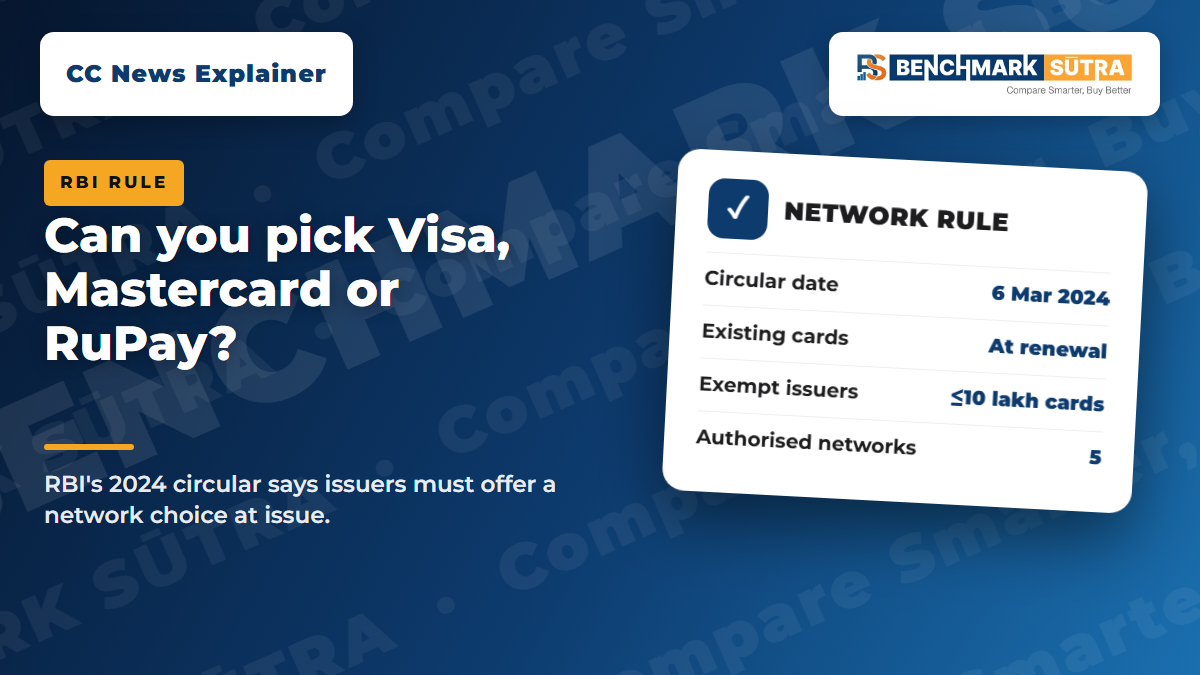
Can you choose Visa, Mastercard or RuPay? RBI's March 2024 circular says yes at issue. We explain who is exempt and how to ask.
Quick Verdict
Can you choose the card network for your credit card? Often yes, at issue, but not always.RBI's circular of 6 March 2024 (RBI/2023-24/131) directs card issuers to offer eligible customers a choice among multiple card networks when the card is issued, and to offer it to existing cardholders at the next renewal. Issuers with 10 lakh or fewer active credit cards, and issuers that run cards on their own authorised network, are outside the choice requirement.
We were asked to cite the clause in the 2025 Directions, and we need to be straight about it. We read the full text of the Credit Cards and Debit Cards: Issuance and Conduct Directions, 2025 (updated as on 1 October 2026) and found no paragraph on network choice. The Directions do point to separate payment-system instructions: paragraph 82 says card issuance is also subject to instructions issued by the Department of Payment and Settlement Systems under the Payment and Settlement Systems Act, 2007. The network rule sits in that separate RBI circular, so that is what we cite. In practice,RBI card network choiceis a right worth asking for at application or renewal, as of November 2026.
Question | Answer |
|---|---|
Is there a rule? | Yes: RBI circular RBI/2023-24/131, 6 March 2024, "Arrangements with Card Networks for issue of Credit Cards" |
Who gets the choice? | Eligible customers, at issue. Existing cardholders: at the next renewal. |
Who is exempt? | Issuers with 10 lakh or fewer active credit cards; issuers using their own authorised network |
Which networks are authorised? | American Express, Diners Club, Mastercard, RuPay (NPCI), Visa |
Is it in the 2025 Directions? | Not as a paragraph we could find; para 82 points to separate payment-system instructions |
Try it with your own numbers:UPI Transaction Statistics India
What Does the RBI Network Rule Actually Say?
The circular is addressed to authorised payment system providers and participants, banks and non-banks. Its background is simple. Card networks partner with banks and non-banks to issue credit cards, and the issuer picks the network for each card under its own agreement with the network. RBI says a review found that some arrangements limited customers' choice. So it gave two directions under Section 18, read with Section 10(2), of the Payment and Settlement Systems Act, 2007:
Direction 3(a):card issuers must not enter into arrangements with card networks that restrain them from using the services of other card networks.
Direction 3(b):card issuers must give eligible customers an option to choose from multiple card networks at the time of issue. For existing cardholders, the option may be given at the time of the next renewal.
Existing agreements had to comply at the time of amendment or renewal, and fresh agreements from the start. Direction 3(b) took effect six months after the circular, which works out to around 6 September 2024. The exemptions are the two above: issuers with 10 lakh or fewer active cards, and issuers that issue credit cards on their own authorised network.
The circular names five authorised networks: American Express Banking Corp., Diners Club International Ltd., MasterCard Asia/Pacific Pte. Ltd., National Payments Corporation of India (RuPay) and Visa Worldwide Pte. Limited.
Where Do the 2025 Directions Come In?
The Directions of 28 November 2025 consolidate the credit and debit card conduct rules for commercial banks and repeal the earlier instructions on card issuance and conduct. They cover underwriting, billing, closure, grievance handling and co-branding. They say nothing on the network a card runs on, other than a passing reference in paragraph 73 to insurance cover that a "card payment network" may provide.
Paragraph 82 is the bridge. It states that the issue of cards as a payment mechanism "shall also be subject to relevant instructions" on matters such as international cards and merchant discount rates issued by the Department of Payment and Settlement Systems. That is where the network circular lives. We could not confirm from the RBI pages whether the circular has been amended since March 2024, so check the RBI site for the latest instruction before you rely on this.
Source | What it covers | Network choice? |
|---|---|---|
RBI circular RBI/2023-24/131 (6 March 2024) | Arrangements between issuers and card networks | Yes: directions 3(a) and 3(b) |
RBI Directions 2025 (updated 1 October 2026), para 82 | Card issuance subject to payment-system instructions | Pointer only |
RBI Directions 2025, other chapters | Conduct, billing, closure, grievances, co-branding | No paragraph found |
Which Card Networks Are on Offer in Practice?
The rule gives you a choice where the issuer offers one. It does not force a bank to put every card on every network. RBL Bank's network guide shows how uneven the choice is. It lists cards by network:
RBL card | Networks listed in RBL's guide |
|---|---|
Platinum Maxima Plus | Visa only |
Blockbuster, Platinum Maxima, Popcorn | Mastercard only |
IRCTC RBL Bank, IndianOil RBL Bank XTRA | Mastercard and RuPay |
Patanjali Swarn, Patanjali Vishisht, QuickPay | RuPay only |
World Safari Lite | Mastercard, RuPay and Visa |
RBL also says existing cardmembers who want to explore an alternate network on an existing card can call +91 22 6232 7777. The guide gives no criteria for choosing a network. Note that the circular's exemption for issuers with 10 lakh or fewer active cards means a smaller issuer may not have to give you any choice at all.
Changing network may cost money. HDFC Bank's MITC (version 4.18, October 2026) lists reissue charges for lost, stolen, damaged or "Network Change" cards at ₹199 for non-metal cards and ₹3,500 for metal cards. Ask what your bank charges before you request a switch.
Visa, Mastercard or RuPay: What Should a Retiree Look For?
For senior citizens and retirees the practical question is usually about daily payments rather than status. Three things matter more than the logo on the card.
UPI use.If you want to pay small shop bills by UPI from a credit card, you need a RuPay variant. Our guides oncredit cards on UPIandlinking a RuPay card to Google Payexplain the setup, and theUPI transaction statistics toolshows how widely UPI is used.
Rewards.Some cards earn nothing on small offline UPI spends under ₹2,000. RBL says so on its RuPay-capable pages, so read the terms. Our ranking ofRuPay cards by cashback mathcompares what is on offer.
Fees and access.A lifetime-free RuPay card can be a low-risk start; see7 lifetime-free RuPay cards. For overseas travel, check international acceptance and the forex markup with your bank before you leave.
If you have a pension account with a bank, ask whether it can issue the same card on a different network. The circular's requirement applies to eligible customers, and "eligible" is for the issuer to define within the rule. Ask in writing if the branch is unsure.
How to Ask for Your Network of Choice
Step | What to do |
|---|---|
1 | Check the card's product page or network guide for the networks offered for your variant. |
2 | At application, pick the variant that matches your network. Ask the bank in writing if the form has no option. |
3 | For an existing card, ask at the next renewal. Note the date on your card. |
4 | Ask for the fee, if any, to change network and whether benefits change. |
5 | If refused, raise it with the bank's grievance officer; paragraph 83 of the Directions requires a published redressal mechanism. |
Checklist
Find your card's renewal month and put a reminder a month before.
Check which networks the issuer offers for your variant.
Ask about any reissue or network-change fee before you request it.
Decide whether you need UPI on the card; if so, choose RuPay.
Check international acceptance if you travel.
Keep a written record of your request and the bank's reply.
Common Mistakes to Avoid
Assuming every card comes in every network. Each card has its own list.
Searching the 2025 Directions for the clause. The rule is in the RBI circular of 6 March 2024.
Believing the choice is automatic. Banks must offer it to eligible customers, but you have to ask.
Switching network without checking that benefits such as lounges and offers carry over.
Relying on social posts. Read the RBI circular itself.
Related on benchmarksutra
FAQs
Can I choose the card network for my credit card?
Often yes. RBI's circular of 6 March 2024 requires card issuers to offer eligible customers a choice among multiple card networks at issue, and existing cardholders at the next renewal. Issuers with 10 lakh or fewer active cards are exempt.
Which clause covers card network choice?
Direction 3(b) of RBI circular RBI/2023-24/131 dated 6 March 2024. We found no network-choice paragraph in the 2025 Directions, which point to separate payment-system instructions in paragraph 82.
Which card networks are authorised in India?
The circular names American Express, Diners Club, Mastercard, RuPay (NPCI) and Visa.
Do I have to pay to change my card network?
It depends on the bank. HDFC lists reissue charges that include a network change at ₹199 for non-metal cards and ₹3,500 for metal cards. Ask your bank first.
Does the rule apply to debit cards?
The final circular applies to credit cards. A 2023 draft covered more card types, but the final text we read addresses credit cards only.
Can I get a RuPay credit card to use on UPI?
Some issuers offer RuPay variants that work on UPI, but not every card has one. Check your bank's network list for your card and read the reward terms for UPI spends.
What if my bank says it cannot offer a choice?
Ask whether it has 10 lakh or fewer active credit cards or issues on its own network, as both are exempt. If neither applies, take it up with the bank's grievance officer.
Official Sources and Editorial Note
Credit Cards and Debit Cards: Issuance and Conduct Directions, 2025 (updated as on 1 October 2026)
HDFC Bank: Most Important Terms and Conditions, version 4.18, October 2026
This article is written from official sources and does not rely on third-party wording.