A new credit card launch comes with a headline rate. Here is how a beginner checks fees, caps, exclusions, eligibility and offer dates before applying.
Quick Verdict
When a new credit card launches in India, check five things before you apply: the full fee and what waives it, how the rewards are capped, which spends are excluded, who actually gets the card, and what the bank's own terms say. A launch headline is a summary. The bank's Most Important Terms and Conditions (MITC) and the product page are the contract.
Every new credit card launch in India comes with a headline rate, such as "5% cashback" or "lifetime free". The real value sits in the caps, exclusions and dates below the headline. This guide gives a beginner a short, repeatable method, as of November 2026.
What to check | Where to find it | Red flag |
|---|---|---|
Joining and annual fee | Product page, MITC fee table | Fee waiver tied to a spend you will not reach |
Reward cap | Reward T&C PDF on the issuer site | Cap per month is tiny next to the headline rate |
Exclusions | Reward T&C, merchant-category list | Fuel, rent, wallet loads, utilities, government all excluded |
Who can apply | Eligibility box, issuer notice | Limited invite phase or closed access |
Offer end date | Offer T&C PDF | Launch benefit that has already ended |
Before applying, check:
whether the card is open to everyone or only to a limited batch
the fee you will pay in year two, not just year one
the monthly cap on the reward you care about
whether your usual spends are excluded
whether the launch offer is still running on the day you apply
Why Does a New Credit Card Launch Need a Checklist?
Launch posts are written to get attention. They lead with the best number. The terms that reduce that number sit in PDFs most people never open. For a first-time card buyer, that gap is where money is lost.
RBI requires banks to give you a one-page Key Fact Statement with the interest rate and charges before you apply, and to send the MITC when you onboard. Read both. They are the official record of what you are signing up for. Under the RBI Credit Cards and Debit Cards: Issuance and Conduct Directions, 2025, the bank also needs your explicit consent before it issues a card, so a card should never arrive unasked.
New cards also change. Banks revise rewards, caps and fees after launch. We track those changes in posts such asHSBC Live+ Credit Card DevaluationandSBI PhonePe devaluation. A launch is the best version of the card on paper. Plan for the average year, not launch week.
What Should You Check on the Fee Table?
Start with money you will definitely pay. A card advertised as "free" often means one of three different things.
Phrase in the launch | What it can mean | What to confirm |
|---|---|---|
Lifetime free | No joining or annual fee at all | Is it for every applicant, or only through one app or employer list? |
First year free | Joining fee waived once, annual fee returns | What is the year-two fee, and what spend waives it? |
Fee waiver on spend | Renewal fee reversed if you spend a set amount | Does the spend include add-on cards, and which spends count? |
A real example from this month: HDFC's Swiggy Ornge card lists a fee of ₹500 plus taxes, but applications made through the Swiggy app from 1 July 2026 qualify for lifetime free. A separate first-year-free offer ran only for applications between 15 April and 10 September 2026, which has ended. Same card, three different outcomes depending on date and channel. We broke this down in Swiggy Ornge HDFC vs Eternal SBI.
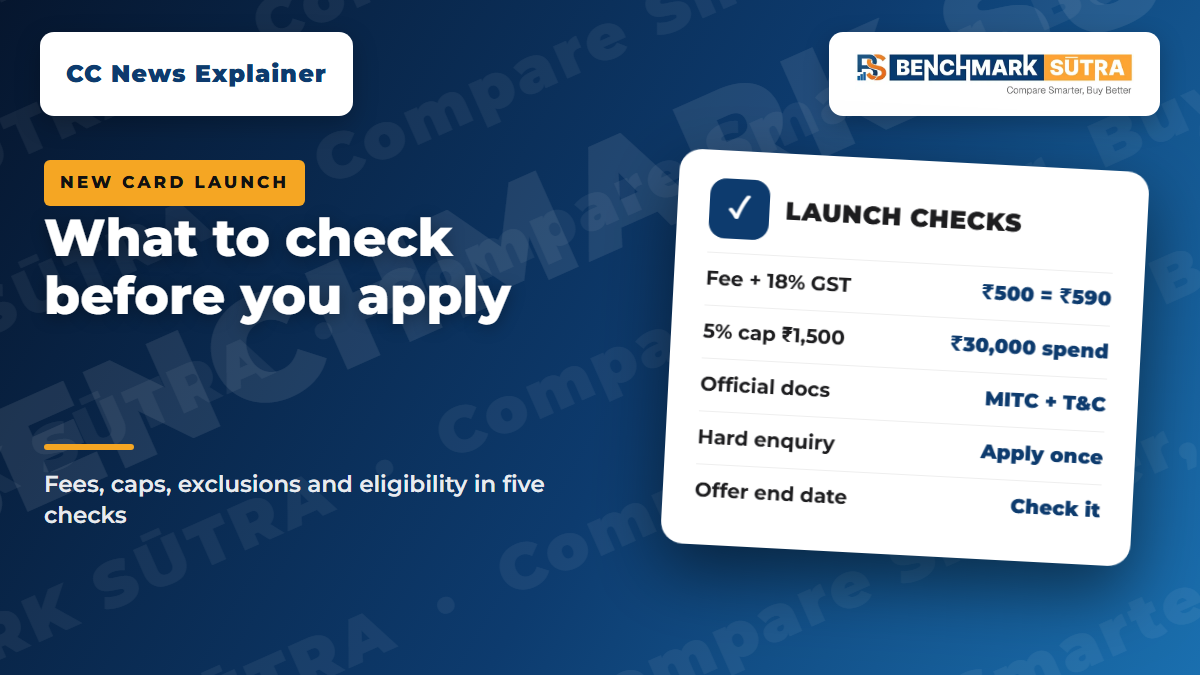
Always add 18% GST to the stated fee. A ₹500 fee costs ₹590. If the fee is waived at ₹1,50,000 of spend, divide that by 12 and ask whether ₹12,500 a month on this card is realistic for you. Ourfee waiver guideand theannual fee breakeven calculatorhelp with the maths.
How Do You Read Reward Rates and Caps?
A reward rate without a cap is only half a number. Divide the monthly cap by the rate to find the spend that earns the full benefit.
Headline | Monthly cap | Spend needed to hit cap | Meaning |
|---|---|---|---|
5% cashback | ₹1,500 | ₹30,000 | Spend above ₹30,000 earns the base rate |
10% discount | ₹2,000 | ₹20,000 | Small spenders may never reach the cap |
10% cashback | ₹1,200 | ₹12,000 | Cap is hit fast; extra spends earn less |
1% base earn | ₹1,000 | ₹1,00,000 | Rarely a limit for most households |
The examples above use cap levels from cards we have reviewed (HDFC Swiggy Ornge, Eternal SBI and HSBC Live+), applied as a simple rate-and-cap division. Your own spend decides whether a cap helps or hurts you.
Also check whether the reward is cashback, points or an instant discount, and how points are valued when redeemed. Our guide to thereward rate vs effective reward rateshows why a high headline rate can turn into a low real return. For a quick estimate, use thereward value calculator.
Who Can Actually Get the New Card?
Launch does not always mean open to all. Banks start some cards in phases. In the Eternal SBI card's case, Eternal's page says only 5,000 cards are available in the first phase and that invites go out in batches, while SBI Card's product page still shows an Apply Now button. If a card is invite-only or closed, a launch post does not help you.
Check the eligibility box on the issuer's page: minimum income, city list, age and employment type. If you are a fresher with no credit history, an unsecured premium card is unlikely to approve you. Read our guides onapproval chances with low incomeandwhy cards are rejectedbefore you apply. Every application can create a hard enquiry on your credit report, so do not apply to many cards in a short window. Seehard enquiry vs soft enquiry.
Self-employed and freelancers
If you do not have a salary slip, check which income proof the bank accepts. Thefreelancer credit card guidelists typical documents.
Which Documents Should You Read Before Applying?
Keep these open in tabs when you evaluate any launch.
Document | What it tells you | Who publishes it |
|---|---|---|
Product page | Headline benefits, eligibility, fee summary | Issuing bank |
MITC | Fees, interest, late charges, forex markup, billing terms | Issuing bank, required by RBI |
Reward T&C PDF | Caps, exclusions, redemption rules | Issuing bank |
Offer T&C PDF | Dates and conditions of welcome offers | Issuing bank |
Key Fact Statement | One-page summary of interest and charges | Issuing bank, required by RBI |
Only apply through the issuer's own site or app, or a link you trust. A bank does not charge you to be considered for a card. If someone asks for money to approve one, walk away.
When a card launches, we read these same documents and publish how we score the result. Our method is inhow we rate Indian credit cardsandhow we keep reviews updated.
Checklist: Before You Apply for a New Card
Read the issuer's product page and the MITC, not just the launch headline.
Add 18% GST to the fee and note year-two cost.
Divide each reward cap by its rate to find the spend that fills it.
List the exclusions and cross them against your last three statements.
Check the offer end date and the channel the offer needs.
Confirm that the card is open to you in your city and income band.
Check whether you need the card, or whether one you hold already does the job.
Apply once, wait, and track the decision before applying elsewhere.
Common Mistakes to Avoid
Trusting a launch summary instead of the terms. Summaries leave out caps and exclusions.
Ignoring year-two fees. A free first year can be followed by a fee in year two.
Applying to every new card. Several hard enquiries in a short time can hurt approval odds.
Counting on a welcome benefit without checking its end date.
Assuming a launch rate lasts. Rewards are revised, often within a year.
Paying anyone to arrange a card. Banks do not charge for applications.
Related on benchmarksutra
Credit cards in India: every benchmarksutra guide in one place
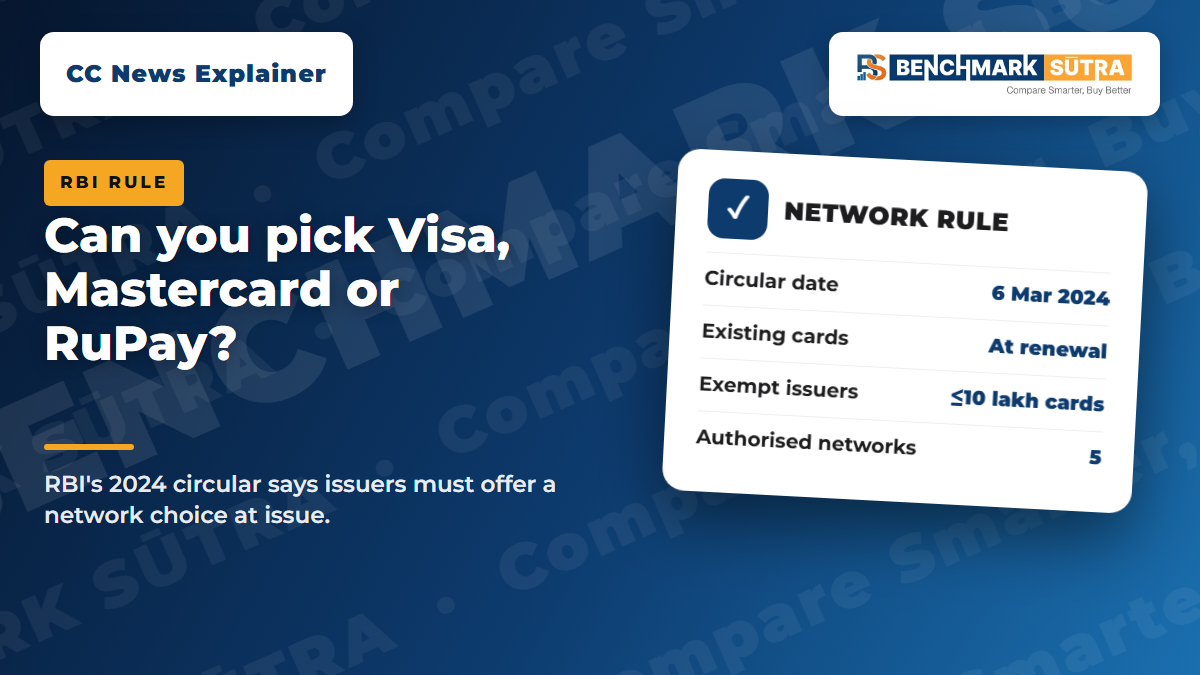
Card network choice: can you pick Visa, Mastercard or RuPay?
FAQs
What should I check when a new credit card launches?
Check the fee and its waiver, reward caps, exclusions, eligibility and offer end date in the bank's product page and MITC. Do not rely on the launch headline alone.
Is it better to wait before applying for a new credit card?
If you do not need it urgently, waiting a few weeks lets the bank's terms settle and shows whether the card is open to everyone. Early offers can be worth taking only when the dates and conditions are clear.
Where do I find the official terms of a new card?
On the issuing bank's product page and in its MITC and reward T&C PDFs. RBI requires banks to send the MITC at onboarding and to give a one-page Key Fact Statement before you apply.
Can a bank send me a card I did not apply for?
No. Under RBI's 2025 Directions for commercial banks, a bank needs your explicit consent before issuing a card, and unsolicited cards are prohibited.
Do new cards change their rewards after launch?
They can. Banks revise rewards, caps and fees from time to time, so check the current terms on the day you apply and again at renewal.
How many credit cards should a beginner apply for at once?
One. Each application can create a hard enquiry on your credit report, so apply, wait for the result and then decide on another.
Does a lifetime free launch card stay free?
Only if the issuer's terms say so for your channel and date. Confirm the exact wording on the bank's page, since some free-fee offers are limited to a period, an app or an employer list.
Official Sources and Editorial Note
Data checked as of: 9 November 2026
RBI (Commercial Banks – Credit Cards and Debit Cards: Issuance and Conduct) Directions, 2025, updated as on 1 October 2026
https://www.rbi.org.in/Scripts/BS_ViewMasDirections.aspx?id=13155
RBI Complaint Management System (Ombudsman)
https://cms.rbi.org.in
HDFC Bank Credit Card MITC
https://www.hdfc.bank.in/content/dam/hdfcbankpws/in/en/personal-banking/discover-products/cards/credit-cards/personal-mitc/mitc-in-english.pdf
HDFC Bank Swiggy Ornge Credit Card product page
https://www.hdfc.bank.in/credit-cards/swiggy-ornge-hdfc-bank-credit-card
HDFC Bank Swiggy Ornge terms and conditions, 15 October 2026
https://www.hdfc.bank.in/content/dam/hdfcbankpws/in/en/personal-banking/discover-products/cards/credit-cards/swiggy-ornge-hdfc-bank-credit-card/pdf/tncs-swiggy-ornge-hdfc-bank-credit-card-15102026.pdf
Eternal credit card page
https://www.eternal.com/credit-card/
SBI Card most important terms and conditions
https://www.sbicard.com/en/most-important-terms-and-conditions.page
This article is written from official sources and does not rely on third-party wording.
Editorial note:Terms change. Examples are from cards we reviewed in November 2026. Confirm the latest terms with the issuing bank before you apply.