Credit card vs BNPL for first-timers: how RBI card rules and digital lending rules differ on KFS, cooling-off, credit reporting and costs.
Quick Verdict
For most people, a credit card is the better first product than Buy Now Pay Later (BNPL). A card from a bank comes with a full set of RBI conduct rules: a Key Fact Statement, the Most Important Terms and Conditions (MITC), a defined interest-free period and a rule against negative amortisation. A BNPL product is a short loan, and the thing to check is who the regulated lender is and what the real cost is.
Our view: the pitch for BNPL is "no card, no paperwork, pay later". The pitch for a card is "rewards". Neither pitch tells you the cost. Both products charge you if you pay late, and both get reported to credit bureaus. The RBI digital lending directions say lending through digital apps must be reported to credit information companies regardless of the nature or tenor of the loan. So BNPL is not a way to dodge your credit record. This is a research article built on RBI and issuer documents, not a test of any app.
For a CA, lawyer or doctor with lumpy practice income, the question is not which product is cooler. It is which one lets you pay a bill in full, on time, with the least chance of an expensive surprise.
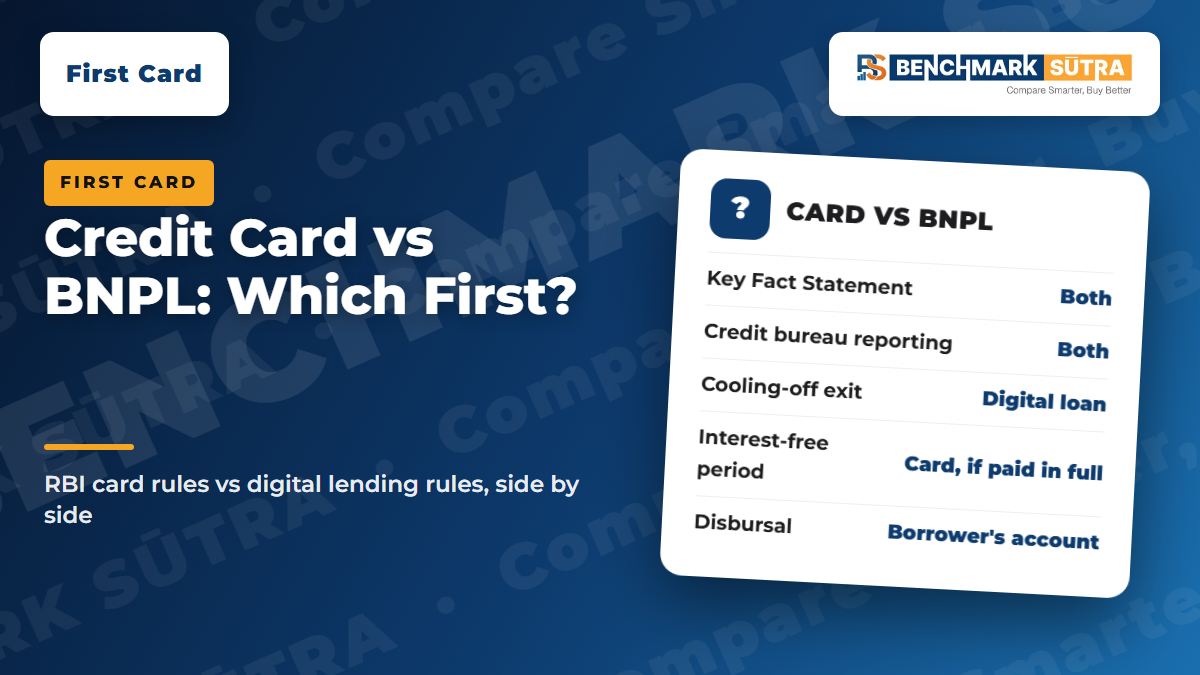
Point | Credit card | BNPL (digital loan) |
|---|---|---|
Who lends | A bank or card issuer | A regulated lender, often through an app or partner |
Key RBI document | Credit Cards and Debit Cards Directions, 2025 | Digital Lending Directions, 2025 |
Interest-free period | Yes, if you pay the full outstanding by the due date | Depends on the lender's offer; read the Key Fact Statement |
Disclosure | Key Fact Statement with application; MITC at onboarding | Key Fact Statement; APR shown |
Credit reporting | Reported to credit bureaus | Digital lending must be reported, whatever the tenor |
Cooling-off exit | Not part of the card Directions we read | Exit by paying principal and proportionate APR; at least one day |
New to cards? Start withcredit card 101and the honestpros and cons of having a card.
Is a Credit Card Better Than BNPL?
Better, in the sense of clearer rules and more options, yes. A credit card is a revolving line from a bank. RBI's RBI, Credit Cards and Debit Cards: Issuance and Conduct Directions, 2025 (updated as on 1 October 2026) shapes how it must be run. The points that matter for a first-timer:
The interest-free credit period runs from the transaction date to the payment due date, subject to full payment of the outstanding amount.
That interest-free period is suspended if any balance from the previous bill is outstanding. The MITC must explain this.
Interest is levied only on the outstanding amount, adjusted for payments, refunds and reversed transactions.
Issuers must give you at least a fortnight to pay before interest starts running.
The minimum amount due must be set so there is no negative amortisation; issuers must not capitalise interest or charges on unpaid taxes, levies or charges.
Statements must warn that paying only the minimum every month stretches repayment over months or years.
Annualised Percentage Rates (APR) must be quoted for different situations, with the annual fee shown with equal prominence.
These are strong rights, but only if you pay the full bill. If you carry a balance, the cost can be heavy; seewhy paying the minimum is dangerousandtotal amount due vs minimum amount due.
What Does RBI Require of a BNPL Lender?
The directions we read, the Reserve Bank of India (Digital Lending) Directions, 2025, speak about digital loans from regulated entities. They do not use BNPL as a defined label in the clauses we read, so think of BNPL as a digital loan when you check your rights. Per those Directions:
The lender must provide a Key Fact Statement (KFS) to the borrower.
Where an app shows offers from more than one lender, the comparison must include the APR, the monthly repayment obligation and penal charges (if applicable), with a KFS link for each lender.
A loan must be disbursed into the borrower's own bank account. Third-party disbursal, including the app's own account, is generally barred, with listed exceptions.
The borrower must have an explicit option to exit a digital loan within a cooling-off period by paying the principal and the proportionate APR. The period is set by the lender's Board and cannot be less than one day. A reasonable one-time processing fee may be kept if it was disclosed upfront in the KFS.
Lending through digital apps must be reported to credit information companies, regardless of the nature or tenor of the loan.
The regulated lender remains fully responsible for the acts and omissions of the app or partner it engages.
Data collection must be need-based, with prior and explicit consent and an audit trail. You can restrict use, revoke consent or ask for deletion.
Before a recovery agent contacts a delinquent borrower, the agent's particulars must be sent to the borrower by email or SMS.
If a complaint is rejected, you are dissatisfied, or there is no reply within 30 days, you can escalate through RBI's CMS portal.
Two things to take away. First, you can leave a digital loan within the cooling-off window, which a card does not give you in the same way. Second, the lender, not the app, is the party RBI holds responsible. Find the lender's name before you tap Accept.
Credit Card vs BNPL: Which Should a Professional Choose First?
Your situation | Better fit | Why |
|---|---|---|
Income arrives in lumps; bills are monthly | Credit card | The interest-free period from transaction to due date lets you time payments against receipts |
You want to build a credit history | Credit card, used lightly and paid in full | A card account is reported to bureaus; payment history is what builds the record |
One-off purchase you want to split | Check both; compare the APR in the Key Fact Statement | Card EMI and BNPL both carry interest or fees; use theEMI calculatorto compare |
You tend to overspend | Neither until you set a limit | Both let you spend before you pay; set a monthly cap first |
You have no card and are not yet eligible | BNPL may be an option, with the lender and KFS checked | Read the KFS and the exit terms, and seewhy cards get rejectedfirst |
The tools help here. Put the purchase through thecredit card interest calculatorto see what a missed payment costs, and compare it with the APR the BNPL lender shows in its KFS. For how a card differs from a debit card, seecredit card vs debit card.
Checklist: Before You Pick Either One
Find the name of the regulated lender behind the product, not just the app's brand.
Read the Key Fact Statement. Note the APR, fees and penal charges.
For a card, read the MITC: interest-free period, late fee, forex markup and cash advance cost.
Write down the due date and set an auto-debit or a reminder; seehow the grace period works.
Cap your monthly use at an amount you can pay in full from your next receipt.
Check the exit terms: for a digital loan, the cooling-off period and any one-time processing fee.
Keep screenshots of the offer and the confirmation.
Do not give a lender access to data it does not need. RBI says collection must be need-based and consent-based.
Common Mistakes to Avoid
Assuming BNPL is free because it says "pay later".The KFS shows the APR and charges. Late payment can add penal charges.
Assuming BNPL stays off your credit record.RBI says digital lending must be reported, whatever the tenor.
Paying only the minimum on a card.The statement warning exists for a reason.
Ignoring the lender's identity.Complaints go to the regulated lender, not the app.
Calling a card EMI "no-cost" without checking.RBI's card Directions say interest-bearing EMIs shall not be camouflaged as zero-interest or no-cost EMI. Seecredit card EMI explained.
Using both at once to stretch spending.Two sets of due dates double the chance of a missed payment.
Related on benchmarksutra
FAQs
Is a credit card better than Buy Now Pay Later?
For most first-time users, yes, because RBI's card Directions set out the interest-free period, the MITC and the minimum due rules. A BNPL product is a digital loan, so check the lender's Key Fact Statement and APR.
Does BNPL affect my credit score?
RBI's Digital Lending Directions require lending through digital apps to be reported to credit information companies, regardless of the nature or tenor of the loan. How it moves your score depends on how you repay.
Can I cancel a BNPL loan after taking it?
Under the Digital Lending Directions, you have an option to exit during a cooling-off period by paying the principal and the proportionate APR. The period is at least one day, and a disclosed one-time processing fee may apply.
Where does BNPL money go?
RBI's Directions say a digital loan must be disbursed into the borrower's bank account, with listed exceptions. Check what the lender's KFS says for your product.
Do I get a Key Fact Statement for a credit card?
Yes. RBI requires a one-page Key Fact Statement along with the credit card application, and the MITC at onboarding.
Which is safer for a first-time user?
Neither is safe if you do not pay on time. The card gives you clearer published rules and an interest-free period if you pay in full; a digital loan gives you a cooling-off exit.
Can a freelancer or professional get a card first?
Eligibility depends on the issuer. See our guide on getting a card as a freelancer for what to prepare.
Official Sources and Editorial Note
This article is written from official sources and does not rely on third-party wording.