Do credit cards give reward points on GST payments? Usually no. We read HDFC and RBL terms for what earns, what is excluded and what fees apply.
Quick Verdict
Do credit cards give reward points on GST payments? Usually not.Where a bank publishes the rule, tax and government payments are on the no-reward list, and the one exception we could read in writing is a set of HDFC Bank business cards. Treat any reward on a GST challan as a bonus you have confirmed, not something to plan around.
Here is our view after reading the terms. If you pay GST or advance tax on a card hoping for points, the official documents mostly say you will earn nothing, and some banks add a fee on utility-type spends on top. The only reason to put a tax payment on a card is the interest-free float, and only if you clear the full bill on time. As of November 2026 that is the honest picture forcredit card rewards on GST payment. We researched the documents; we did not test GST payments on any card.
Question | Short answer (as of November 2026) |
|---|---|
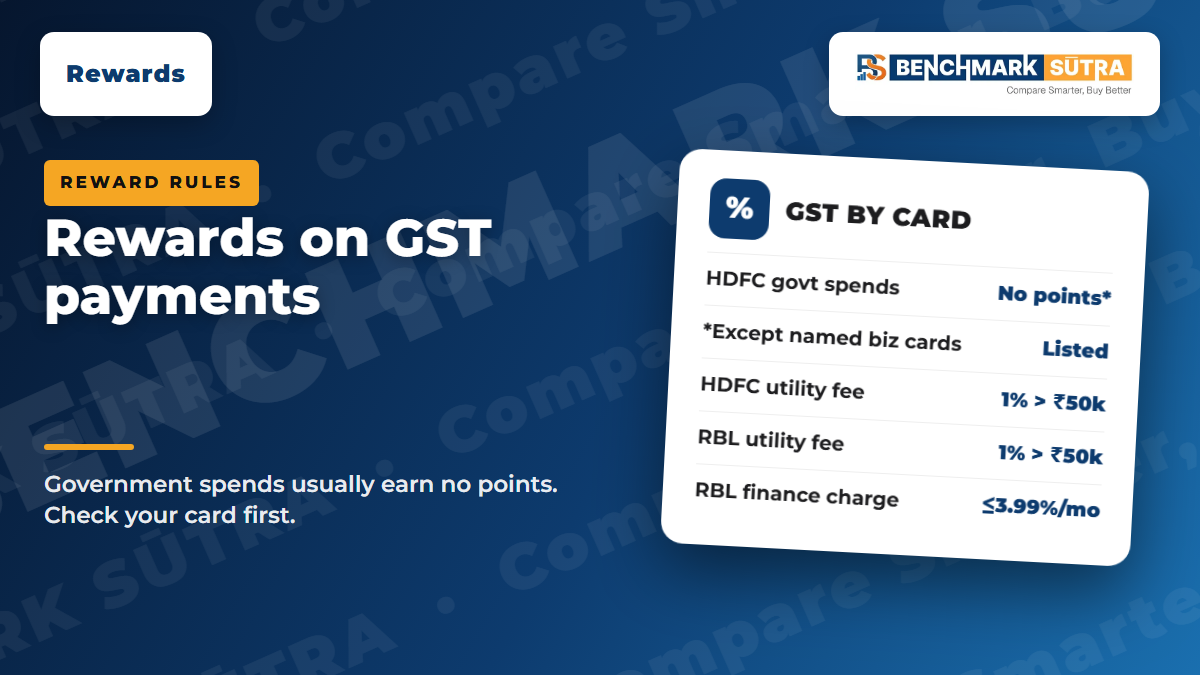
Do GST and government payments earn points? | HDFC MITC v4.18 (October 2026): government-related transactions earn nothing on all cards except listed business cards. RBL excludes "Government Services" on cards we checked. |
Do business cards earn more? | Only where the bank says so. HDFC lists named business cards as exceptions; check your own card's terms. |
Can a fee apply? | Some banks charge 1% on utilities above a monthly limit. HDFC: above ₹50,000 (consumer) or ₹75,000 (business). RBL: above ₹50,000 a month. |
What decides it? | The merchant category code (MCC) the payment is booked under, plus the card's own exclusion list. |
What do we suggest? | Read the exclusion list before paying; use the card only for float, and pay the full bill by the due date. |
Try it with your own numbers:Credit Card Reward Value Calculator
Why Do GST and Tax Payments Usually Earn No Points?
Reward engines work on categories, not on what you meant to buy. Every card payment arrives at the bank tagged with a four-digit merchant category code set by the card network. RBL says so plainly in its Schedule of Charges: the merchant category codes "are defined by the network", and the bank does not define them. We explain how that tagging works in our guide tomerchant category codes.
Government and tax payments sit in a category that many banks list among the exclusions. We could not open the GST portal's payment help page during research (it returned an error), so we cannot tell you which MCC your GST challan will carry. The category is set by the payment gateway and acquirer, not by you. Check the modes the challan screen offers, and treat the first payment as a test of whether points arrive.
The same logic is behind the problem we cover inwhy you sometimes earn zero reward points. A payment that looks like shopping to you can look like government revenue to the bank.
What the Banks' Own Documents Say
HDFC Bank: the clearest written rule
HDFC's Most Important Terms and Conditions (version 4.18, dated October 2026) lists reward exclusions in one block. The wording is: "Government related transactions will not earn Reward Points/CashPoints on all the cards except" a named list that starts with BizBlack Metal, BizPower, BizGrow, Micro Enterprise Card, BizFirst, GIGA Business, Business Regalia, Business Regalia First, Business Money Back and CSC small business moneyback. The list continues past what we reproduce here, so read the full clause for your own card.
The same block says rent payments earn nothing on all cards, and education payments through third-party apps earn nothing. It also caps points on groceries, utilities and telecom. If you hold a consumer HDFC card such as Regalia or Millennia, the written rule says a government payment earns nothing.
RBL Bank: government spends sit on the exclusion list
On RBL's Platinum Maxima Plus page, the categories that earn no points or milestone benefit include fuel and auto, utilities, insurance, education, government services and cash. Its cashback and rewards cards (Cookies, Apex, Shoprite) carry similar exclusion lists. RBL's page does not say how it codes a GST challan, so the same MCC caveat applies.
SBI Card and others: read the card's own reward terms
SBI Card's MITC lists fees such as 1% on utilities above ₹50,000 in a billing cycle, but in the sections we could read it did not state a reward rule for tax or government payments. We are not going to guess. Look up the reward terms for your exact card on the issuer's site, and if the page does not say, ask the bank in writing.
Bank (document) | What it says on government/tax payments | Fee on related spends |
|---|---|---|
HDFC Bank (MITC v4.18, Oct 2026) | No points on all cards except named business cards | 1% on utility spends above ₹50,000 a month (consumer) or ₹75,000 (business), capped at ₹4,999 a month |
RBL Bank (product page and Schedule of Charges) | Government services excluded from rewards on cards checked | 1% on utility spends above ₹50,000 a month |
SBI Card (MITC) | Not stated in the sections we could read | 1% on utilities above ₹50,000 a billing cycle |
Can a Business Card Earn Rewards on GST?
This is the question CAs, lawyers and doctors with a practice ask most. The answer is that a business card may be treated differently, but only if the bank says so. HDFC's exception list for government-related transactions is the clearest example we found in writing. It is a list of named cards, not a general rule for "business" cards.
Two other points. First, HDFC's MITC also records that a charge for vendor, utility or GST payments through its SmartHub Vyapar module was discontinued on business cards from February 2024, so older advice about that route is out of date. Second, a business card does not change your tax treatment. Whether you can claim input credit on what you pay is a question for your CA, not for a card issuer.
If you are a freelancer or small business choosing a card for work spends, our guides ongetting a credit card as a freelancerandIDFC FIRST Business Max vs Multipliercover the eligibility side.
What Does a GST Payment on a Card Actually Cost or Earn?
Take a ₹2,00,000 GST payment. The table shows the arithmetic under three situations. The 1% reward rate is an assumption for illustration only; it is not a rate any bank promises on tax payments. Use thereward value calculatorto test your own card.
Situation | Reward | Fee or interest | Net effect |
|---|---|---|---|
Card excludes government spends | ₹0 | None, full bill paid on time | You gain only the interest-free float |
Hypothetical 1% reward, if your card pays it | ₹2,000 | None, full bill paid on time | ₹2,000 gain, but only if your terms say so |
Bill not paid in full (RBL finance charge up to 3.99% a month) | ₹0 or ₹2,000 | Up to 3.99% a month on the unpaid part, plus GST | Interest can wipe out any reward within a month |
RBL's Schedule of Charges (version dated 4 June 2026) states finance charges of up to 3.99% a month, or 47.88% a year, plus 18% GST on charges. Other banks publish their own rates. The lesson is simple: a tax payment on a card is a float trade, not a rewards trade.
Where Do Business Spends Still Earn?
Ordinary purchases from vendors that are coded as retail, software, travel or dining, if your card does not exclude them.
Category-based accelerated rates, within the monthly caps the card states (for example, HDFC caps points on groceries, utilities and telecom).
Cashback cards that pay on listed brands only, within their monthly cap.
Read the exclusion list line by line. Banks often exclude fuel, rent, wallet loads, insurance, education and government payments in one breath, and that is where business owners lose points. Also note that RBI's Directions require reward benefits to be provided "in a transparent manner including source of such benefits", with detailed information displayed on the card-issuer's website (paragraph 72). That means the exclusion list should be on the bank's site, and you are entitled to look for it.
Checklist
Open your card's reward terms and search for "government", "tax", "utilities" and "exclusion".
Note any monthly cap or fee on utility-type spends.
Make one small payment first and see whether points are credited on the next statement.
Check if your card is a named business card in the bank's exception list.
Set an auto-debit for the full statement amount so the float is not lost to interest.
Keep the challan and statement together for your CA.
Common Mistakes to Avoid
Assuming a 5X or 10X category rate applies because the payment feels like a "business" spend.
Paying a large tax bill on a card and carrying the balance, where interest costs more than any reward.
Ignoring the 1% fee some banks charge on utility spends above a monthly limit.
Reading old advice. Rules such as the HDFC exclusions carry effective dates, and the MITC is revised.
Treating a bank's rewards-portal promise as a guarantee for tax payments. Ask for it in writing.
Related on benchmarksutra
FAQs
Do credit cards give reward points on GST payments?
Usually not. HDFC's MITC (v4.18, October 2026) says government-related transactions earn no points on all cards except a named list of business cards, and RBL lists government services as excluded on the cards we checked. Confirm with your own card's terms.
Can I pay GST with a credit card at all?
The GST portal lists the payment modes on its challan payment screen. We could not open its payment help page during research, so check the modes shown when you generate the challan.
Do HDFC business cards earn points on government payments?
HDFC names certain business cards, such as BizBlack Metal, BizPower and Business Regalia, as exceptions to its no-reward rule for government-related transactions. The list is in the MITC and runs longer than we quote, so check your card.
Why did my GST payment earn no points even though my card has a high rewards rate?
The accelerated rate applies to specific merchant categories. A payment coded as government or tax typically falls outside them, and the bank applies the exclusion list. See our explainer on merchant category codes.
Is there a fee for paying utilities or business bills by card?
Some banks charge 1% above a monthly limit. HDFC charges it above ₹50,000 for consumer cards and ₹75,000 for business cards, capped at ₹4,999 a month. RBL charges 1% above ₹50,000 a month.
Is the float worth it for a tax payment?
Only if you pay the full statement by the due date. If you carry a balance, finance charges, up to 3.99% a month at RBL, will cost more than any float benefit.
Where do the banks have to publish reward rules?
RBI's Directions (paragraph 72) require card benefits to be provided transparently, with detailed information displayed on the card-issuer's website and a copy given to the cardholder.
Official Sources and Editorial Note
Credit Cards and Debit Cards: Issuance and Conduct Directions, 2025 (updated as on 1 October 2026)
HDFC Bank: Most Important Terms and Conditions (MITC), version 4.18, October 2026
This article is written from official sources and does not rely on third-party wording.