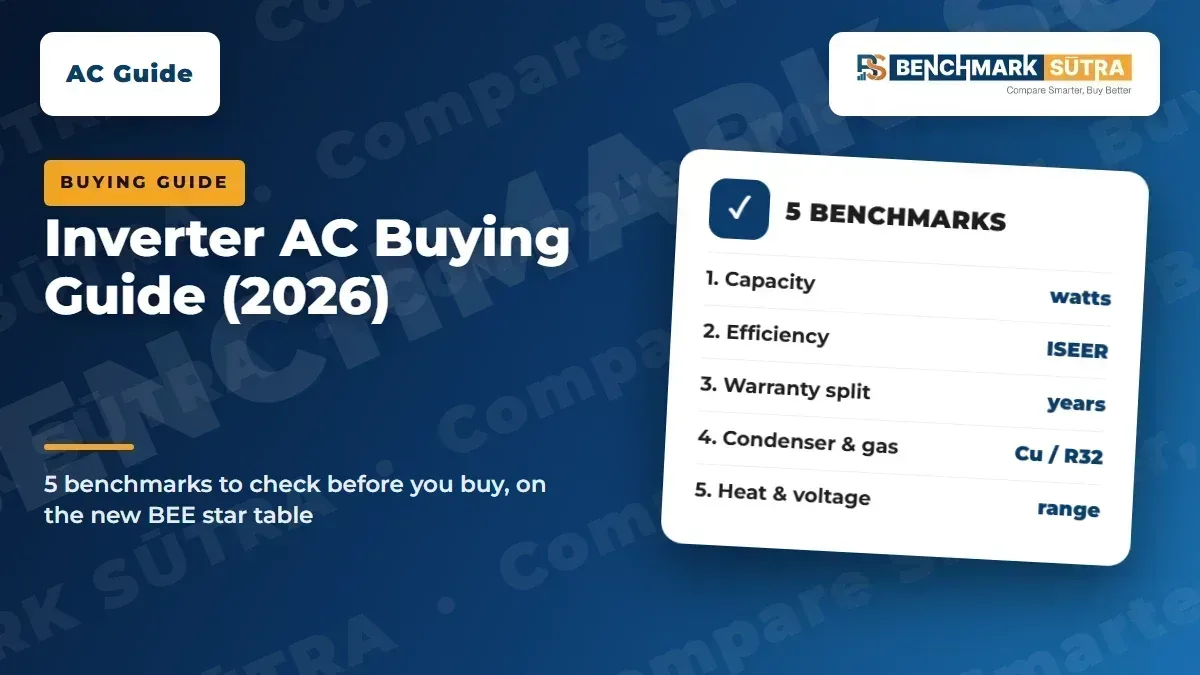
Check five things before you buy an inverter AC: rated watts, ISEER on the 2026 BEE table, the warranty split, condenser and refrigerant, and heat and voltage range.
Quick Verdict
Buy on five benchmarks in order: rated cooling in watts, ISEER on the 2026 BEE table, product/compressor/PCB warranty, condenser and refrigerant, and operating range. Compare ISEER, not stars, across label years.
Best For
First-time and repeat AC buyers who want a checklist before shortlisting models.
Avoid If
You already know your room size and want specific models; see the best AC lists instead.
Quick Verdict
This inverter AC buying guide for India comes down to five benchmarks, checked in order: rated cooling capacity in watts, ISEER on the 2026 BEE table, the warranty split, the condenser and refrigerant, and the operating range for heat and voltage. Get capacity right first; no star rating fixes an AC that is too small for the room.
The biggest change for 2026 buyers: BEE raised the split AC star bands on 1 January 2026. A 5-star split now needs an ISEER of 5.60 or more (it was 5.00), and a 3-star needs 4.30 (it was 3.80). Stars on older stock are not comparable with new ones, so compare ISEER numbers.
Benchmark | What to read | Where to find it | What good looks like |
|---|---|---|---|
1. Capacity | Rated cooling in watts, and the min–max range | Brand spec sheet, BEE label | Matched to your room's heat load, not to the ton label |
2. Efficiency | ISEER and label year | BEE label, brand spec sheet | 2026 label; ISEER 4.30+ (3 star) or 5.60+ (5 star) |
3. Warranty | Product, compressor and PCB years | Brand product page, warranty card | Each term stated separately and in writing |
4. Condenser and refrigerant | Coil material, refrigerant type | Brand spec sheet | Stated plainly (for example "100% copper", "R32") |
5. Operating range | Maximum outdoor temperature, voltage range | Brand spec sheet, manual | Covers your city's peak heat and your home's voltage |
How we researched this:Researched, not hands-on tested. Based on BEE star-label data and official manufacturer specifications checked on 5 November 2026.
Prices change frequently. The prices on this page were correct when we wrote and checked it, but they may have changed by the time you read this. Check the current price on the retailer's page before you buy.
Benchmark 1: How much cooling capacity do you need?
Capacity comes first. One ton of cooling is 3.5 kW (12,000 BTU per hour), so a 1-ton AC delivers about 3.5 kW and a 1.5-ton about 5.3 kW.
Brands round these figures, and the gaps are large. In the 2026 3-star models we checked, three ACs sold as "1.5 ton" are rated as follows:
LG AS-Q18DNXE: 4,400 W rated (LG India).
Samsung AR60H18D13W: 4,750 W rated, which Samsung itself calls 1.35 ton (Samsung India).
Blue Star IA318MXU: 5,100 W rated, which Blue Star calls 1.45 ton (Blue Star).
That is a 16% spread between models sold under the same label. Read the rated watts on the spec sheet or BEE label.
An inverter AC also lists a range. Blue Star gives 2,038 to 5,315 W for the IA318MXU; Samsung gives 1.2 to 5.5 kW for the AR60H18D13W. The low end lets the AC run gently once the room is cool; the high end is the short burst it can deliver on the hottest afternoon.
Room size alone does not settle the answer. Sun exposure, a top floor, poor insulation and the number of people all add heat. OurAC Tonnage Calculatortakes these into account, and our1 ton vs 1.5 ton AC guidecovers the borderline cases.
Benchmark 2: What do ISEER and the 2026 star bands mean?
ISEER (Indian Seasonal Energy Efficiency Ratio) is the cooling an AC delivers over a year divided by the electricity it uses. BEE's schedule for inverter ACs calculates it across outdoor temperatures from 24°C to 43°C over 1,600 cooling hours a year. Higher is better. Our explainerwhat is ISEERgoes deeper.
What ISEER does each star rating need in 2026?
Star | Split AC ISEER, 2021 to 2025 | Split AC ISEER, 1 Jan 2026 to 31 Dec 2027 | Split AC ISEER, 1 Jan 2028 to 31 Dec 2029 |
|---|---|---|---|
1 star | 3.30 to 3.49 | 3.50 to 3.79 | 3.80 to 4.29 |
2 star | 3.50 to 3.79 | 3.80 to 4.29 | 4.30 to 4.69 |
3 star | 3.80 to 4.39 | 4.30 to 4.99 | 4.70 to 5.19 |
4 star | 4.40 to 4.99 | 5.00 to 5.59 | 5.20 to 5.79 |
5 star | 5.00 and above | 5.60 and above | 5.80 and above |
Source: Ministry of Power notifications S.O. 3897(E) (2019), S.O. 2794(E) (2024) and S.O. 3984(E) (2025). The 2025 notice also bars 1-star ratings for inverter (variable-capacity) split ACs in 2028 and 2029.
So a 2025 "5-star" with an ISEER of 5.2 would be 4 star today, and a 2025 "3-star" at 3.9 would be 2 star. Discounted older stock is not wrong to buy, but judge it by its ISEER.
Is 5-star worth the extra money?
It depends on hours of use. For the same cooling, electricity use scales with 1 ÷ ISEER. A 5-star at 5.60 uses about 23% less than a 3-star at 4.30, because 1 − 4.30 ÷ 5.60 = 0.23.
A worked example: if the 3-star uses 1,200 units a year (an assumed figure; the BEE label shows each model's own rating), the 5-star saves about 1,200 × 0.23 = 276 units. At an assumed tariff of ₹8/kWh, that is 276 × ₹8 = ₹2,208 a year. Divide the price gap between the two models by that figure to get the payback in years. Our3-star vs 5-star AC guideruns more scenarios.
Benchmark 3: How should you read the warranty?
Split every warranty into three terms: the whole product, the compressor and the PCB (the control board). Brands differ a lot, and a headline "10-year warranty" usually covers only the compressor. Three examples from brand pages:
Samsung(the two 2026 Bespoke AI models we checked): 5 years comprehensive (1 year standard plus 4 years extended) and 10 years on the compressor.
Blue Star(2026 M and N Series): 10 years on the inverter compressor and 5 years on the PCB, each under its own terms.
Voltas(warranty policy page): 9 more years on the compressor of inverter ACs after the first-year warranty ends.
Ask the seller to show the product, compressor and PCB terms for the exact model, and keep the invoice and warranty card. Gas refill, installation faults and damage from voltage or misuse are usually treated separately, so read the exclusions.
Benchmark 4: Which condenser and refrigerant should you look for?
Check that the spec sheet states the condenser coil material. Brands that use copper say so: Blue Star lists "100% Copper" for its 2026 M Series, and LG lists "100% Copper Tubes" for the AS-Q18DNXE. If the sheet is silent, ask. Ourcopper vs alloy condenser guideexplains the trade-offs.
Most current inverter splits use R32. Samsung's spec sheet lists R32 as a fluorinated greenhouse gas with a global warming potential (GWP) of 675. The refrigerant type matters most at service time, since the technician must refill with the same gas.
Benchmark 5: Will it handle your heat and your voltage?
Two numbers decide whether an AC copes with Indian conditions: the highest outdoor temperature it is rated to cool at, and the voltage range it accepts. Samsung and Blue Star both rate the 2026 models above for cooling at outdoor temperatures up to 52°C. If your city regularly crosses that, or your terrace unit sits in direct sun, choose more capacity.
For voltage, find the operating range in the spec sheet or manual and compare it with your home's supply. If your voltage stays inside it, a stabilizer adds cost without benefit; if it often drops or spikes outside it, you need one. Our guidedoes an AC need a stabilizerlists brand ranges.
One more setting worth knowing: since 1 January 2020, BEE-labelled room ACs must ship with a default temperature of 24°C.
Which inverter AC should you choose?
Small bedroom or study, moderate use:a 1-ton (about 3.5 kW) 3-star on the 2026 label. A 5-star pays back only if it runs most nights.
Medium bedroom:a 1.5-ton-class AC; compare rated watts, since "1.5 ton" models range from about 4.4 kW to 5.1 kW.
Top floor, west-facing or hot city:the highest rated watts in your budget, and a 52°C cooling rating.
Heavy daily use (8+ hours):the highest ISEER you can afford; run the payback maths above with your own hours.
Firm budget:see ourbest AC under ₹40,000list, which compares current models on these same benchmarks.
Checklist
Room heat load estimated, and rated cooling in watts noted for each model.
BEE label year checked: 2026 for current star bands.
ISEER written down for each model you compare.
Product, compressor and PCB warranty years confirmed in writing.
Condenser material and refrigerant stated on the spec sheet.
Maximum operating temperature and voltage range checked against your home.
Installation, extra piping and outdoor stand charges asked for upfront.
Service centre coverage in your pincode confirmed on the brand site.
Common Mistakes to Avoid
Choosing by the ton label.Two "1.5-ton" ACs can differ by 700 W of cooling.
Comparing stars across label years.The 2026 table moved every band up.
Paying for 5 star on light use.Savings scale with hours; at a few hours a night the payback can take years.
Reading "10-year warranty" as full cover.It is usually the compressor only.
Skipping the voltage range.Either you buy a stabilizer you do not need or you go without one you do.
Ignoring installation.Extra piping, stands and wiring add to the bill; ask for these charges before the technician arrives.
Related on benchmarksutra
Best 1.5 Ton 3 Star Inverter AC in India (2026): 6 Value Picks
Best AC Temperature for Sleep: 24°C vs 18°C and India's Rules
Hidden Costs of Buying an AC in India: 2026 Installation Charges
Inverter vs Dual Inverter vs Triple Inverter AC: What Differs?
FAQs
What should I check before buying an inverter AC in India?
Five things, in order: rated cooling in watts, ISEER on the 2026 BEE label, the product, compressor and PCB warranty terms, the condenser and refrigerant, and the operating temperature and voltage range.
What ISEER should a 5-star AC have in 2026?
For split ACs, 5.60 or more under BEE's table valid from 1 January 2026 to 31 December 2027. From 2028 the 5-star threshold rises to 5.80.
Is a 3-star inverter AC good enough?
For moderate use, yes. A 2026 3-star split needs an ISEER of at least 4.30, up from 3.80 before 2026.
Why does a "1.5 ton" AC show 4.4 kW or 4.75 kW on the spec sheet?
Brands round capacity to marketing ton labels. One ton is 3.5 kW, so a true 1.5 ton is about 5.3 kW; compare the rated watts.
Does an inverter AC need a stabilizer?
Only if your supply voltage goes outside the range in the AC's spec sheet or manual. Inside that range, a stabilizer is not needed.
Which refrigerant do most new inverter ACs use?
R32 in the 2026 models we checked from Samsung, Blue Star and LG. Samsung lists its GWP as 675.
Is a 10-year AC warranty full cover?
Usually not. In the brand terms we checked, the 10-year term applies to the compressor; the product and PCB have shorter terms.
What temperature should I set my AC to?
BEE-labelled ACs have shipped with a 24°C default since 2020. Each degree lower makes the AC work harder.
Official Sources and Editorial Note
Data checked as of: 5 November 2026
Ministry of Power notification S.O. 2794(E), 16 July 2024 (split AC star table from 1 January 2026)
https://beestarlabel.com/Content/Notification/RAC/IAC_Notification_SO_4634_E_dated_16th_July_2024.pdf
Ministry of Power notification S.O. 3984(E), 28 August 2025 (2026 table to 2027; 2028–2029 table)
https://beestarlabel.com/Content/Notification/RAC/IAC_Notification_SO_3984_E_dated_28th_Auguest_2025.pdf
Ministry of Power notification S.O. 3897(E), 29 October 2019 (2021–2025 table; 24°C default setting)
https://beestarlabel.com/Content/Notification/RAC/IAC_Notification_SO_3897_E_dated_29th_October_2019.pdf
BEE Schedule 19, variable capacity (inverter) air conditioners: ISEER method
https://www.beestarlabel.com/content/files/inverter%20ac%20schedule%20final.pdf
Samsung India: Bespoke AI WindFree AR60H18D13W specifications and warranty
https://www.samsung.com/in/air-conditioners/split-ac/bespoke-ai-windfree-inverter-split-ac-4-8-kw-3-star-ar60h18d13wnna/
Blue Star: IA318MXU specifications and warranty
https://consumer.bluestarindia.com/products/inverter-ac-m-series-1-5-ton-3-star-2026-bee-label
LG India: AS-Q18DNXE specifications
https://www.lg.com/in/air-conditioners/split-air-conditioners/as-q18dnxe/
Voltas: product warranty terms
https://www.voltas.com/pages/terms-conditions-product-warranty
Prices change often; check the retailer before you buy. This article is benchmarksutra's own research and does not rely on any other review site's scores or wording.