DPD means days past due. See how it is counted from the statement due date, worked ₹ card examples, RBI's new 3-day rule from April 2027 and how to fix wrong entries.
Quick Verdict
DPD means days past due: the number of days a payment has stayed unpaid after the due date printed on your credit card statement. It is counted from that due date, not from the statement date, and it shows up month by month in the payment history of your credit report.
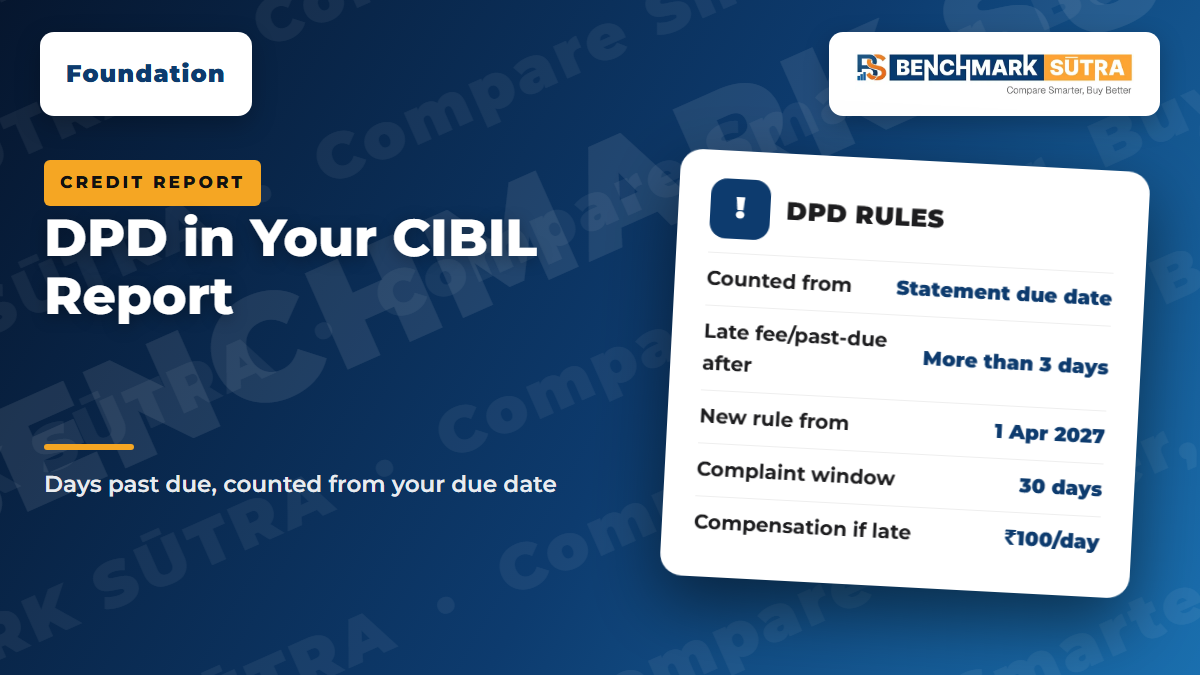
One short delay can leave a mark, but a pattern of 30, 60 or 90 days past due does far more harm. The good news from RBI's latest rules: from 1 April 2027, a card account can be reported as past due, or charged late fees, only after it stays unpaid for more than three days.
Term | Meaning |
|---|---|
DPD | Days since the due date on the statement that the payment is still unpaid |
Counted from | Payment due date in the statement (RBI Credit Cards Directions, para 23(5)) |
Where it appears | Monthly payment history on your credit report |
New 3-day rule | Past-due reporting and late fees only after more than 3 days (from 1 April 2027) |
What Does DPD Mean in a Credit Report?
Our reading of the RBI text: DPD is the one number in your report that cannot be argued with, because it is pure arithmetic on a date you can see on your statement. If your due date is 25 November and the money reaches the bank on 28 November, you are three days past due on that bill.
RBI's Credit Cards and Debit Cards Directions (updated 1 October 2026) say the number of days past due and late payment charges are computed from the payment due date mentioned in the credit card statement. RBI's credit information directions also tell lenders that accounts whose only change is in days past due must still form part of the reporting. So a card that slips from 0 to 15 to 45 days past due will be reported each time, even if nothing else changes.
Lenders also alert you. The RBI reporting directions require lenders to send SMS or email alerts about default or days-past-due status where contact details are available, so keep your registered phone and email current.
DPD Worked Examples on a Credit Card
Take a card with a statement dated 5 November, total amount due ₹40,000, minimum amount due ₹2,000, and a due date of 25 November. Here is what different payment dates mean.
You pay | Amount | Days past due | What it means |
|---|---|---|---|
On or before 25 Nov | ₹40,000 | 0 | Paid in full, no interest, clean record |
On 25 Nov | ₹2,000 (minimum) | 0 for the minimum | Minimum met; interest charged on the balance (see our TAD vs MAD guide) |
On 28 Nov | ₹2,000 | 3 (after 25 Nov) | Late by 3 days; the 3-day tolerance applies from 1 April 2027 |
On 10 Dec | ₹2,000 | 15 | 15 days past due; a late fee and a bureau mark are likely |
On 24 Dec | ₹2,000 | 29 | Just under 30; still shown as late |
On 26 Dec | ₹2,000 | 31 | Now in the 30-plus bracket |
Notice that paying less than the minimum amount due leaves the account past due even if you paid ₹1,500. Paying the minimum on time stops DPD from building, though it leaves interest running. Read total amount due vs minimum amount due and why the minimum is dangerous before you rely on it.
A late fee example helps with scale. If the bank charges a late fee of ₹750 on a ₹40,000 outstanding, and 3.5% monthly interest accrues on the balance after the grace period is lost, a 15-day delay costs the fee plus about half a month of interest on ₹40,000, which is roughly ₹700. Both numbers are illustrations; use your own card's fee schedule.
The New Three-Day Rule From 1 April 2027
RBI amended para 23(5) of the Credit Cards Directions on 27 April 2026. The rule says an issuer can report a card account as past due to a credit information company, or levy late payment charges, only when the account remains past due for more than three days, and the days are still computed from the due date on the statement. It applies from 1 April 2027.
Two cautions. First, this is a tolerance for reporting and fees, not a longer due date. Interest on unpaid balances is a separate matter and follows your card's terms. Second, until 1 April 2027 your bank's current practice applies, so do not plan around a three-day buffer today.
How DPD Affects Your Score
No bureau or RBI document gives a points table for 15, 30 or 60 days past due, and we will not invent one. What the bureaus do say is that payment history is a core factor. Experian lists payment history first among the factors that drive its score, and says poor repayment history lowers it.
From the structure of the data, the practical ranking is easy to see: a single account at 3 or 5 days late once in three years is a small blemish, while repeated lateness and anything stretching to 60 or 90 days looks like stress. Longer delays also lead the bank to start its default process, and settlement or write-off follows if the account is never cleared (see settled vs closed).
If your score has already dipped, our CIBIL score guide covers what lenders look at, and common beginner mistakes lists the habits that create DPD in the first place.
How to Read and Fix DPD on Your Report
Download your free full credit report; each credit information company must give one free report a year, with the score, on request after authentication.
Find the card account and look at the monthly payment history. Match each DPD figure to your statement due date and the date the payment reached the bank.
If a payment was made on time but shows as late, collect the bank statement and file a complaint with the lender or the bureau.
If the complaint is not resolved in 30 calendar days, RBI's directions entitle you to ₹100 per calendar day of compensation.
Set up auto-debit for at least the minimum due. See auto-debit explained.
Checklist
Know your due date on every card (it is not the statement date).
Keep the payment source funded two days before the due date.
Pay at least the minimum amount due, every cycle.
Keep your mobile number and email current with the bank for DPD alerts.
Check your report every quarter using one bureau at a time.
Common Mistakes to Avoid
Counting from the statement date. DPD runs from the due date.
Paying a little less than the minimum. Even ₹100 short means past due.
Relying on the 3-day rule today. It starts on 1 April 2027.
Paying on the last evening via a slow channel. The date the bank receives it counts.
Ignoring a wrong DPD entry. The complaint clock only starts when you file.
FAQs
What does DPD mean in a CIBIL report?
DPD stands for days past due. It is the number of days a payment remained unpaid after its due date, shown month by month in your payment history.
From which date is DPD counted on a credit card?
RBI's Credit Cards Directions say days past due are computed from the payment due date in the credit card statement.
Is one day late reported to the bureau?
Today it can be, depending on the bank. From 1 April 2027 RBI allows past-due reporting only after more than three days.
Does paying the minimum amount due avoid DPD?
Paying at least the minimum by the due date keeps the account from becoming past due, although interest continues on the unpaid balance.
How can I dispute a wrong DPD entry?
File a complaint with your lender or the credit information company. If it is unresolved in 30 calendar days you are entitled to ₹100 per calendar day.
Will the bank tell me when I am past due?
RBI's reporting directions require SMS or email alerts about default or days-past-due status where contact details are available.
How often is my DPD updated at the bureau?
Lenders submit data to credit information companies on fixed reference dates each month; the RBI NBFC reporting text lists the 9th, 16th, 23rd and last day of the month.
Official Sources and Editorial Note
Data checked as of: November 2026
RBI Credit Cards and Debit Cards Directions 2025, as updated 1 October 2026 (para 23(5))
https://www.rbi.org.in/Scripts/NotificationUser.aspx?Id=13155&Mode=0
RBI Credit Information Companies Directions 2025, as updated 1 July 2026 (para 15, para 21(7), para 41)
https://www.rbi.org.in/Scripts/BS_ViewMasDirections.aspx?id=12926
RBI Credit Information Reporting Directions for NBFCs, 2025 (reporting dates para 10(2), alerts para 34)
https://www.rbi.org.in/Scripts/BS_ViewMasDirections.aspx?id=12955
Experian India: what is your credit score
https://www.experian.in/2022/04/17/what-is-your-credit-score/
This article is written from official sources and does not rely on third-party wording.
The 3-day rule's 1 April 2027 start date is from the 27 April 2026 amendment as summarised in our brief; read para 23(5) on rbi.org.in for the exact wording. The reporting reference dates are from the NBFC text; the bank version may differ.
Editorial note:
Rules, bureau policies and bank terms change. Worked ₹ examples are illustrations, not predictions of your score. This is general information, not financial advice; confirm with your bank and bureau before acting.