What RBI says happens to an unused credit card, whether it still charges fees, and how closing or keeping it affects your utilisation and credit age, with ₹ examples.
Quick Verdict
An inactive credit card is not free to keep, and RBI has rules for what the bank can do with it. If a card has not been used for more than a year, the issuer must write to you, and if you do not reply within 30 days it closes the account. Annual fees can still apply in the meantime, because fee waivers usually depend on spending you are not doing.
The simplest choices are to use the card a little, or close it yourself. Closing it has a small effect on utilisation and credit age that you can work out in advance.
Situation | RBI rule (Credit Cards Directions, 2025) |
|---|---|
Card never activated, 30 days after issue | Bank must seek OTP consent to activate; without consent it closes the account at no cost within 7 working days (para 11(6)) |
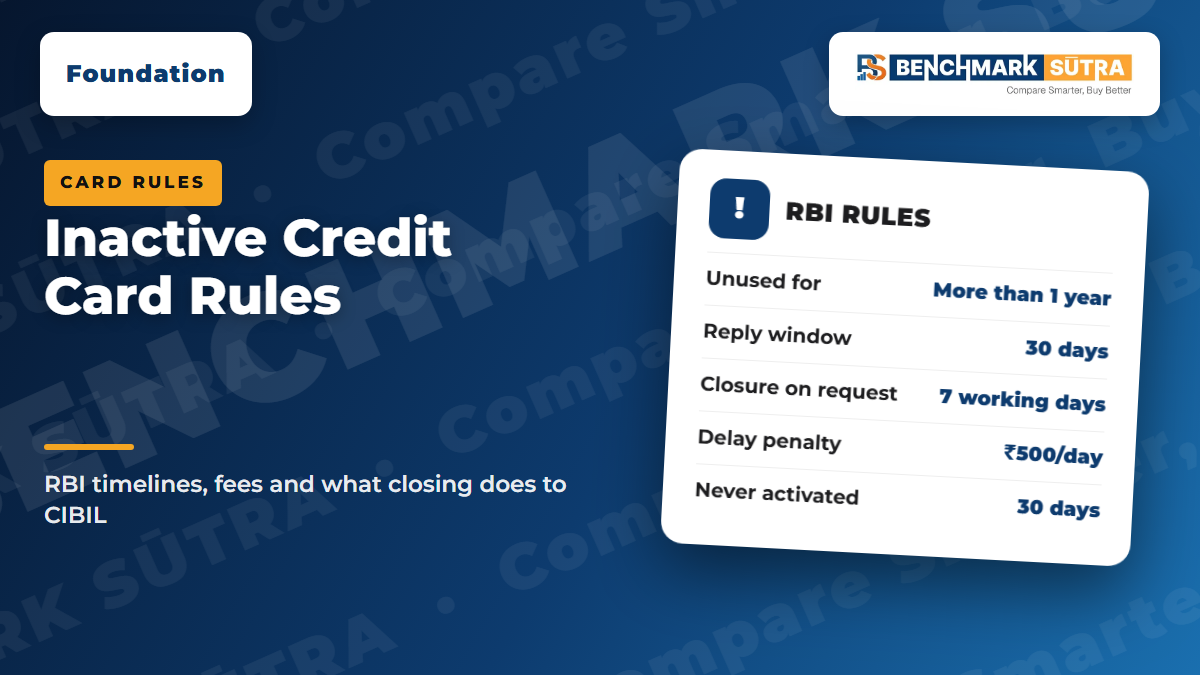
Card unused for more than a year | Bank notifies you; no reply in 30 days means the account is closed (para 20) |
You ask to close | Closed within 7 working days, or ₹500 per day of delay payable to you (para 19) |
What Counts as an Inactive Credit Card?
Our view after reading the Directions: RBI treats two different cases and many people mix them up. A card you never activated is one case. A card you activated and later stopped using is another. Both have a defined end.
RBI's Credit Cards and Debit Cards Directions (updated 1 October 2026) say that if a card has not been activated by the customer for more than 30 days from the date of issue, the issuer must seek OTP-based consent to activate it, and if consent is not given it must close the account within seven working days, without cost to the customer (para 11(6)). If an activated card has not been used for more than one year, the issuer must write to you, and if no reply comes within 30 days the card account is closed (para 20).
This is a regulator rule for credit cards issued under these Directions. Co-brand and lifetime-free cards fall under the same rules, but check your own card's terms for anything the bank adds on top.
Do Inactive Cards Still Charge Fees?
The honest answer is: it depends on the card, and the RBI rule does not stop the fee before the year is up. A fee charged while the card is open is a bank decision under your card's terms. Waivers are usually tied to spend, which an unused card cannot meet.
Take the HDFC Freedom card from our Freedom vs Bharat comparison. It carries a ₹500 plus taxes annual fee that is waived on ₹50,000 of yearly spend. If you never use it, the waiver never triggers and the fee applies. Over three idle years that is ₹1,500 plus GST for a card you do not use.
Card type | Annual fee | Waiver spend | Cost of 3 idle years (before GST) |
|---|---|---|---|
Entry-level fee card (example) | ₹500 | ₹50,000 a year | ₹1,500 |
Mid-tier fee card (example) | ₹1,000 | ₹1,00,000 a year | ₹3,000 |
Lifetime-free card | ₹0 | None | ₹0 |
Read how fee waivers work and annual fee vs joining fee for the details, then check the schedule of charges for your own card. Our annual fee breakeven calculator shows how much spend it takes to justify any fee.
What an Inactive Card Does to Your CIBIL Score
A card you never use contributes a limit and an age. The limit reduces your overall utilisation, and the age adds to your credit history length. Experian's consumer pages list credit age and credit accounts among the score's inputs, and say the closer balances are to limits the bigger the effect on the score.
The cost of idleness is the fee. The cost of closing is a smaller total limit. Put numbers on it: if you hold two cards with ₹1,00,000 and ₹50,000 limits and carry a ₹30,000 balance on the first, utilisation is 20 per cent (₹30,000 of ₹1,50,000). Closing the ₹50,000 card pushes it to 30 per cent (₹30,000 of ₹1,00,000). The score effect depends on the bureau's model, which no regulator publishes.
When a card is closed, RBI says the issuer must also report the closure to the credit information companies. See our closing maths for the full comparison.
Keep It Alive or Let It Close?
Lifetime-free card with a decent limit: keep it alive with one small recurring bill (say ₹200 on a subscription) paid in full each month. This avoids the one-year inactivity closure.
Annual-fee card you will never use: close it yourself; you are paying for the limit.
A card you might want as a back-up: test whether the fee is worth it with the breakeven calculator before deciding.
Card you never activated: you do not need to do anything; RBI's 30-day rule means the bank must close it if you do not consent.
If you do keep it, protect it. Use auto-debit so the small bill is always paid on time. A missed payment on a card you barely use can cost more than the fee.
How to Close an Inactive Card Properly
Pay the outstanding balance and any pending fee, EMI or charge.
Redeem or use reward points; points are normally forfeited at closure, so check your card's terms.
Cancel any auto-debits or recurring merchant mandates tied to the card.
Send a closure request through the bank's own channel and keep the reference number.
The bank must honour the request within seven working days; if it does not, you are entitled to ₹500 per calendar day of delay (para 19).
Check the account shows as closed at the bureaus after the next reporting cycle.
Checklist
List every card you hold and when you last used each.
Check each fee and its waiver condition.
Decide keep, use or close for every card.
Set one small monthly bill on any card you keep.
Close annual-fee cards you will not use, with a written request.
Check your report 30 to 45 days after a closure.
Common Mistakes to Avoid
Assuming an inactive card costs nothing. Fee waivers depend on spend.
Ignoring the bank's notice. No reply within 30 days means the card is closed.
Closing with a pending EMI or balance. Clear everything first.
Letting a recurring bill fail on a card you forgot. It can create a late mark.
Closing the oldest card first. It carries your credit age.
FAQs
What happens if I do not use my credit card for a year?
RBI's Credit Cards Directions say the issuer must notify you, and if you do not reply within 30 days it closes the card account.
Can a bank close my unused card without asking?
Only after notice. For a card unused for more than a year it must write to you and wait 30 days for a reply; for a card never activated it must seek your OTP consent first.
Do I pay an annual fee on a card I never use?
Usually yes, if your card has one and the waiver depends on spend. Check your card's schedule of charges.
Does an inactive card affect my CIBIL score?
It adds to your total limit and credit age, which can help utilisation, but the effect size is not published. Closing it removes both.
How long does a bank have to close a card on request?
Seven working days; for delays the bank pays ₹500 per calendar day to the cardholder.
What if I never activated the card?
Per RBI, the bank must seek OTP consent after 30 days and, without it, close the account within seven working days at no cost to you.
Is the closure reported to the bureaus?
Yes. RBI says the issuer must report the closure of the card account to the credit information companies.
Official Sources and Editorial Note
Data checked as of: November 2026
RBI Credit Cards and Debit Cards Directions 2025, as updated 1 October 2026 (paras 11(6), 19, 20)
https://www.rbi.org.in/Scripts/NotificationUser.aspx?Id=13155&Mode=0
Experian India: what is your credit score
https://www.experian.in/2022/04/17/what-is-your-credit-score/
Experian India: credit utilisation and credit score pressure
https://www.experian.in/2023/05/31/do-you-exhaust-your-credit-card-limit-often-your-credit-score-could-come-under-pressure/
HDFC Bank Freedom Credit Card page (fee example, via our comparison)
https://www.hdfc.bank.in/credit-cards/freedom-credit-card
This article is written from official sources and does not rely on third-party wording.
Fee examples use the HDFC Freedom ₹500 fee and ₹50,000 waiver quoted in our 4 November comparison; other examples are illustrations. Check your own card's schedule of charges.
Editorial note:
Rules, bureau policies and bank terms change. Worked ₹ examples are illustrations, not predictions of your score. This is general information, not financial advice; confirm with your bank and bureau before acting.