Two 27-inch QHD QD-OLED gaming monitors compared on stand, ports, price and the burn-in terms each maker documents in India.
Quick Verdict
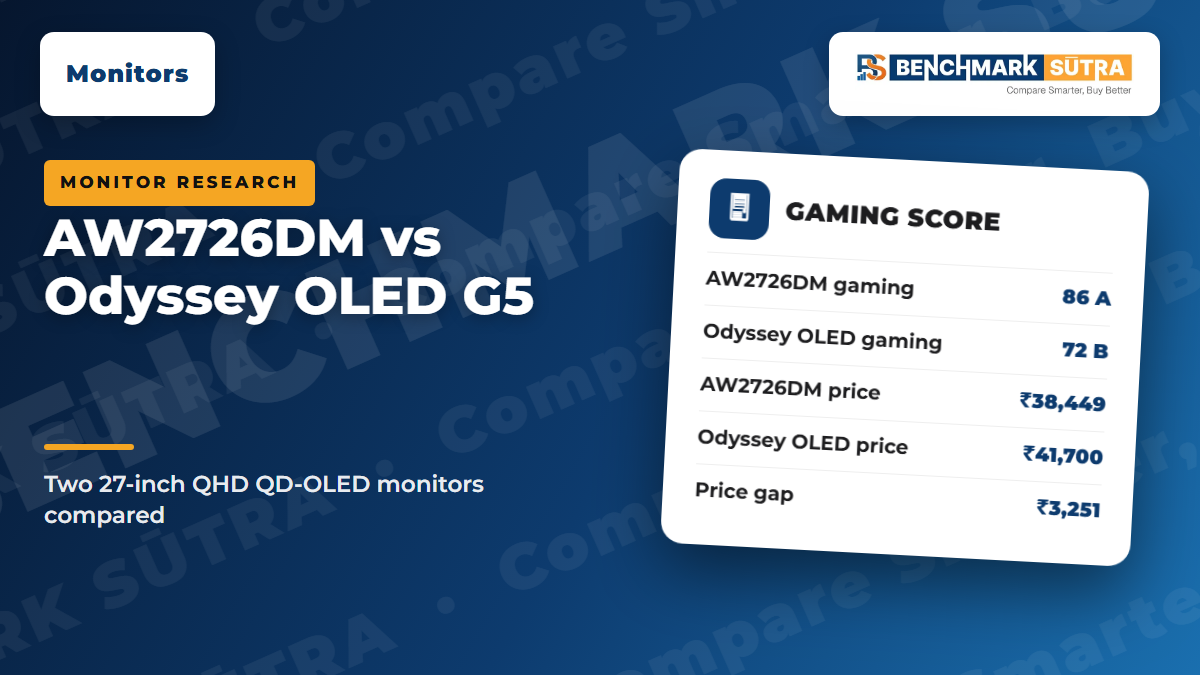
The Alienware AW2726DM is the better buy: 86 A against 72 B on the gaming profile and 82 A against 67 C on the general profile, for ₹3,251 less (₹38,449 against ₹41,700). Both are QHD QD-OLED panels with 0.03 ms GtG and 99% DCI-P3 claims, but the Dell runs at 240 Hz against 180 Hz, has a stand with height, swivel and pivot, two HDMI 2.1 ports and Dell India's documented three-year burn-in cover with Premium Panel Exchange. The Samsung's tilt-only stand and older ports cost it the comparison.
Researched, not hands-on tested.Prices checked 6 November 2026. Every figure below is the maker's published claim or a retailer listing where the maker is silent; we did not measure brightness, colour or response time. Scores are our own editorial ratings of those specs, explained in ourMonitor Score method.
Alienware AW2726DM | Samsung Odyssey OLED G5 (G50SF) | |
|---|---|---|
Gaming score · tier | 86 A | 72 B |
General score · tier | 82 A | 67 C |
Price (retailer) | ₹38,449 (Flipkart) | ₹41,700 (Flipkart) |
Prices change frequently. The prices on this page were correct when we wrote and checked it, but they may have changed by the time you read this. Check the current price on the retailer's page before you buy.
Side-by-side specs
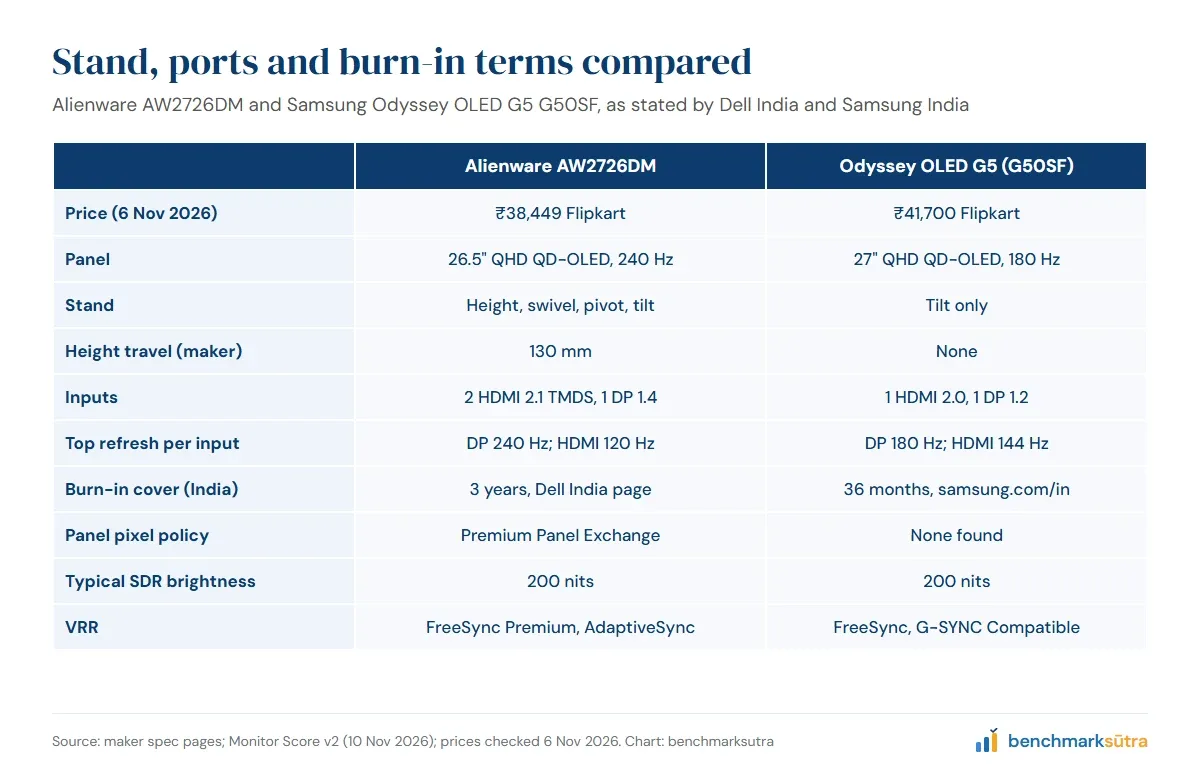
Spec | Alienware AW2726DM | Samsung Odyssey OLED G5 (G50SF) |
|---|---|---|
Panel | 26.5" QHD QD-OLED, 240 Hz | 27" QHD QD-OLED, 180 Hz |
Response time (maker) | Dell rates it at 0.03 ms GtG | Samsung rates it at 0.03 ms GtG |
Colour gamut (maker) | 99% DCI-P3 | 99% DCI-P3 |
Brightness / contrast | 200 nits typical SDR; 1,500,000:1 dynamic | 200 nits typical SDR; 1,000,000:1 static |
HDR and VRR | HDR supported (no VESA tier on Dell India page); FreeSync Premium, VESA AdaptiveSync | HDR10; FreeSync, G-SYNC Compatible |
Stand | Height 130 mm, swivel, pivot, tilt | Tilt only |
Inputs | 2 HDMI 2.1 TMDS (up to 2560x1440 at 120 Hz), 1 DisplayPort 1.4 (240 Hz, DSC) | 1 HDMI 2.0 (up to 144 Hz), 1 DisplayPort 1.2 (up to 180 Hz) |
VESA mount | 100 x 100 mm | 100 x 100 mm |
India warranty | 3 years Advanced Exchange with Premium Panel Exchange; 3-year OLED burn-in warranty (Dell India) | 36 months; burn-in at normal usage covered, excluding commercial use, abuse and misuse (samsung.com/in) |
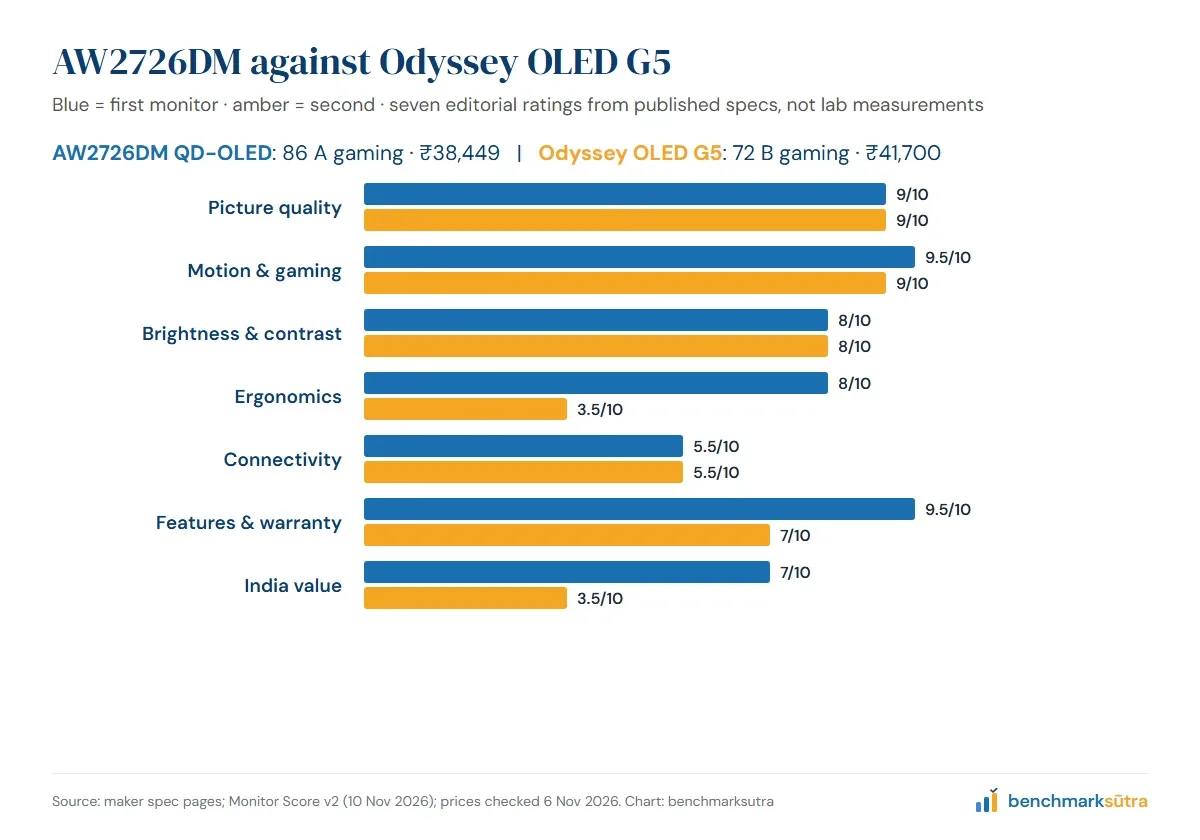
Row by row
Picture quality: 9 against 9
A tie. Both are QHD QD-OLED panels with 99% DCI-P3 claims, at about 111 pixels per inch on the 26.5-inch Dell and 109 on the 27-inch Samsung. Neither earns a True Black tier credit or a calibration report. Dell's India page lists HDR as supported without a VESA DisplayHDR tier, and Samsung lists HDR10, so neither gets HDR credit.
Motion and gaming: 9.5 against 9
Both list 0.03 ms GtG, which earns the OLED bonus. Dell's 240 Hz scores 8 before the bonus; Samsung's 180 Hz scores 7.5. The refresh rate also depends on the port. Dell lists 240 Hz over DisplayPort and 120 Hz at QHD over HDMI 2.1; Samsung lists 180 Hz over DisplayPort 1.2 and 144 Hz over HDMI 2.0. Dell lists FreeSync Premium and VESA AdaptiveSync; Samsung lists FreeSync and G-SYNC Compatible, a small point in its favour if you use an NVIDIA card.
Brightness and contrast: 8 against 8
Both list 200 nits typical SDR, which is below the 250-nit threshold in our OLED rules, and neither lists a True Black tier. Contrast claims differ in method: Dell states 1,500,000:1 dynamic and Samsung 1,000,000:1 static, so do not compare them as like for like. In practice both suit dim rooms better than bright ones.
Ergonomics: 8 against 3.5
The widest gap. Dell lists 130 mm of height travel with swivel and pivot; Samsung's stand only tilts. That is 4.5 points of rating, and ergonomics carries 10 points of the gaming profile and 15 of the general profile. Both use a 100 x 100 mm VESA pattern, so a monitor arm fixes the Samsung's stand, but it is another purchase.
Connectivity: 5.5 against 5.5
Dell lists two HDMI ports described as HDMI 2.1 over TMDS (not full-bandwidth HDMI 2.1, so our v2 rules give them no HDMI 2.1 credit) and a DisplayPort 1.4; Samsung lists one HDMI 2.0 and a DisplayPort 1.2. For a PC the Dell's DisplayPort does 240 Hz; for a console the Dell's HDMI reaches 120 Hz at QHD, while the Samsung's HDMI 2.0 tops out at 144 Hz. Neither has a USB hub, KVM or USB-C video.
Features and warranty: 9.5 against 7
Both document three years of cover in India. Dell lists Advanced Exchange, Premium Panel Exchange (free panel replacement even for one bright pixel) and a three-year OLED burn-in warranty on its India page. Samsung India says burn-in at normal usage is covered for 36 months and excludes commercial use, abuse and misuse. We found no stated pixel policy for the Samsung. Dell's other QD-OLED, the 32-inch S3225QC, is different: its Dell Store India page does not mention burn-in, so do not assume the AW2726DM's cover applies to other Dell OLEDs.
India value: 7 against 3.5
The Dell costs ₹38,449 and the Samsung ₹41,700, so the better monitor is also ₹3,251 cheaper. Amazon.in showed ₹39,799 for the Dell the same day, so the Flipkart price was lower by ₹1,350; confirm the seller and invoice.
What the OLED premium buys over IPS
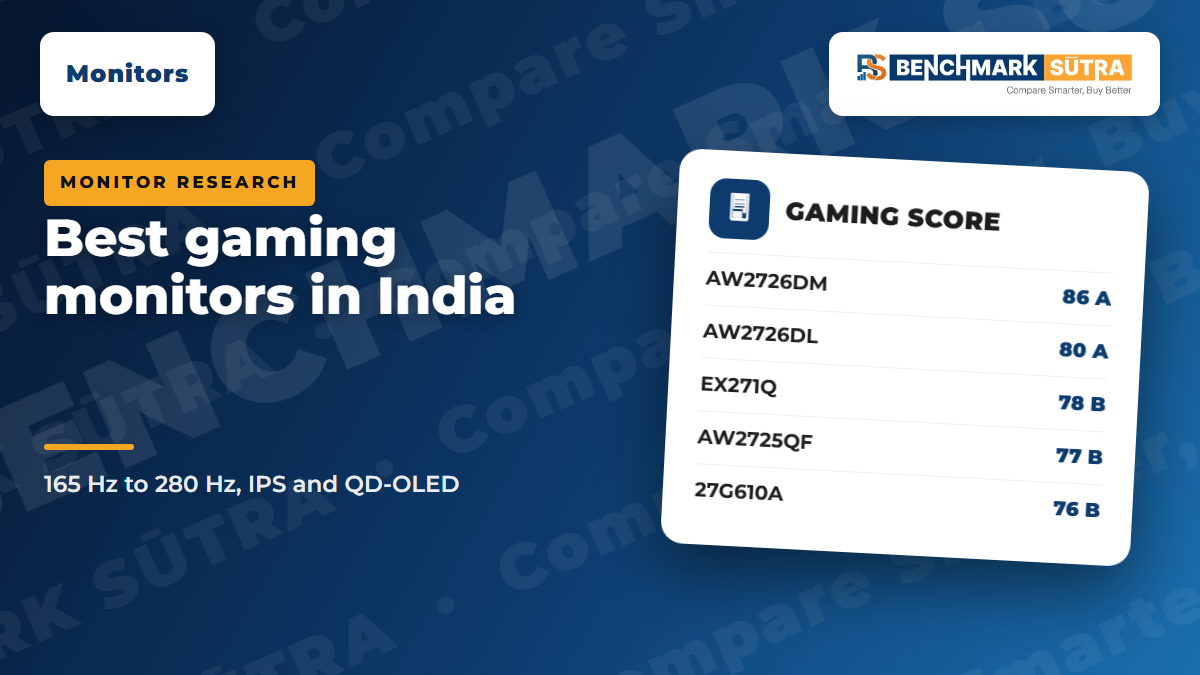
The cheapest way to 280 Hz in our data is the Alienware AW2726DL, a QHD IPS at ₹20,999 that scores 80 A on the gaming profile. The AW2726DM costs ₹17,450 more and scores 86 A, buying 0.03 ms GtG pixel response, deeper contrast and 99% DCI-P3, and costing brightness (200 nits against the IPS's 400). Whether that trade is worth it depends on your room and your games, not on a score alone. We have not tested either panel; every figure is the maker's claim.
Which should you buy?
Choose the Alienware AW2726DM ifyou want the best QD-OLED in this price band, a stand that adjusts, 240 Hz over DisplayPort and Dell's documented burn-in cover.Choose the Samsung Odyssey OLED G5 only ifyou prefer its 27-inch size, need G-SYNC Compatible branding, or find it at a clearly lower price from an authorised seller. At ₹41,700 we cannot find a reason in the data.
For the wider picture, see ourbest gaming monitors in Indiaguide.
How we score
The benchmarksutra Monitor Score rates every monitor on seven rows out of 10: Picture quality, Motion & gaming, Brightness & contrast, Ergonomics, Connectivity, Features & warranty and India value. Each buyer profile then weights those rows differently, and the score is the weighted sum shown as a whole number out of 100. This guide uses the gaming and general profile: on gaming, Motion & gaming 35, Picture quality 15 and India value 15; on general, Picture quality 20 and the other rows between 10 and 15. Read the full rules inbenchmarksutra Monitor Score: how we rate monitorsand ourhow we review productspage.
Brightness, contrast, response time and colour gamut are the maker's claims; we write "Dell rates it at" or "Samsung lists", never "it measures". Where a retailer listing contradicts the maker, the maker wins. Where the maker publishes nothing we say so rather than guess.
Related on benchmarksutra
Frequently asked questions
Which is better, the Alienware AW2726DM or the Samsung Odyssey OLED G5?
The Alienware, at 86 A against 72 B on our gaming profile, and it costs ₹3,251 less.
Do both monitors have burn-in cover in India?
Both documents say so: Dell India lists a three-year OLED burn-in warranty, and Samsung India says burn-in at normal usage is covered for 36 months, with exclusions for commercial use, abuse and misuse. Read the terms for your use case.
Is 200 nits enough?
For a dim or curtained room, yes. In a bright room these OLEDs are harder to see than a 400-nit IPS such as the Alienware AW2726DL or LG 27G610A.
Can the Samsung run at 180 Hz over HDMI?
No. Samsung lists 180 Hz over DisplayPort 1.2 and 144 Hz over HDMI 2.0.
Is 26.5 inches too small?
It is a different panel size from the usual 27 inches but sits at about 111 pixels per inch, so text sharpness is nearly identical to the 27-inch Samsung.
Related monitor guides
Best Gaming Monitors in India: 165 Hz to 280 Hz, IPS and OLED
Samsung Odyssey G5 (G53F) vs ASUS TUF VG27AQ5A: QHD Gaming Monitor
Official sources
Specifications are attributed to the maker pages above. Retailer links in the price lines are the exact listings we checked on 6 November 2026; they are plain links with no affiliate tracking. Prices change daily, so recheck before you buy and confirm the exact model code and an authorised India invoice. benchmarksutra does not reuse any other site's scores or test results.