What credit card settlement means, how settled differs from closed on your credit report, what RBI says banks must do, and the ₹ cost of settling versus repaying.
Quick Verdict
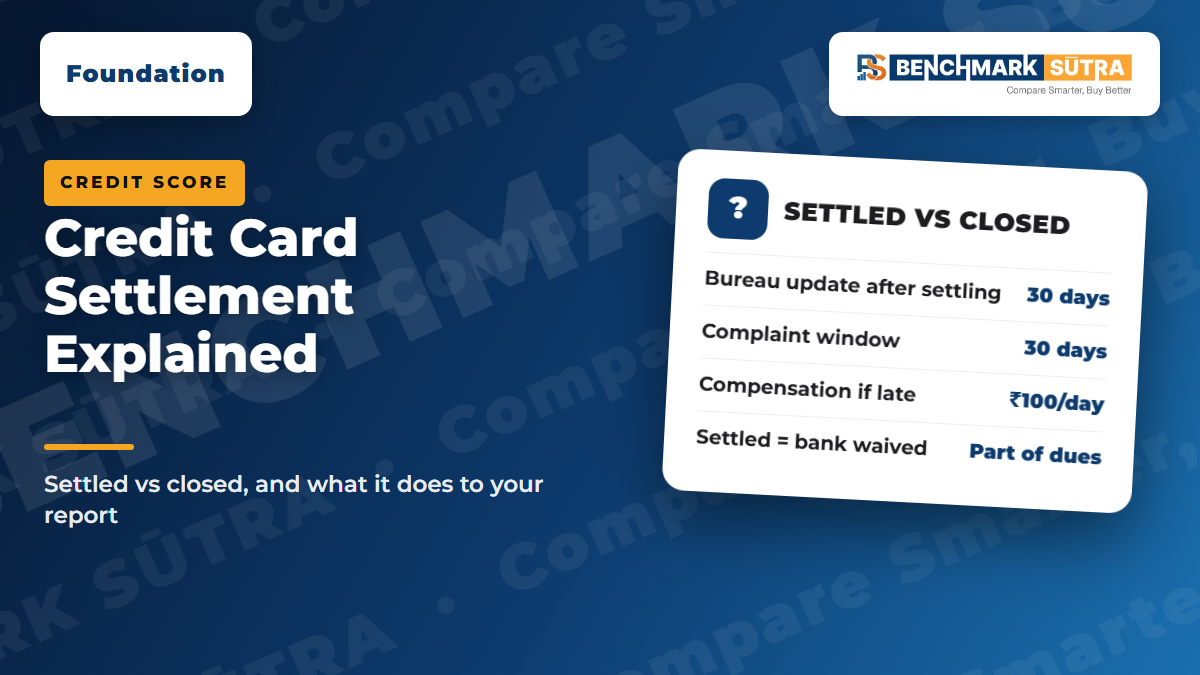
Credit card settlement means your bank agrees to accept less than the full outstanding and treat the account as resolved. It is not the same as paying in full: the account is reported as “settled”, not “closed”, and future lenders can see the difference on your credit report.
Settlement is a last resort for people who genuinely cannot repay. If you can pay the full amount over time, even through an instalment plan, you keep a cleaner record. RBI's own reporting rules reserve “settled” for waivers given because of financial inability, which tells you how lenders read it.
Question | Short answer |
|---|---|
Settled vs closed | Closed = paid in full. Settled = lender took less and waived the rest. |
Does it hurt the report? | Yes. The status stays visible and lenders read it as a waiver. |
How fast must the bank update the bureau? | Within 30 days of settlement (RBI Credit Cards Directions, para 36). |
Can a settled status be changed? | Only if the entry is wrong, or the lender agrees to a different status after dues are cleared. |
What a Credit Card Settlement Really Is
The point of view we take after reading the Directions: settlement is a negotiated loss for the bank, and the credit report is how that loss is recorded. A card account that is paid in full ends as “closed”. A card account where the bank accepted ₹70,000 against ₹1,20,000 ends as “settled”, and the ₹50,000 gap is what the lender waived.
RBI's credit information reporting directions say a lender should use the “settled” status only where, because of financial inability to repay on the original terms, a principal or interest waiver (or both) is given. The same text says disputed charges or wrong debits must be reported as “disputed”, not as settled. So a genuine billing error should never end up as a settlement on your record.
This article is about the cardholder side: what the process looks like, what the status does to your credit report, and what you can still fix. We have not tested any bank's settlement desk; everything below comes from RBI text and bureau pages.
How the Settlement Process Works
RBI's Credit Cards and Debit Cards Directions (updated 1 October 2026) do not lay out a settlement procedure. What they do regulate is the reporting around it. The practical sequence, as far as official text supports it, is:
Dues build up. You stop paying and the account runs past due. Before reporting you as a defaulter to a credit information company, the issuer has to follow its board-approved policy and tell you first (para 36).
You ask for a settlement offer. Do this in writing, by email or through the bank's customer care channel, and keep the reference.
The bank names a figure and a payment date. Get the amount and the effect on your account status in writing before you pay.
You pay the agreed amount. Pay only through the bank's own channels and keep proof.
The bank updates the bureau. If you were already reported as a defaulter, the issuer must update the status with the credit information company within 30 days from the date of settlement (para 36).
Ask the bank for a settlement letter showing the outstanding, the amount accepted and the waived balance. That letter is your evidence if the bureau entry is later wrong.
Settled vs Closed: What Changes on Your Report
Credit reports list each account with its status. For a cleared account, the status is either closed or settled, and that one word is what a lender reads first.
Paid in full | Settled | |
|---|---|---|
Example | Outstanding ₹1,20,000, you pay ₹1,20,000 | Outstanding ₹1,20,000, bank accepts ₹70,000 |
Waived amount | ₹0 | ₹50,000 |
Status after bureau update | Closed | Settled |
How a lender may read it | Normal closed account | Borrower could not repay the original amount |
RBI wording | Closure to be reported to the bureaus (para 19) | Used only where financial inability led to a waiver |
RBI's Directions do not give a score penalty in points, and no bureau publishes one. Experian's consumer pages say the score depends on payment history, credit age and credit accounts, and that a poor repayment history lowers it. A settled card is by definition a repayment shortfall, so expect the score to carry the damage of the earlier late payments as well as the status itself.
What Settlement Costs You Beyond the Score
The bigger effect is often on access, not on a number. A loan or card officer reading “settled” on your report sees that a previous lender took a loss. Some lenders decline; others price the loan higher. How your score and report are read depends on each lender's credit policy, and no official source gives a standard waiting period, so we will not quote one.
Run the cost of the alternatives before you choose. Say you owe ₹1,20,000. A settlement at ₹70,000 saves ₹50,000 today. But if the settled status leads to a ₹10,00,000 loan being priced 1 percentage point higher over five years, that is roughly ₹30,000 in extra interest on a standard EMI schedule. The saving is real, and so is the cost on the other side.
Compare it with repaying on instalments. Use the credit card payoff calculator to see how long a fixed monthly payment takes, and read how card EMI conversion works before you assume it is cheaper. Our minimum amount due explainer shows why paying the minimum is the slowest way out.
Can You Fix a Settled Status?
There are two situations, and they are different.
The status is wrong
If you paid in full but the bureau still shows “settled”, or the amounts do not match your letter, raise a complaint. Under RBI's Credit Information Companies Directions, a complaint can be filed with the lender or the credit information company. If it is not resolved in 30 calendar days, you are entitled to compensation of ₹100 per calendar day (para 41). The lender gets 21 of those days and the bureau the rest.
The status is correct, but you have since paid the balance
If you settled and later pay the waived balance, ask the lender in writing whether it will update the account to reflect full payment, and whether it will give a no-dues certificate. Whether it agrees is the lender's call; we found no official rule that forces a settled account to be converted. Do not pay a “credit repair” agent for this. The only legitimate routes are the lender and the bureau complaint process.
Checklist
Try a repayment plan or EMI conversion before asking for settlement.
Get the settlement amount, the waived amount and the final status in writing before paying.
Pay only through the bank's own channels and keep the receipt.
Ask for a settlement letter and a no-dues certificate.
Check the bureau entry about 30 days after payment.
Raise a complaint if the status or amount is wrong; use the 30-day clock.
Check all four bureaus with your free yearly reports (see what score a card needs).
Common Mistakes to Avoid
Paying an agent or collector without paperwork. No letter, no proof.
Assuming settled equals closed. They are different statuses with different readings.
Stopping payments on purpose to get a discount. Late payments and a default report come first, and you do not control the bank's reply.
Ignoring the minimum due while negotiating. Interest and fees keep growing while you wait.
Not rechecking the report. The 30-day update window is your trigger to look.
FAQs
Is credit card settlement good or bad for CIBIL?
It is bad compared with paying in full, because the account shows as settled and the earlier missed payments remain on record. It can still be better than an unresolved default, because it ends the dues.
What is the difference between settled and closed?
Closed means the account was paid in full and shut. Settled means the lender accepted less than the full amount and waived the rest.
How long does the bank take to update the bureau after settlement?
RBI's Credit Cards Directions say the issuer must update the status with the credit information company within 30 days from the date of settlement, where you had already been reported as a defaulter.
Can I get a settled status changed to closed?
Only if the entry is wrong, or the lender agrees to update it after you clear the full balance. Ask the lender in writing; there is no official rule that forces the change.
Does a bank have to tell me before reporting me as a defaulter?
Yes. RBI's Directions require the issuer to follow its approved policy and intimate you before reporting default status to a credit information company.
What can I do if the bureau record is wrong?
File a complaint with the lender or the credit information company. If unresolved within 30 calendar days, you are entitled to ₹100 per calendar day under RBI's directions.
Should I settle or take an EMI plan?
If you can afford a fixed monthly payment, an instalment plan keeps the account out of settled status. Settle only when full repayment is not possible, and get everything in writing.
Official Sources and Editorial Note
Data checked as of: November 2026
RBI Credit Cards and Debit Cards Directions 2025, as updated 1 October 2026 (para 36 reporting, para 19 closure)
https://www.rbi.org.in/Scripts/NotificationUser.aspx?Id=13155&Mode=0
RBI Credit Information Companies Directions 2025, as updated 1 July 2026 (para 41 complaints and compensation)
https://www.rbi.org.in/Scripts/BS_ViewMasDirections.aspx?id=12926
RBI Credit Information Reporting Directions for NBFCs, 2025 (settled status, para 12(4))
https://www.rbi.org.in/Scripts/BS_ViewMasDirections.aspx?id=12955
Experian India: what is your credit score
https://www.experian.in/2022/04/17/what-is-your-credit-score/
This article is written from official sources and does not rely on third-party wording.
The settled-status wording comes from RBI's reporting directions for NBFCs; banks report under their own version of the directions. Check your own bureau report for how your lender coded the account.
Editorial note:
Rules, bureau policies and bank terms change. Worked ₹ examples are illustrations, not predictions of your score. This is general information, not financial advice; confirm with your bank and bureau before acting.