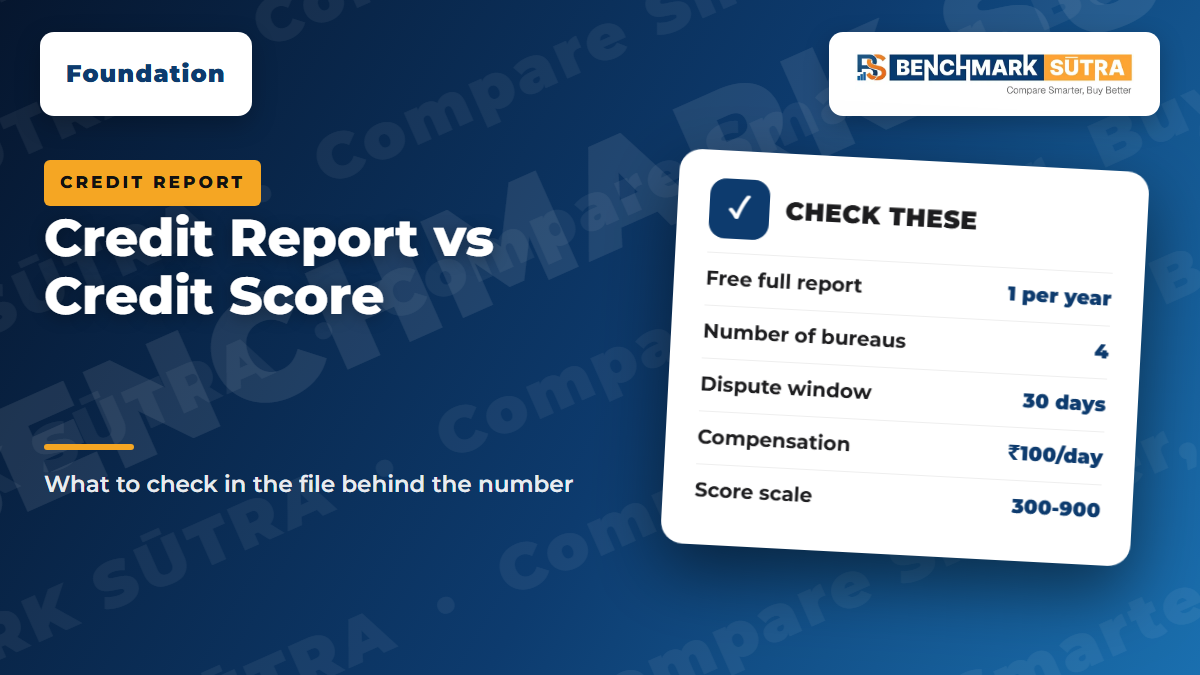
A credit score is one number; a credit report is the evidence. See what to check in your report, how often to pull it, the free report RBI guarantees and how to dispute errors.
Quick Verdict
A credit score is one number from 300 to 900; a credit report is the full file behind it: every account, limit, balance, payment record and enquiry. Lenders read both, and wrong entries hide in the report, not in the score.
Check your full report at least once a year at each bureau using the free report RBI entitles you to, and before every big application. Check the score more often only if it helps you spot a problem.
Credit score | Credit report | |
|---|---|---|
What it is | One number, 300 to 900 | Full list of accounts, payments, limits, balances and enquiries |
Who sets the scale | Calibrated 300 to 900 by each bureau (RBI para 21(7)) | Compiled from data lenders submit |
Errors show up where? | As a lower number, without the reason | As a wrong line you can dispute |
Free? | Included in the free full report | One free full report per bureau each calendar year |
Credit Report vs Credit Score: The Difference
The way we explain it after reading the RBI text: the score is the headline and the report is the evidence. RBI's directions call the free offering a “Free Full Credit Report” that includes the credit score, so even RBI treats them as one package with two layers.
A score can fall for reasons a report explains in minutes: a card that shows a ₹60,000 balance when you paid it, an account that is not yours, or a missed payment shown as days past due. The number alone cannot tell you which one it is.
What to Check in Your Credit Report
Section | What to verify | Red flag |
|---|---|---|
Personal details | Name, PAN, address, phone | A wrong address or an unfamiliar phone |
Accounts | Every card and loan is yours | Accounts you never opened |
Limits and balances | Limit and balance on each card | Balance higher than your statement |
Payment history | Days past due month by month | Late marks on bills you paid on time (see our DPD guide) |
Status | Closed, settled, written off or active | A closed card still showing active |
Enquiries | Which lenders checked you | Checks you did not trigger (see hard vs soft enquiries) |
Take a card with a ₹2,00,000 limit. If the report shows a ₹1,40,000 balance but your bank statement shows ₹40,000, your utilisation looks like 70 per cent instead of 20 per cent. That one wrong line could cost you a card approval. Use our credit utilisation calculator to see what the number should be.
How Often Should You Check?
The free report rule sets the minimum: RBI's Credit Information Companies Directions say each company provides one Free Full Credit Report including the score once at any time in a year (January to December), on request and after authentication. With four bureaus, that is four free reports a year.
Situation | Check |
|---|---|
Every year | One free full report, rotating bureaus |
Before a home, car or personal loan | All four bureaus, 1 to 2 months before applying |
After closing or settling a card | The same bureau about 30 days later (RBI's 30-day update window) |
After you notice an unexpected SMS or alert | Immediately, from the bureau that sent it |
After a rejected application | The report the lender used, if the lender names it |
Lenders report to bureaus on fixed monthly reference dates (the NBFC text names the 9th, 16th, 23rd and last day), so checking daily adds nothing. Equifax's page notes that checking your own report does not harm it, so checking is safe; it is just not useful more often than data changes.
What to Do If You Find an Error
Note the account, the wrong detail and your proof (statement, receipt, no-dues letter).
File a complaint with the lender or the credit information company. RBI's directions let you complain to either, with the lender given 21 of the 30 days.
If unresolved in 30 calendar days, you are entitled to ₹100 per calendar day.
Check again once the bureau confirms the correction.
Repeat at the other three bureaus; errors do not always copy across.
For what a bank asks about your report when you apply, read what CIBIL score a card needs. If your first report looks weak, our guide on how long a score takes to improve lays out what to fix first, and the low CIBIL card guide lists products for damaged profiles.
Reading the Report Like a Lender
A lender looks at the report in a rough order: Is there any late payment or default? How much of your limit are you using? How many new accounts and enquiries are there? Do the numbers match what you declared on the application? A score of 760 with a recent written-off account is a different case from a score of 760 with a clean file, so the report decides the outcome as much as the number.
What the lender sees | Example | Likely reading |
|---|---|---|
Balance vs limit | ₹70,000 on a ₹1,00,000 card | High use, 70 per cent |
Recent enquiries | 4 cards applied for in 3 months | Credit-hungry |
Payment history | One 30-day mark, 2 years old | Old and minor |
Account status | One settled account | Past repayment shortfall |
Link the report to your own habits. Our enquiries guide and CIBIL score guide cover the two readings that most often surprise people.
Checklist
Request one free full report per bureau each year.
Verify name, PAN and address first.
Match every card limit and balance to your latest statement.
Scan payment history for late marks you did not cause.
Look at the enquiries list.
Raise any dispute in writing and keep the reference.
Set a yearly reminder for the next bureau.
Common Mistakes to Avoid
Looking only at the number. The reason is in the report.
Checking the same bureau every time. A wrong entry may be on another.
Paying for repeated scores. One free full report is available per bureau each year.
Not keeping proof. Disputes need statements and letters.
Assuming a fix updates everywhere at once. Verify each bureau.
FAQs
What is the difference between a credit report and a credit score?
The score is a single number from 300 to 900. The report is the full file of accounts, limits, balances, payment history and enquiries that sits behind it.
How often should I check my credit report?
At least once a year, using the free report each bureau must provide, and before any big loan or card application.
Is my first free report really free?
Yes. RBI's directions require each credit information company to provide one free full credit report, including the score, once in a calendar year on request.
Does checking my own report lower my score?
Equifax's page says checking your own credit report will not harm it.
What should I check first in my report?
Your personal details, then whether every account is yours, then limits, balances and any late-payment marks.
What if I find a mistake?
File a complaint with the lender or the bureau and keep proof. If it is unresolved in 30 calendar days you are entitled to ₹100 per calendar day.
Do all four bureaus have the same report?
Not necessarily. Data timing and coverage can differ, so check each bureau.
Official Sources and Editorial Note
Data checked as of: November 2026
RBI Credit Information Companies Directions 2025, as updated 1 July 2026 (para 21(7) free report and scale, para 41 complaints)
https://www.rbi.org.in/Scripts/BS_ViewMasDirections.aspx?id=12926
RBI Credit Information Reporting Directions for NBFCs, 2025 (reporting dates)
https://www.rbi.org.in/Scripts/BS_ViewMasDirections.aspx?id=12955
Equifax India (free report, checking your own report does not harm it)
https://www.equifax.co.in/
Experian India: what is your credit score
https://www.experian.in/2022/04/17/what-is-your-credit-score/
This article is written from official sources and does not rely on third-party wording.
The section list in the report table is our general description of what a credit report lists; check your own report's legend, as layouts differ by bureau.
Editorial note:
Rules, bureau policies and bank terms change. Worked ₹ examples are illustrations, not predictions of your score. This is general information, not financial advice; confirm with your bank and bureau before acting.