A higher limit helps your CIBIL score only through lower utilisation, and only if you do not spend more. See ₹ examples, RBI's consent rule and when it does not help.
Quick Verdict
A credit limit increase can help your CIBIL score indirectly, but only if you do not spend more. It lowers your utilisation, which is one of the factors bureaus use, and does nothing for payment history. If the extra limit tempts you to spend, utilisation goes back up and the benefit disappears.
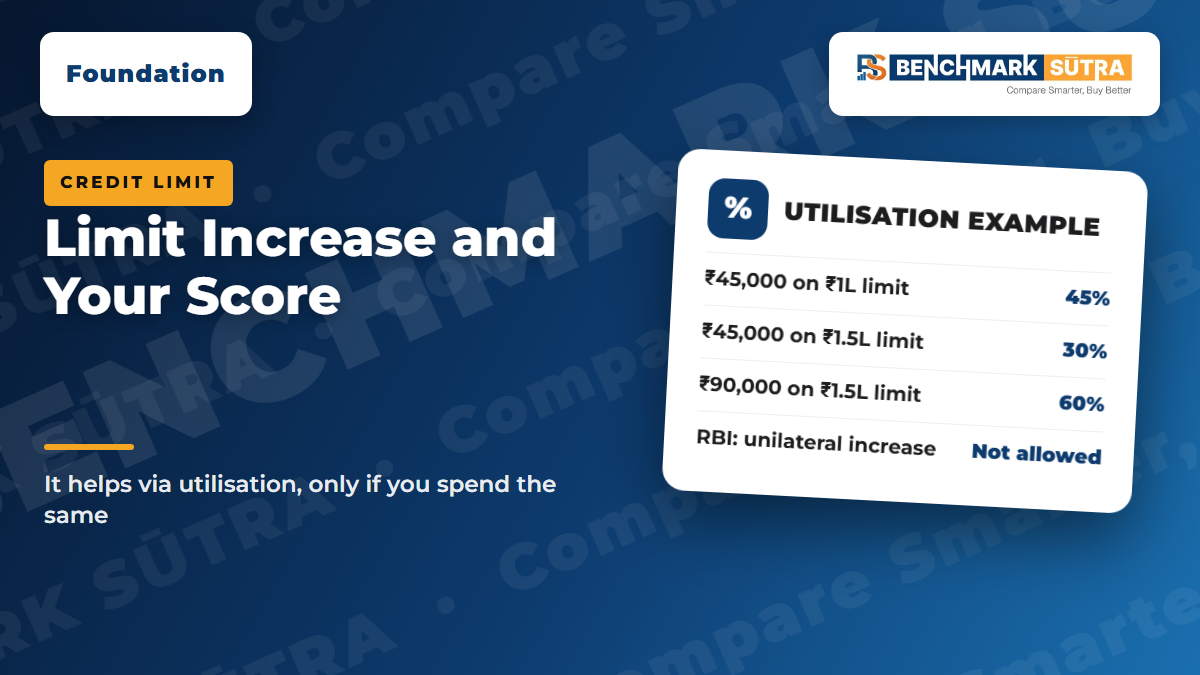
Also, a limit increase must be your choice. RBI's Credit Cards Directions say card issuers shall not unilaterally upgrade cards or enhance credit limits, so an unsolicited increase needs your explicit consent.
Scenario | Limit | Balance | Utilisation |
|---|---|---|---|
Before increase | ₹1,00,000 | ₹45,000 | 45% |
After increase, same spend | ₹1,50,000 | ₹45,000 | 30% |
After increase, you spend more | ₹1,50,000 | ₹90,000 | 60% |
How a Higher Limit Helps Your Score
Our reading after going through Experian's pages: the score does not reward having a high limit. It rewards a low share of that limit in use. Experian's consumer article says the closer your credit card balances are to the limit, the higher the effect on the score, and that it helps to keep utilisation low.
A limit increase is a way to move the denominator. With a ₹45,000 balance on a ₹1,00,000 limit you are at 45 per cent. At ₹1,50,000, the same balance is 30 per cent, around the level Experian's guidance mentions. Nothing about your repayment behaviour changed; the ratio did. Use the credit utilisation calculator to see how it looks across all your cards.
This is also why the effect depends on your situation. If you already keep utilisation at 10 per cent, a bigger limit has almost nothing to improve.
When a Limit Increase Does Not Help
You spend up to the new limit. Your balance rises with it and utilisation does not fall.
Your problem is late payments. A bigger limit does not erase days past due (see our DPD guide).
The bank runs a fresh check. Some requests may trigger a credit check; we could not confirm bank policy from an official source, so ask the bank first and read our hard vs soft enquiry guide.
You take on a fee. Some upgrades come with a higher card tier and annual fee.
RBI's Rule on Limit Increases
RBI's Credit Cards and Debit Cards Directions (updated 1 October 2026) say, in para 34, that card issuers shall not unilaterally upgrade credit cards and enhance credit limits, and require explicit consent. Para 12(5) bars breaching the sanctioned limit without explicit cardholder consent. Our unsolicited limit increase explainer covers the consent steps, and how banks increase limits covers how banks decide.
Para 12(2) of the same Directions says holding several credit cards enhances the total credit available to a consumer, so issuers assess a limit by considering all the limits you hold elsewhere. That means a limit increase at one bank can be affected by what other banks have given you.
Worked Example: Two Years of Spending
Take Riya, who spends ₹40,000 a month on her card and pays in full. Her limit is ₹1,00,000. If the bank reports the statement balance (₹40,000), her utilisation is 40 per cent every month. The bank offers ₹1,50,000 and she accepts. Same spending, 27 per cent. She changed nothing but the limit.
Now take Arjun, who gets the same increase and starts using the card for a ₹60,000 phone on EMI. His balance climbs to ₹1,00,000 against ₹1,50,000, which is 67 per cent. His score is worse off, not better.
Person | Limit | Balance | Utilisation | Effect |
|---|---|---|---|---|
Riya, before | ₹1,00,000 | ₹40,000 | 40% | Baseline |
Riya, after | ₹1,50,000 | ₹40,000 | 27% | Ratio improves |
Arjun, before | ₹1,00,000 | ₹40,000 | 40% | Baseline |
Arjun, after | ₹1,50,000 | ₹1,00,000 | 67% | Ratio worsens |
Whether to ask for an increase is a different decision from whether to accept one offered to you. If you are not sure you can control spending, decline. A simple test: write down your highest monthly spend of the last six months, and only accept a limit that keeps that figure under about 30 per cent of it. For Riya that means a limit of at least ₹1,33,000 for a ₹40,000 month, so ₹1,50,000 clears the bar while ₹1,00,000 does not.
How to Ask Well
Pay in full and on time for several months before asking.
Ask for a specific figure that brings utilisation under about 30 per cent at your usual spend.
Ask whether it triggers a bureau check before you agree.
Get the new limit confirmed in writing or in the app.
Decline unsolicited offers you do not want; consent is yours.
What to Ask Your Bank Before You Accept
Does accepting the increase involve a new bureau check?
Does the new limit change the card's annual fee, interest rate or tier?
From which statement will the new limit apply?
Will the limit change appear in the app and on the statement?
Can I reverse it later if I find myself spending more?
Write down the answers. If an unsolicited offer arrives by SMS or call, you can ignore it; RBI's Directions require explicit consent. Our credit limit explained guide covers how the limit, the available limit and the cash limit differ.
If you have an EMI running, remember that the EMI's principal is blocked against your limit. A ₹60,000 phone EMI on a ₹1,50,000 card leaves ₹90,000 available, and the full ₹60,000 may count as the balance for utilisation. Check how your bank treats it; the rule differs by bank.
Checklist
Work out current utilisation per card and in total.
Decide a target balance and stick to it.
Ask the bank whether a bureau check is involved.
Give consent only to what you want.
Recheck utilisation after the new limit is reported.
Common Mistakes to Avoid
Spending the extra limit. It cancels the benefit.
Accepting unsolicited limits blindly. RBI requires your consent.
Requesting increases at several banks in a month. Enquiries pile up.
Expecting a rise in score the next day. The new limit has to be reported first.
Ignoring the fee on a card upgrade. A higher tier may cost more.
FAQs
Does a credit limit increase improve my CIBIL score?
Indirectly. It lowers utilisation if your balance stays the same, and utilisation is one factor in the score. It does nothing for payment history.
Can a bank raise my limit without asking?
No. RBI's Credit Cards Directions say card issuers shall not unilaterally upgrade cards or enhance credit limits; explicit consent is needed.
Will a limit increase request cause a hard enquiry?
It may, depending on the bank. We could not confirm policy from an official source, so ask the bank before you apply.
What utilisation should I aim for?
Experian's consumer guidance points to keeping it near or under about 30 per cent, and lower is better.
Is declining a limit increase bad for my score?
No. Declining changes nothing in your report; you simply keep the current limit.
Does my limit at other banks matter?
Yes. RBI says issuers assess a limit considering all the limits you hold elsewhere.
How soon does a new limit show on my report?
After the bank reports it to the bureaus on its next submission, which follows fixed monthly reference dates.
Official Sources and Editorial Note
Data checked as of: November 2026
RBI Credit Cards and Debit Cards Directions 2025, as updated 1 October 2026 (paras 12, 34)
https://www.rbi.org.in/Scripts/NotificationUser.aspx?Id=13155&Mode=0
Experian India: credit utilisation and credit score pressure
https://www.experian.in/2023/05/31/do-you-exhaust-your-credit-card-limit-often-your-credit-score-could-come-under-pressure/
Experian India: what is your credit score
https://www.experian.in/2022/04/17/what-is-your-credit-score/
RBI Credit Information Reporting Directions for NBFCs, 2025 (reporting dates)
https://www.rbi.org.in/Scripts/BS_ViewMasDirections.aspx?id=12955
This article is written from official sources and does not rely on third-party wording.
Whether a requested increase triggers a hard enquiry is bank-specific and not stated in any official source we could read. The 30 per cent level is a widely used rule of thumb, not a limit set by any bureau. Overlap note: our live post on how banks increase limits covers eligibility; this post covers the score effect.
Editorial note:
Rules, bureau policies and bank terms change. Worked ₹ examples are illustrations, not predictions of your score. This is general information, not financial advice; confirm with your bank and bureau before acting.