
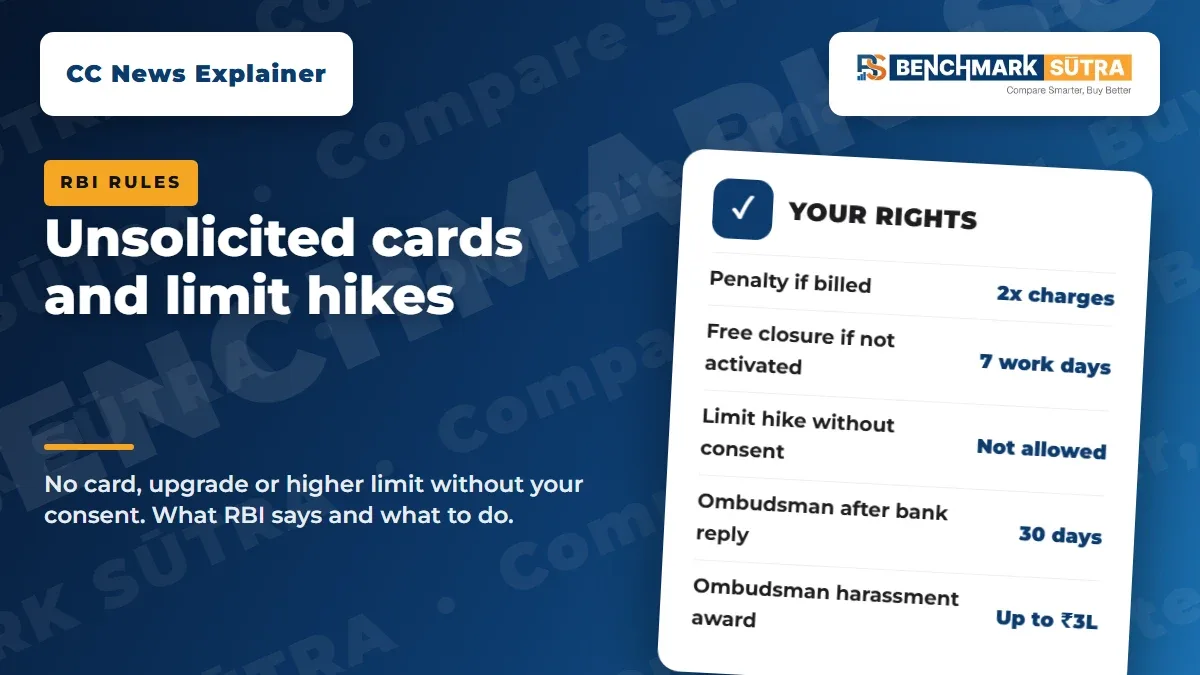
Can a bank send a card or raise your limit without asking? No. RBI's consent rules, the 2x penalty, what counts as activation and how to complain, as of November 2026.
Quick Verdict
No. Under RBI rules, a bank cannot issue you a credit card, upgrade your card or raise your credit limit without your explicit consent. If it sends an unsolicited credit card and bills you for it, RBI rules say the bank must reverse the charges at once and pay you a penalty of twice that amount.
The same rules cover limit hikes. A bank may offer you a higher limit, but it cannot switch it on by itself. It can cut your limit, but it must tell you when it does. This guide explains what counts as consent, what to do if a card or a higher limit arrives that you never asked for, and how retirees can protect themselves, as of November 2026.
Situation | What RBI says | Your remedy |
|---|---|---|
Card you never applied for | Issue of unsolicited cards is "strictly prohibited" | Do not activate it; the bank must close it free within 7 working days |
Billed for an unsolicited card | Charges reversed at once, plus a penalty of twice the reversed amount | If ₹1,000 was billed, you get ₹1,000 back plus ₹2,000 |
Card upgraded without asking | Unsolicited upgrades are prohibited | Same reversal and penalty if you were billed |
Limit raised without asking | Banks "shall not unilaterally" enhance credit limits | Ask the bank to restore the old limit; complain if it refuses |
Limit reduced | Allowed, but the bank must inform you | Ask for the reason in writing |
Loan or credit line added to the card | Not allowed without explicit consent | Object; the bank must withdraw it |
What Do the RBI Rules on Unsolicited Credit Cards Say?
The rules sit in the Reserve Bank of India (Commercial Banks – Credit Cards and Debit Cards: Issuance and Conduct) Directions, 2025, issued on 28 November 2025 and shown on RBI's site as updated on 1 October 2026. Small finance banks and NBFC card issuers follow parallel directions. We cover the full rulebook in RBI Credit Card Rules Explained. This post goes deep on one part: consent.
Four clauses do most of the work:
Written consent first (para 11(8)): the bank needs the applicant's written consent before issuing a card. Consent must be explicit, not implied. Digital consent is allowed only through modes with multi-factor authentication.
No unsolicited cards or upgrades (para 11(4)): both are "strictly prohibited". If a card is issued or upgraded and activated without explicit consent and you are billed, the bank must reverse the charges immediately and pay a penalty of twice the reversed amount, "without demur".
Misuse before delivery (para 11(5)): if an unsolicited card, or even one you applied for, is misused before it reaches you, the bank alone bears the loss. You are not liable.
No credit report entry before activation (para 11(7)): a new card account cannot be reported to credit bureaus until you activate it. If it was reported anyway, the bank must withdraw that data at once.
What counts as "activating" a card?
This is where people slip. The directions say that steps such as generating a PIN, changing transaction controls, using the IVR, a recorded call to customer care, or replying by SMS may count as activation. RBI's own advice to someone who receives a card they did not ask for: do not activate it, and do not give consent through an OTP or any other means.
If you stay silent, the bank must ask for your OTP-based consent. With no consent, it must close the account at no cost within seven working days of seeking confirmation and tell you. You then destroy the card.
Can a Bank Raise My Credit Limit Without Consent?
No. Paragraph 34 of the directions says card issuers "shall not unilaterally upgrade credit cards and enhance credit limits", and that explicit consent is needed for any change in terms and conditions. If the limit is reduced, the bank must inform you.
So what you will usually see is an offer: a message in the app, an SMS or a call saying you are eligible for a higher limit. Nothing should change until you accept. If your limit goes up without your yes, that is a breach you can raise with the bank. For how banks decide on these offers, read How Banks Increase Your Credit Card Limit.
Why would anyone refuse a higher limit?
A higher limit is not always good for you. For a retiree on a fixed pension, it raises the most a fraudster can spend before the card is blocked. It also raises how much you can spend in a bad month. Many people over 60 prefer a limit close to one or two months of pension.
What about going over the limit?
Over-limit spending also needs your explicit, prior consent (para 12(5)). Without it, the bank can neither let you cross the limit nor charge an over-limit fee. You must be able to switch the facility on or off through card controls. Interest, fees and charges cannot be counted when checking whether you crossed the limit. See Over-Limit Fee Explained.
How Is the Limit Set in the First Place?
RBI asks banks to assess your "independent financial means" and to count the limits you already hold with other lenders, using your own declaration or credit bureau data (para 12). A paragraph on this was substituted with effect from 1 October 2026. This is why a pensioner with three cards may get a smaller limit on the fourth. Read Credit Limit Explained for the basics.
Change to your card | Needs your explicit consent? | RBI clause |
|---|---|---|
New card issued | Yes, written or multi-factor digital | Para 11(8) |
Card upgraded to a higher variant | Yes | Paras 11(4), 34 |
Credit limit increased | Yes | Para 34 |
Credit limit reduced | No, but you must be informed | Para 34 |
Over-limit facility | Yes, prior consent, with on/off control | Para 12(5) |
Loan or other credit facility on the card | Yes | Para 33 |
Insurance cover tied to the card | Yes, in writing or digital mode, with nominee details | Para 11(3) |
Add-on card | Only for people the main cardholder names | Para 18 |
Why Retirees Should Pay Extra Attention
Unsolicited offers tend to reach people with steady balances and long banking histories. That describes many pensioners. A few situations to watch:
"Pre-approved" card calls. A call saying a card is "already approved" is still only an offer. Nothing should be issued until you apply and give consent. Bank representatives may call only between 10:00 and 19:00 (para 11(9)).
OTP requests after a sales call. If someone asks for an OTP "to send your free card", stop. An OTP may be treated as your consent, and it is also the most common fraud route.
Insurance added to the bill. Any insurance cover tied to the card needs your explicit consent. RBI adds that it has not prescribed any requirement for insurance cover on cards (para 73).
Add-on cards for family. An add-on card can be issued only to people the main cardholder names, and the main cardholder carries all liability. No one can get an add-on on your account without you naming them.
What to Do If You Get a Card or Limit Hike You Did Not Ask For
Step 1: Do not activate anything
Do not generate a PIN, call the activation number, or share an OTP. Keep the envelope and note the date it arrived.
Step 2: Write to the bank
Use an official channel: the email address or grievance link on the bank's website, its app, or net banking. Say you did not apply, ask for the card to be closed at no cost, and ask for written confirmation. For a limit hike, ask for the earlier limit back. Keep the complaint number.
Step 3: Check your bill and credit report
If any fee, GST or insurance premium was charged, ask for the reversal and the penalty of twice that amount under para 11(4). Check that the card does not appear on your credit report. Under RBI's 2016 directions, each credit bureau must give you one free full credit report, with your score, every calendar year.
Step 4: Go to the RBI Ombudsman if needed
Under the Reserve Bank – Integrated Ombudsman Scheme, 2026, in force from 1 July 2026, you can file a complaint if the bank does not reply within 30 days or you are unhappy with its reply. File within 90 days of that point. Filing is free, at cms.rbi.org.in, by email to [email protected], or by post to the Centralised Receipt and Processing Centre, RBI, Sector 17, Chandigarh. The Ombudsman can award up to ₹3 lakh for your time, expenses, harassment and mental anguish, on top of any loss.
The toll-free number 14448 gives guidance and status updates, but RBI says you cannot file a complaint through it.
Checklist
Never activate a card you did not apply for.
Never share an OTP with a caller, even one who says they are from your bank.
Turn down limit-increase offers you do not need; accept only through the bank's app or net banking.
Keep over-limit switched off in your card controls.
Read every statement for new fees, insurance premiums or a changed limit.
Check your credit report once a year for accounts you do not recognise.
Complain in writing, keep the complaint number, and note the 30-day clock.
New to cards? Start with Credit Card 101: A Beginner's Guide.
Common Mistakes to Avoid
Mistake 1: Activating "just to check" the card
A PIN request or an IVR call can count as activation. Once active, you have to prove you did not consent.
Mistake 2: Cutting up the card and doing nothing else
Destroy the card, but also write to the bank so it closes the account and you have a record.
Mistake 3: Treating a sales call as a done deal
"Pre-approved" means offered, not issued. You can say no.
Mistake 4: Paying the fee to make the problem go away
If you were billed for a card you never asked for, the bank owes you the reversal plus twice the amount. Do not pay first and argue later.
Mistake 5: Skipping the bank and going straight to RBI
The Ombudsman needs you to complain to the bank first. Without that step, your complaint can be turned away.
FAQs
Can a bank issue a credit card without my consent?
No. RBI's 2025 directions require written or multi-factor digital consent before a card is issued, and they strictly prohibit unsolicited cards.
What compensation do I get for an unsolicited credit card?
If you were billed, the bank must reverse the charges at once and pay you twice the reversed amount. You can also ask the RBI Ombudsman for compensation for time, expenses and harassment.
Can a bank increase my credit limit without asking?
No. Paragraph 34 says banks shall not unilaterally enhance credit limits; your explicit consent is needed.
Can a bank reduce my credit limit without asking?
Yes, but it must inform you. Ask the bank for the reason in writing if it is not clear.
Who pays if an unsolicited card is misused before I receive it?
The bank. RBI says misuse before the card reaches the named person is the bank's loss alone.
Will an unsolicited card hurt my credit score?
It should not appear at all. Banks cannot report a new card account to credit bureaus before you activate it, and must withdraw any data already reported.
How long do I wait before going to the RBI Ombudsman?
Thirty days after complaining to the bank, or sooner if the bank replies and you are not satisfied. File within 90 days after that.
Official Sources and Editorial Note
Data checked as of: 5 November 2026
Reserve Bank of India (Commercial Banks – Credit Cards and Debit Cards: Issuance and Conduct) Directions, 2025, updated as on 1 October 2026 (paras 11, 12, 18, 33, 34, 73)
https://www.rbi.org.in/Scripts/BS_ViewMasDirections.aspx?id=13155
RBI FAQs on the Reserve Bank – Integrated Ombudsman Scheme, 2026
https://www.rbi.org.in/commonperson/english/scripts/FAQs.aspx?Id=3407
RBI Complaint Management System
https://cms.rbi.org.in
RBI circular on free annual credit report from credit information companies (2016)
https://www.rbi.org.in/Scripts/NotificationUser.aspx?Id=10590
This article is written from official sources and does not rely on third-party wording.
Editorial note:
Paragraph numbers follow the 2025 Directions for commercial banks. Small finance bank and NBFC directions are parallel texts and their wording can differ. RBI amends its directions from time to time, so check the latest text before relying on a specific clause.


