India has four RBI-licensed credit bureaus: CIBIL, Experian, Equifax and CRIF High Mark. Learn why scores differ, how to use your free yearly reports and what to check.
Quick Verdict
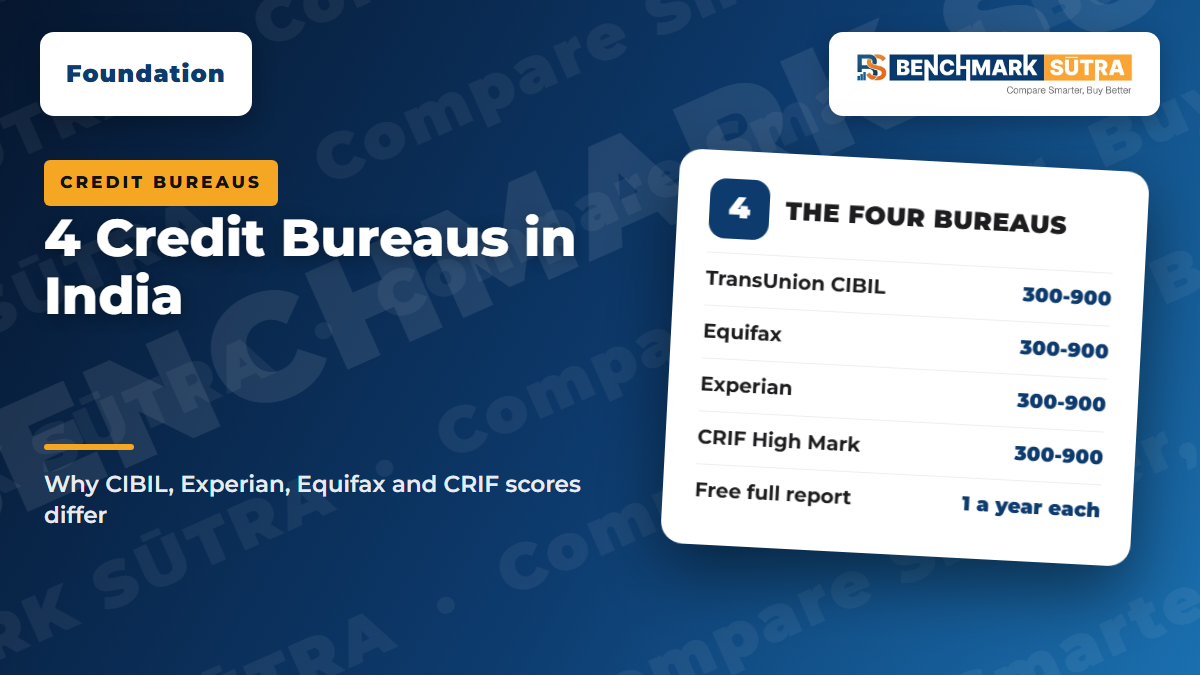
India has four RBI-licensed credit bureaus: TransUnion CIBIL, Equifax, Experian and CRIF High Mark, and your score can differ across them even on the same day. They all use the 300 to 900 scale, but each gets its own copy of your lenders' data and runs its own model.
Do not chase one number. Check each bureau's free full credit report once a year, look for wrong entries, and remember that your lender decides which bureau it pulls and how it reads the result.
Bureau | RBI scale | Free report |
|---|---|---|
TransUnion CIBIL | 300 to 900 | One free full report a year per RBI directions |
Equifax | 300 to 900 | One free report a year (Equifax page) |
Experian | 300 to 900 | One free full report a year per RBI directions |
CRIF High Mark | 300 to 900 | One free full report a year per RBI directions |
Who Are India's Four Credit Bureaus?
Our reading of the RBI notifications: the bureau you hear about most, CIBIL, is only one of four. RBI's notices list Credit Information Bureau (India) Limited, now branded TransUnion CIBIL, along with Equifax Credit Information Services, Experian Credit Information Company of India and CRIF High Mark Credit Information Services. They are credit information companies under the Credit Information Companies (Regulation) Act, 2005, and RBI regulates them.
An RBI notice also requires credit institutions to become members of all credit information companies. That is why a card issuer's data normally reaches all four, though the timing and completeness of what each holds can differ.
Why Your Scores Differ
There is no single “India credit score”. RBI's Credit Information Companies Directions say credit scores are calibrated from 300 to 900 by a credit information company. The scale is common; the calculation is each company's own. Four things drive the gaps.
Reason | Example in ₹ |
|---|---|
Different models | Bureau A weighs a ₹3,00,000 limit use differently from Bureau B |
Different data timing | Your ₹40,000 payment is already reported at one bureau, not yet at another |
Different coverage | A small lender's account shows at three bureaus, not four |
Different report errors | A wrong DPD entry sits at only one bureau |
RBI's reporting rules have lenders submit data on fixed reference dates (the NBFC text names the 9th, 16th, 23rd and last day of the month), so two bureaus can briefly show different snapshots after a payment.
Which Bureau Matters?
It depends on who is reading. A bank chooses which bureau or bureaus to pull. Many lenders mention CIBIL, but none is required to use only one. RBI also expects lenders to be members of all four, which is what makes cross-checking meaningful.
Experian's consumer pages describe a score of 750 and above as generally good, and Experian's own score runs from 300 to 900. Treat that as guidance on that bureau's scale, and read the band descriptions on each bureau's own site for its own score.
How to Use All Four Without Paying
RBI's Credit Information Companies Directions say each company must provide one free full credit report, including the score, once in a calendar year, on request and after authentication. That is a free check at each of four bureaus. A practical way to use it:
Quarter | Bureau to check | What to do |
|---|---|---|
Jan to Mar | First bureau | Read every account, status and limit |
Apr to Jun | Second bureau | Compare accounts; note any missing or wrong item |
Jul to Sep | Third bureau | Check enquiries and recently closed cards |
Oct to Dec | Fourth bureau | Repeat; use before a loan or card application |
Equifax's own page says checking your own credit report will not harm it. Our enquiries guide explains why that differs from a lender's check.
If you find an error, complaints go to the lender or the bureau. RBI says unresolved complaints after 30 calendar days earn you ₹100 per calendar day. Since the error may be at only one bureau, check each.
What to Do With the Numbers
Do not average the scores or pick the highest. Use them to spot wrong entries.
Look at account status, limits, balances and enquiries, not just the number. Our report vs score guide shows what to read.
If one bureau looks worse than the others, find out why: usually a wrong or missing entry.
Before a big loan, check all four so the lender's pull does not surprise you.
See what score a card needs for how banks use the report.
A ₹ Example of Two Bureaus Disagreeing
Suppose your card has a ₹2,00,000 limit. You paid ₹40,000 of a ₹1,00,000 balance on the 10th. Bureau A received your lender's data on the 16th and shows a ₹60,000 balance, 30 per cent utilisation. Bureau B has not yet processed it and still shows ₹1,00,000, 50 per cent. The same person, the same day, two different utilisation figures, so two different scores. Nothing is wrong with either bureau; the snapshots differ.
The same applies to accounts. A small lender may report to three bureaus but not the fourth, which is why a report at one bureau can look thinner. If you are new to credit, credit card 101 explains how your first accounts start showing up.
Do not read “CIBIL score” as a generic term. CIBIL is one brand among four. When a lender says it checks your CIBIL score, it means that bureau's number; ask which bureau a lender pulls so you can look at the same one.
Checklist
Request your free full report from each bureau once a calendar year.
Compare account lists across bureaus.
Note differences in status, balance and DPD.
File a complaint for any wrong item.
Keep your mobile and email current with every lender.
Recheck 30 to 45 days after any correction.
Common Mistakes to Avoid
Treating CIBIL as the only bureau. There are four licensed bureaus.
Paying for scores weekly. One free full report a year is available at each.
Comparing scores from different dates. Data snapshots differ.
Ignoring a wrong entry because the score looks fine. Banks read the report.
Assuming a different score means a mistake. Models differ.
FAQs
How many credit bureaus are there in India?
Four RBI-licensed credit information companies: TransUnion CIBIL, Equifax, Experian and CRIF High Mark.
Why is my CIBIL score different from my Experian score?
Each bureau runs its own model on its own copy of your data, and the data can arrive at different times, so scores differ even when both use the 300 to 900 scale.
Which credit score do banks use?
Each bank chooses. Many pull one or more bureaus; none is required by RBI to use a single bureau.
Is a free credit report available at all four bureaus?
RBI's directions require each credit information company to provide one free full credit report, including the score, once a calendar year on request.
Does checking my own score reduce it?
Equifax's page says checking your own credit report will not harm it.
What should I do if bureaus show different details?
Compare each account line, then raise a complaint with the lender or the bureau for any wrong entry. Unresolved complaints after 30 days earn ₹100 per day.
Is 750 a good score at every bureau?
Experian describes 750 and above as generally good on its scale. Other bureaus publish their own bands, so check each one's site.
Official Sources and Editorial Note
Data checked as of: November 2026
RBI Credit Information Companies Directions 2025, as updated 1 July 2026 (para 21(7), para 41)
https://www.rbi.org.in/Scripts/BS_ViewMasDirections.aspx?id=12926
RBI notification on membership of credit information companies
https://www.rbi.org.in/Scripts/NotificationUser.aspx?Id=9485
RBI Credit Information Reporting Directions for NBFCs, 2025 (reporting dates)
https://www.rbi.org.in/Scripts/BS_ViewMasDirections.aspx?id=12955
Experian India: what is your credit score
https://www.experian.in/2022/04/17/what-is-your-credit-score/
Equifax India
https://www.equifax.co.in/
This article is written from official sources and does not rely on third-party wording.
CRIF High Mark and TransUnion CIBIL consumer pages are not used here, so their score bands are not quoted. The bureau names come from RBI notices; confirm current legal names on rbi.org.in.
Editorial note:
Rules, bureau policies and bank terms change. Worked ₹ examples are illustrations, not predictions of your score. This is general information, not financial advice; confirm with your bank and bureau before acting.