Work out whether to close an unused credit card with ₹ utilisation maths, what RBI says about closure timelines, and which cards to keep or close first.
Quick Verdict
Close an unused card only if its fee is not worth the limit it gives you, and run the utilisation maths first. A lifetime-free card with a decent limit usually costs nothing to keep and helps your utilisation, so keep it with one small bill. A card with an annual fee you cannot waive is worth closing.
The one number that can hurt is utilisation: closing a card removes its limit while your balances stay. The rest, such as credit age, depends on bureau models that no regulator publishes.
Card | Keep if | Close if |
|---|---|---|
Lifetime-free | You can run one small bill on it | You keep forgetting it and miss payments |
Paid card, fee waivable | You can reach the spend naturally | You would have to spend extra to waive it |
Paid card, fee not waivable | The benefits are worth the fee | The fee exceeds what you get back |
Your oldest card | Almost always | Only if the fee is unreasonable |
The CIBIL Maths of Closing a Card
Here is the point of view we take: the common advice, “never close a card”, is too blunt, and the common worry, “closing hurts your score by years”, is not something any regulator states. What is clear from the sources we could read is that two things change when you close a card: your total limit drops, and one account stops adding to your history.
Experian's consumer pages list payment history, credit age and credit accounts among the score's inputs, and say that balances close to the limit weigh more. The same Experian page also suggests closing unused credit card lines to maintain a healthy score, which shows bureau advice is not one-sided. The arithmetic below helps you judge which effect matters for you.
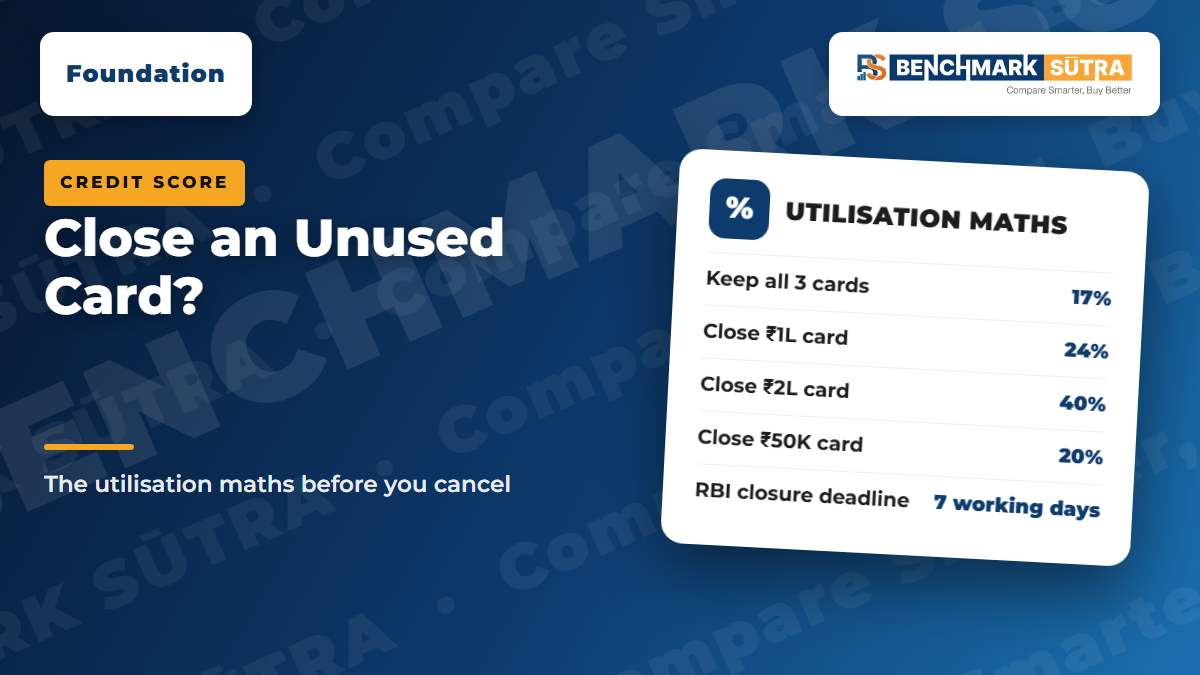
Say you hold three cards and carry a ₹60,000 balance in total:
Scenario | Total limit | Balance | Utilisation |
|---|---|---|---|
Keep all three (₹2,00,000 + ₹1,00,000 + ₹50,000) | ₹3,50,000 | ₹60,000 | 17% |
Close the ₹1,00,000 card | ₹2,50,000 | ₹60,000 | 24% |
Close the ₹2,00,000 card | ₹1,50,000 | ₹60,000 | 40% |
Close the ₹50,000 card | ₹3,00,000 | ₹60,000 | 20% |
Closing the small card changes little. Closing the large card pushes utilisation from 17 per cent to 40 per cent on the same spending, which is above the 30 per cent Experian guidance. Use our credit utilisation calculator with your own limits before you decide.
When Closing Makes Sense
The fee beats the value
If a card charges ₹1,000 plus GST a year, you cannot reach the waiver spend, and you get no benefit you use, you are paying ₹1,000 a year for nothing. Our annual fee breakeven guide shows how to test it, and the breakeven calculator does the sum.
You are losing track of it
An unused card is a risk if you miss a due date. A late mark on a card you hardly use can hurt more than the fee. If you cannot set up auto-debit, closing is safer. See auto-debit explained.
You carry a balance on the card
Do not close a card with a balance or active EMI. Clear it first. Our EMI guide covers what happens to an EMI on a closed card.
When to Keep It
It is your oldest card; closing it shortens the history the bureau can show.
It has a high limit relative to your other cards; closing it raises utilisation (see the table).
It is lifetime free; there is no fee to avoid.
It carries benefits you actually use, such as a fuel waiver or lounge visits.
A keep-alive tip from RBI's rule: a card unused for more than one year can be closed by the bank after notice and a 30-day wait (para 20). One recurring ₹200 subscription paid in full avoids that. Our inactive card guide has the full rule.
How to Close It Properly
Clear the balance, EMIs, pending fees and any cash advance.
Use or transfer reward points; check whether they lapse.
Cancel recurring payments linked to the card.
Send a written closure request through the bank's own channel and keep the reference.
RBI says closure requests must be honoured within seven working days; the bank pays ₹500 per calendar day for delay (para 19).
Check your bureau report after the next reporting cycle to confirm it shows closed.
RBI says the issuer must also report the closure to the credit information companies. If it does not show up, complain to the bank or the bureau; the 30-calendar-day resolution clock and ₹100 per day compensation apply.
A Worked Fee-vs-Utilisation Comparison
Say you hold a card with a ₹1,000 plus 18% GST annual fee, a ₹50,000 limit and no spend. Keeping it for five years costs ₹1,180 × 5 = ₹5,900. If you carry a ₹30,000 balance on another card with a ₹1,00,000 limit, your utilisation is 20 per cent with the ₹50,000 card included (₹30,000 on ₹1,50,000) and 30 per cent without it (₹30,000 on ₹1,00,000). You would pay about ₹5,900 over five years to hold utilisation 10 percentage points lower. If you keep a low balance anyway, that ten points buys little, and the fee is not worth it.
The reverse also holds. If you spend ₹70,000 a month on the ₹1,00,000 card, losing the extra ₹50,000 limit takes you from about 47 per cent to 70 per cent. In that case you either keep the card, or ask for a limit increase first. Our guide to how banks raise limits shows how.
Checklist
List every card with limit, balance, fee and age.
Calculate utilisation with and without each card.
Decide keep, use or close per card.
Clear dues and cancel mandates before closing.
Ask for a written closure confirmation.
Recheck your report after about 30 to 45 days.
Common Mistakes to Avoid
Closing your largest limit card. Utilisation can jump.
Closing your oldest card to avoid a fee. Compare with the fee first.
Closing with a balance or EMI. Clear first.
Forgetting recurring bills. A failed mandate becomes a late mark elsewhere.
Not confirming closure in writing. You need proof for a delay claim.
FAQs
Does closing an unused credit card hurt my CIBIL score?
It can, mainly because your total limit falls and utilisation rises. How much is not published; work it out with your own limits.
Should I close a credit card I never use?
Close it if it has an annual fee you cannot waive. Keep it if it is lifetime free, old, or has a large limit.
Which card should I close first?
Generally the newest, smallest-limit card with a fee. Keep your oldest and highest-limit cards.
How long does a bank have to close my card?
Seven working days after your request, or it owes you ₹500 for each calendar day of delay (RBI para 19).
What happens to my reward points when I close?
That depends on the card's terms. Check them and redeem points before closing.
Will the closure be shown on my credit report?
RBI says the issuer must report the closure to the credit information companies. Check your report about 30 to 45 days later.
What if the bank keeps charging after I close the card?
Complain to the bank. If a delay or wrong charge persists, escalate using the RBI timelines in this guide.
Official Sources and Editorial Note
Data checked as of: November 2026
RBI Credit Cards and Debit Cards Directions 2025, as updated 1 October 2026 (paras 19, 20)
https://www.rbi.org.in/Scripts/NotificationUser.aspx?Id=13155&Mode=0
Experian India: what is your credit score
https://www.experian.in/2022/04/17/what-is-your-credit-score/
Experian India: credit utilisation and credit score pressure
https://www.experian.in/2023/05/31/do-you-exhaust-your-credit-card-limit-often-your-credit-score-could-come-under-pressure/
RBI Credit Information Companies Directions 2025 (para 41 complaints)
https://www.rbi.org.in/Scripts/BS_ViewMasDirections.aspx?id=12926
This article is written from official sources and does not rely on third-party wording.
The utilisation table is arithmetic on assumed limits. The statement that Experian suggests closing unused lines comes from its 2022 consumer article; we found no official source that quantifies the score effect of closing.
Editorial note:
Rules, bureau policies and bank terms change. Worked ₹ examples are illustrations, not predictions of your score. This is general information, not financial advice; confirm with your bank and bureau before acting.