A 'save up to ₹8,400' movie offer can be worth ₹1,200 to your family. Our five-step method for valuing card dining and movie offers, with real My Zone, PIXEL and Millennia maths.
Quick Verdict
Credit card dining and movie offers are worth something, but usually far less than the "save up to" figure on the card page. We value them by what a real household would actually save in a year: the per-use cap, times how often you would genuinely use it, after any spend conditions you must meet first.
That is how benchmarksutra works out the value of credit card dining offers and movie offers before they feed into a card's score. A "buy one get one up to ₹200 a month" offer can be worth ₹2,400 a year to a family that goes to the movies every month, and ₹0 to one that goes twice a year.
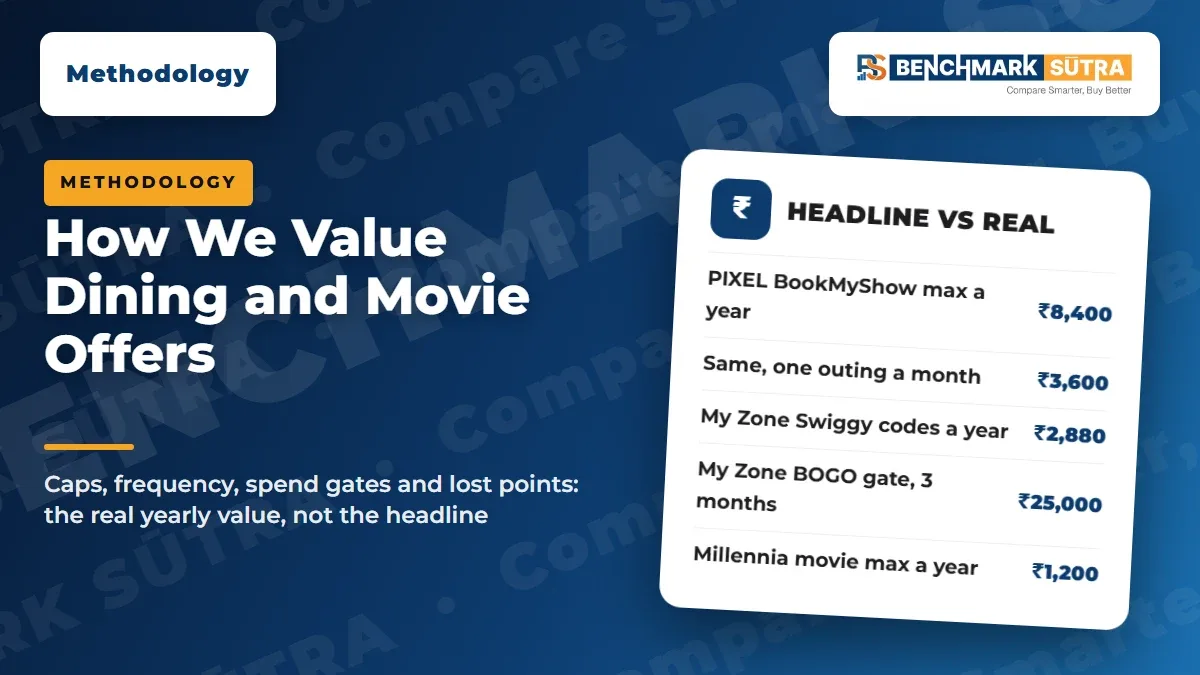
Offer (as listed, November 2026) | Headline maximum a year | What a typical family might realise |
|---|---|---|
Axis My Zone: ₹120 off Swiggy (₹500+ orders), twice a month | ₹2,880 | ₹2,880 if you order ₹500+ twice a month |
Axis My Zone: District movie BOGO up to ₹200 a month | ₹2,400 | ₹0 to ₹2,400; needs ₹25,000 spend in the previous 3 months |
HDFC PIXEL Times: BookMyShow 25% off up to ₹350, twice a month | ₹8,400 | About ₹3,600 at one family outing a month |
IDFC FIRST Millennia: 25% off movies up to ₹100, once a month | ₹1,200 | ₹600 to ₹1,200 |
The gap between the two columns is the whole point of this method.
Why Headline Offer Values Mislead
Banks describe offers at their best case: every month, every slot used, the full cap reached. Real families do not live like that. Four things shrink the value:
Caps per use. "25% off" with a ₹100 cap is worth ₹100 at most, however big the bill.
Frequency limits. Once or twice a month, often per calendar month, and unused slots do not carry over.
Unlock conditions. More offers now need a spend in an earlier month or quarter before they work.
Platform lock-in. The offer works only on one app, such as District, BookMyShow or Swiggy Dineout.
There is also a hidden cost. Some cards earn no reward points on the spend that uses the offer. Axis My Zone, for example, earns zero points on movies, so the discount replaces your rewards rather than adding to them.
How We Value a Dining or Movie Offer: Five Steps
Step 1: Find the most a single use can save
Take the lower of the percentage on a typical bill and the rupee cap. For a family of four booking ₹1,200 of movie tickets, PIXEL Times' 25% off is ₹300, under its ₹350 cap. Millennia's 25% off is capped at ₹100.
Step 2: Count only the uses you would make anyway
We count the movie nights and restaurant meals a household already has, not extra outings the offer tempts you into. If an offer makes you order a ₹500 meal you would not have ordered, the ₹120 discount is not a saving. You spent ₹380 more.
Step 3: Apply the unlock condition
If an offer needs a qualifying spend, we ask whether the card's target user meets it without forcing spend. From 1 November 2026, the Axis My Zone movie offer needs ₹25,000 of spends in the previous three months. A family that puts ₹8,000 a month or more on the card meets it. One that uses the card lightly does not, and the offer is worth nothing to them.
Step 4: Check minimum bills and platform rules
The My Zone Swiggy code needs an order of ₹500 or more. PIXEL Times' Swiggy Dineout benefit is a flat 10% off when you dine out through Dineout, so restaurants not on that platform do not count.
Step 5: Net off rewards you lose and fees you pay
We subtract the points you would have earned on a normal card, and we compare the total with the card's annual fee plus 18% GST. A ₹1,000 fee card needs more than ₹1,180 a year of real offer value to break even on offers alone.
A Family Worked Example
Meet a family of four in a metro. They go to the movies once a month, spending about ₹1,200 on tickets. They order food on Swiggy above ₹500 twice a month. They eat out at a restaurant twice a month, about ₹2,500 a meal. They put about ₹30,000 a month on their card.
Card and offer | How we count it | Realised value a year |
|---|---|---|
Axis My Zone: Swiggy ₹120 off, twice a month | 2 eligible orders × ₹120 × 12 | ₹2,880 |
Axis My Zone: District BOGO up to ₹200 | Gate met at ₹30,000 a month; 12 outings × ₹200 | ₹2,400 |
HDFC PIXEL Times: BookMyShow 25% up to ₹350 | One outing a month × ₹300 (25% of ₹1,200) | ₹3,600 |
HDFC PIXEL Times: Swiggy Dineout 10% | 2 meals × ₹250 × 12, only if booked via Dineout | Up to ₹6,000 |
IDFC FIRST Millennia: 25% off movies up to ₹100 | 12 × ₹100 | ₹1,200 |
For this family, PIXEL Times' movie and dining offers can be worth several times its ₹1,000 + GST fee, if they really book through BookMyShow and Dineout. Axis My Zone, which Axis lists at ₹NIL on Visa for a limited period, gives about ₹5,280 at no fee. Millennia's movie offer is small, but it comes on a lifetime-free card with zero forex.
Now change one thing: the family goes to the movies four times a year and orders Swiggy once a month. My Zone drops to about ₹1,440 from Swiggy plus ₹800 from movies, if they still meet the spend gate. PIXEL's movie value falls to ₹1,200. The ranking of the cards can flip on habits alone.
How Dining and Movie Offers Feed the Benchmarksutra Score
Our 100-point framework does not have a separate line for dining or movies. They count in three places:
Score category | Max points | How offers count |
|---|---|---|
Benefits & Perks | 10 | Realised yearly value of dining, movie and other perks, not the headline |
Use-Case Fit | 15 | Higher if the card is built for entertainment and food and does that job well |
Hidden Costs & Conditions | 10 | Lower if offers need spend gates, exclude points, or depend on one app |
This is why an entertainment card can look generous and still score in the 60s. Axis My Zone scores 68/100: its Swiggy and movie offers are useful, but it earns about 0.4% on other spends, its movie BOGO now needs ₹25,000 in three months, and its forex markup is 3.5%. HDFC PIXEL Times Rush scores 60/100 for similar reasons.
Read the full method in Benchmarksutra Credit Card Score Explained, our wider process in How We Review Credit Cards, and how we use bank documents in Behind the Math: MITC and Official Data.
Instant Discount vs Cashback vs Points
Offers come in three forms, and we value them differently.
Instant discount at checkout (such as a promo code or a BOGO ticket): counted at full rupee value, because you see it on the bill.
Statement cashback: counted at full value once credited, but we check the crediting time and caps. See How Credit Card Cashback Is Credited.
Bonus reward points: counted at the rupee value of a point after redemption fees, which is often much less than the multiplier suggests.
Checklist
Write down how many times a month you really go to the movies and eat out.
Check the per-use cap, not just the percentage.
Check the frequency limit: once a month, twice a month or per quarter.
Read any unlock condition, such as a spend in the previous quarter.
Confirm the app or platform the offer runs on.
Check whether the card earns points on the spend that uses the offer.
Compare your realistic yearly saving with the fee plus 18% GST.
Common Mistakes to Avoid
Adding up "save up to" figures. They assume you use every slot, every month.
Counting offers you only use because you have the card. Extra spending is not saving.
Ignoring spend gates. A gated BOGO is worth nothing in a light-spend quarter.
Forgetting the lost points. Some cards earn nothing on movie spends.
Choosing a card for one offer. Offers change often; the reward rate and fee matter year after year.
FAQs
Are credit card dining and movie offers worth anything?
Yes, if you already dine out or watch movies often. Their real value is usually well below the headline because of caps, frequency limits and spend conditions.
How does benchmarksutra value a movie offer?
We take the saving per use after the cap, multiply by the uses a household would make anyway, and drop it if a spend condition is unlikely to be met.
Is a BOGO movie offer worth ₹200 a month?
Only if you book every month on the right platform and meet any spend gate. On Axis My Zone, that gate is ₹25,000 of spends in the previous three months from 1 November 2026.
Do dining offers affect a card's Benchmarksutra Score?
Yes, through Benefits & Perks, Use-Case Fit and Hidden Costs & Conditions. We score the realistic value, not the advertised maximum.
Should I pick a card for its movie offers?
Only if you watch movies most months and the card is also decent on fees and everyday rewards. Offers change more often than core terms.
Is an instant discount better than cashback?
Both are worth their rupee value. Instant discounts are certain at checkout, while cashback depends on crediting rules and caps.
Official Sources and Editorial Note
Data checked as of: 5 November 2026
Axis Bank My Zone Credit Card and offer terms
Official page
My Zone terms (PDF)
HDFC Bank PIXEL Times Credit Card
Official page
PIXEL MITC (PDF)
IDFC FIRST Millennia Credit Card
Official page
This article is written from official sources and does not rely on third-party wording.
Editorial note:
Dining and movie offers change often, sometimes monthly. Check the bank's current offer terms before relying on any figure here.