Who qualifies for a business credit card in India: RBI's definition, HDFC Biz income bars from ₹6 lakh ITR, FD-backed GST cards, and the right route for doctors, CAs and proprietors.
Quick Verdict
In India, a business credit card is open to self-employed individuals, sole proprietors and business entities who will use it for business expenses. Banks usually want proof of business income, such as an ITR above a set level or GST returns. Salaried employees normally get a corporate card through their employer instead.
That is the short answer on business credit card India eligibility. The rules come from RBI and from each bank. RBI defines business credit cards as cards "issued to business entities / individuals for the purpose of business expenses ... and not for personal use." Each bank then sets its own age, income and document tests.
You are | Usual route (as of November 2026) |
|---|---|
Doctor, CA, lawyer or consultant filing ITR as self-employed | HDFC Biz cards from ₹6 lakh ITR; ₹12 lakh+ for Biz Power |
Sole proprietor with GST registration but thin ITR | FD-backed business card, such as IDFC FIRST Business Max |
Partner or director buying for a firm or company | Corporate or commercial card through the entity's bank |
Salaried employee | Employer-issued corporate card; personal card for your own use |
New practice with no ITR yet | FD-backed card first; apply for an income-based card after your first ITR |
Apply with HDFC Bank: Check HDFC Bank credit cards
Disclosure: this is an affiliate link. BenchmarkSutra may earn a commission if you apply through it, at no extra cost to you. It does not change our analysis.
What Counts as a Business Credit Card Under RBI Rules?
RBI's Credit Cards and Debit Cards Directions, 2025 (updated as on 1 October 2026) separate three types of card used for work.
Type | RBI definition, in short | Who pays |
|---|---|---|
Business credit card | Issued to business entities or individuals for business expenses, not personal use | The business or the individual, as agreed |
Corporate credit card | Issued to specific employees of a corporate employer | The company, the employee, or both, as per the product |
Charge card | A card where the bill must be paid in full on the due date, with no rollover | Depends on whether it is personal or corporate |
The Directions also say business cards may be issued as charge cards or corporate cards, or linked to a business credit facility such as an overdraft or cash credit. Banks must have a way to monitor how the money is used.
One rule matters for business owners: the liability on business cards forms part of the entity's total assessed credit. In plain terms, the bank sees your business card limit as part of the borrowing it has given your business.
Who Is Eligible for a Business Credit Card in India?
There is no single RBI income rule. Each bank decides. Here is what two issuers publish as of November 2026.
HDFC Bank Biz cards: income-based
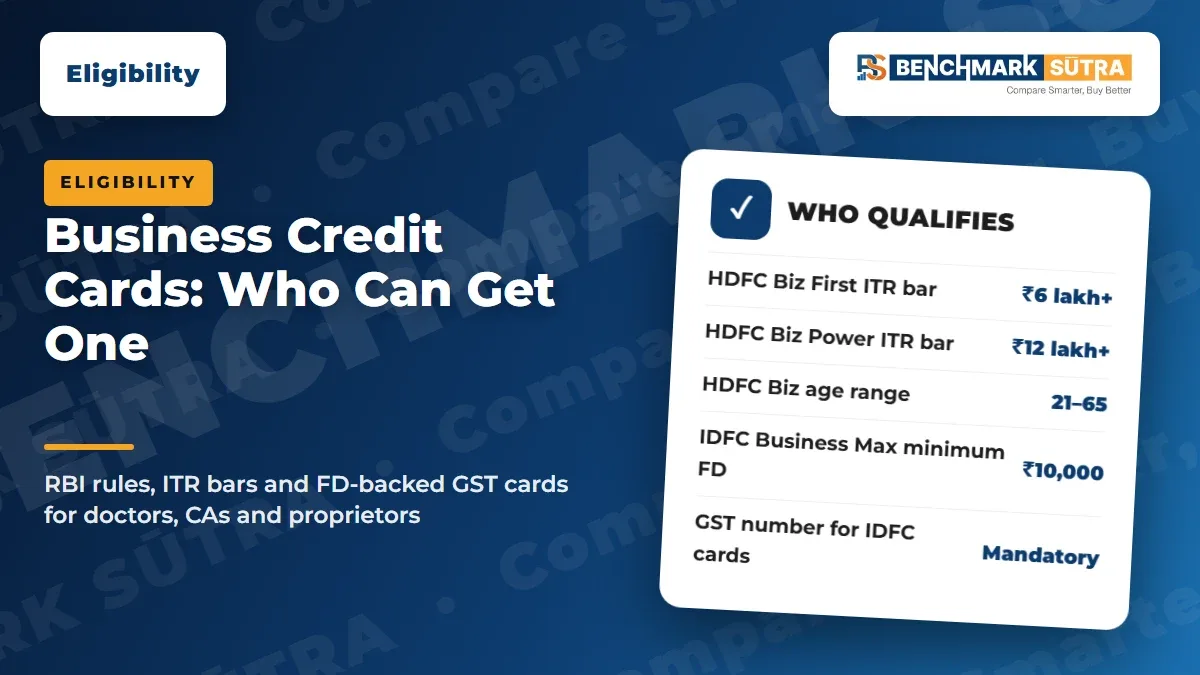
HDFC's Biz cards are for self-employed Indian citizens aged 21 to 65. The income bar rises with the card.
Card | Income test | Joining / renewal fee | Renewal fee waived at |
|---|---|---|---|
Biz First | Annual ITR above ₹6 lakh | ₹500 + GST | ₹50,000 a year |
Biz Grow | Annual ITR above ₹6 lakh | ₹500 + GST | ₹1 lakh a year |
Biz Power | Annual ITR above ₹12 lakh | ₹2,500 + GST | ₹4 lakh a year |
Biz Black Metal Edition | ITR above ₹45 lakh (business income), with a mandatory liability relationship | ₹10,000 + GST | ₹7.5 lakh a year |
HDFC says it can process Biz First and Biz Power applications using ITR filings, GST returns, bank statements and merchant payment reports. For Biz Black, it asks for the ITR. On Biz First and Biz Power, HDFC charges the first-year joining fee 120 days after the card is issued.
IDFC FIRST Bank business cards: FD-backed
IDFC FIRST takes a different route. Its two business cards are secured by a fixed deposit, so income history matters less, but GST registration is compulsory.
Business Max: lifetime free, for businesses with registered GST and applicants aged 18 or over. You need a fixed deposit of at least ₹10,000, and the limit is 100% of the FD. IDFC FIRST says applicants without a registered and active GST number are not eligible.
Business Multiplier: for sole proprietors or self-employed individuals with an active GST number and an FD of at least ₹50,000. The ₹1,000 + GST annual fee is waived if you spend ₹5 lakh in the card year.
For a full comparison of these two, read IDFC FIRST Business Max vs Multiplier.
Eligibility by Profession and Business Type
Doctors, CAs, lawyers and other professionals
If you run your own practice and file your ITR as self-employed, you fit the HDFC Biz profile. A first-year CA or a doctor who has just set up a clinic may not yet show ₹6 lakh on an ITR. The FD-backed route works if you have GST registration. If you do not, a personal FD-backed card is the fallback until your first full year's ITR is filed.
Professionals with a salaried job at a hospital or firm are a different case. HDFC's Biz cards are for the self-employed. Your route to a work card is your employer's corporate card programme.
Sole proprietors and shop owners
A proprietor's business card is issued in the owner's name. The owner is personally responsible for the dues. GST returns and current account statements help show turnover where profit on the ITR is low.
Partnerships, LLPs and companies
Cards for an entity are usually corporate or commercial cards, arranged through the bank that handles the entity's accounts. RBI requires the bank to set out clearly the responsibilities and liabilities of the company and its employees. For a business card where the entity bears full liability, RBI allows payment and refund timelines to be agreed between the bank and the principal account holder.
Freelancers
Freelancers are self-employed, so the same tests apply. For card picks and approval tips, see How to Get a Credit Card as a Freelancer.
Documents Banks Ask For
Identity and address: PAN, Aadhaar and the usual KYC documents.
Income: latest ITR. HDFC's Biz cards accept ITR or GST returns, and for some cards bank statements and merchant payment reports.
GST: registration number, which is compulsory for IDFC FIRST's business cards.
Fixed deposit: for FD-backed cards, created during the application.
Video KYC: HDFC says some cases need document upload or video KYC.
Business Card vs Personal Card: What Changes?
Point | Business credit card | Personal credit card |
|---|---|---|
Purpose under RBI rules | Business expenses only | Personal spending |
Income proof | ITR from business, GST returns | Salary slip, Form 16 or ITR |
Rewards | Often on tax, GST, ads, software and travel | Often on shopping, dining and apps |
GST invoice | HDFC Biz cards let you link a GSTIN for input tax credit | Rarely offered |
Who is liable | The business or proprietor, as agreed | The individual |
A business card keeps practice expenses out of your personal statement, which makes bookkeeping and tax filing easier.
How to Improve Your Approval Chances
File your ITR on time and in full. It is the main income proof for self-employed applicants.
Keep GST returns current. Banks that accept GST returns look for regular filing.
Apply where you bank. Your current account history helps the bank judge cash flow.
Start small. Apply for the card that matches your ITR, not the top one.
Use an FD if your income history is thin. It gives you a card now and a repayment record to build on.
More on this: 7 Ways to Boost Your Approval Chances and 5 Common Reasons Your Card Was Rejected.
Checklist
Confirm you file ITR as self-employed or run a registered business.
Note your latest ITR income and match it to the card's bar (₹6 lakh, ₹12 lakh and so on).
Keep PAN, Aadhaar, ITR and GST returns ready.
Check whether the card needs an active GST number.
Work out whether you will cross the fee-waiver spend in a year.
For HDFC Biz cards, plan to link your GSTIN after the card arrives.
Keep business and personal spending on separate cards.
Common Mistakes to Avoid
Applying for a business card on a salary. HDFC's Biz cards are for the self-employed.
Using a business card for personal spends. RBI defines it as a card for business expenses, and banks must monitor end use.
Applying without GST registration for a card that requires it. IDFC FIRST rejects these outright.
Applying above your ITR level. Biz Power needs ₹12 lakh; Biz Black needs ₹45 lakh of business income.
Forgetting the delayed fee. HDFC bills the joining fee on Biz First and Biz Power 120 days after issue.
Assuming the company pays. On a proprietor's card, you are personally liable.
FAQs
Who is eligible for a business credit card in India?
Self-employed individuals, sole proprietors and business entities that need a card for business expenses. Each bank sets its own age, income and document rules.
Can a salaried person get a business credit card?
Usually not. Banks such as HDFC offer Biz cards to the self-employed; salaried staff normally get a corporate card through their employer.
What is the minimum income for a business credit card?
It varies by card. HDFC's Biz First and Biz Grow need an annual ITR above ₹6 lakh, and Biz Power needs above ₹12 lakh.
Can I get a business credit card without ITR?
Yes, through an FD-backed card. IDFC FIRST Business Max needs an FD of ₹10,000 or more and an active GST number.
Is GST registration mandatory for a business credit card?
Not for every card, but it is for IDFC FIRST Business Max and Business Multiplier. HDFC accepts GST returns as one form of income proof.
Can doctors and CAs get business credit cards?
Yes, if they are self-employed and meet the bank's income test, such as an ITR above ₹6 lakh for HDFC Biz First.
Who is liable for a business credit card?
It depends on the product. A proprietor is personally liable, while a corporate card's liability can rest with the company, the employee or both.
Official Sources and Editorial Note
Data checked as of: 5 November 2026
RBI (Commercial Banks – Credit Cards and Debit Cards: Issuance and Conduct) Directions, 2025
RBI Directions
HDFC Bank Biz First, Biz Grow, Biz Power and Biz Black credit cards
Biz First
Biz Grow
Biz Power
Biz Black
IDFC FIRST Bank Business Max and Business Multiplier credit cards
Business Max
Business Multiplier
This article is written from official sources and does not rely on third-party wording.
Editorial note:
Eligibility rules, fees and waivers change. Banks also approve at their own discretion. Check the bank's current page before you apply.