
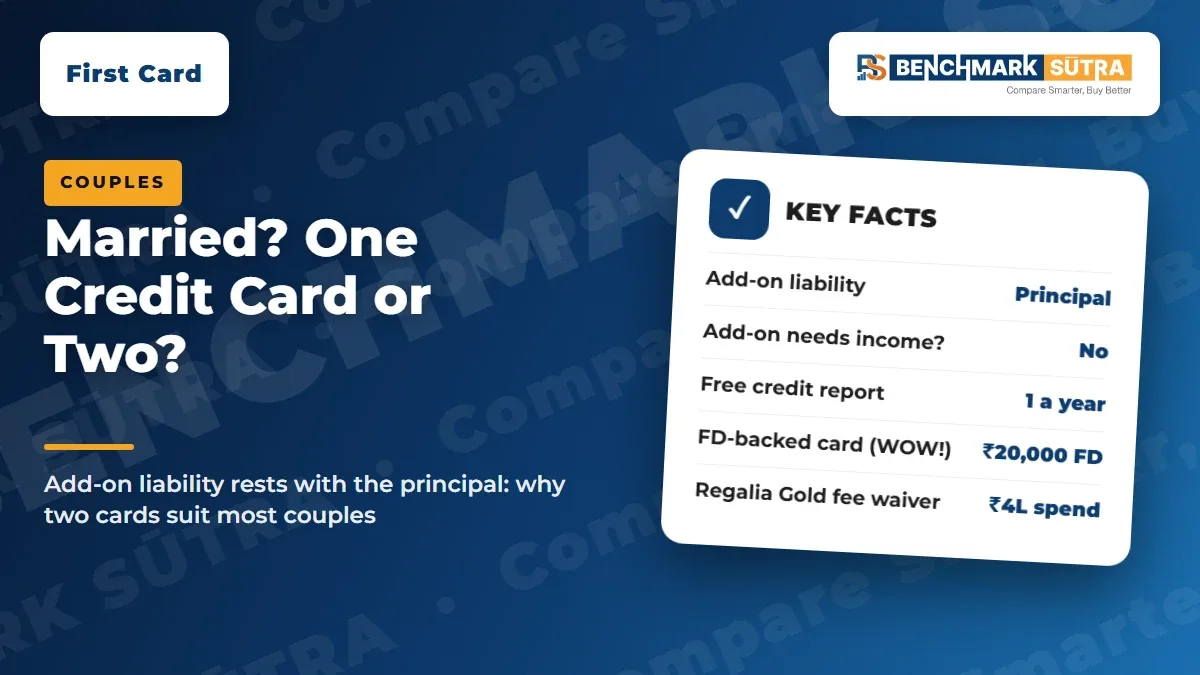
One card with an add-on, or two cards? RBI puts all add-on liability on the principal. Why most couples should hold two cards, and when pooling on one pays.
Quick Verdict
Most married couples are better off with two credit cards, one in each partner's name, and an add-on card only where pooling spends on one card earns a clear extra benefit. Two cards mean two credit histories, two credit limits and no single point of failure. One card with an add-on is simpler, but every rupee of debt sits on one person's record.
That is the short answer on a credit card for married couples. In India, a credit card account is held by one person, the principal cardholder. A spouse can get an add-on card on that account, but RBI's rules say the liability for all dues rests solely with the principal cardholder.
Setup | Best for | Main risk |
|---|---|---|
Two separate cards | Both partners earn, or one can get an FD-backed card | Rewards split across two accounts |
One card + add-on | Simple household spending, chasing one card's milestones | Only the principal builds a credit history; one person carries all the debt |
Two cards + add-ons on the better card | Couples who want both records and pooled rewards | More cards to track |
How Do Credit Cards Work for Couples in India?
A credit card account in India belongs to one person. There is no shared ownership of a single card account in the way a joint savings account works. Couples have two tools.
Add-on cards
An add-on card is a second card on the principal cardholder's account. RBI's credit card directions for banks say:
add-on cards are issued only to people the principal cardholder specifically names
they are issued "with the clear understanding that the liability will be that of the principal cardholder"
the liability for dues "shall rest solely with the principal cardholder and not with the add-on cardholders"
for activation, the bank seeks consent from the principal, not the add-on holder
The add-on shares the principal's credit limit. Our full guide is Add-on Credit Cards Explained.
Separate cards
Each partner applies in their own name, on their own income. Each gets their own limit, their own statement and their own entry on the credit bureau record.
Should a Married Couple Share One Credit Card or Have Two?
Here is how the two setups compare on the things that matter to a new household.
Factor | One card + add-on | Two separate cards |
|---|---|---|
Who owes the bank | Principal only, for all spends | Each partner for their own card |
Credit history | Built for the principal | Built for both partners |
Credit limit | One shared limit | Two limits |
Reward pooling | All spends earn on one card | Split, unless you plan it |
Fee waivers and milestones | Easier to reach on one card | Harder, unless one card is the main spender |
If one card is blocked or lost | Both partners may be affected | The other card still works |
Eligibility | Spouse needs no income | Each partner must qualify, or use an FD-backed card |
Why two credit histories matter
Your credit report and score are your own. Credit information companies must give every individual one free full credit report, with score, once a year.
A spouse who has only ever used an add-on card should not assume it has built their own credit record, because the liability for that account is the principal's. Later, when you apply for a home loan or car loan as co-borrowers, each of you will need a credit history of your own. Starting it early helps.
Why pooling still has a place
Fee waivers, milestones and lounge gates are judged on one card's spend. For example, HDFC waives Regalia Gold's renewal fee at ₹4 lakh of yearly spend, and its domestic lounges need ₹60,000 of spend in the previous calendar quarter. Splitting ₹50,000 a month across two cards can miss both; putting it on one card can clear both.
Check whether your bank counts add-on spends towards the principal's waiver or milestone. Some offers are for primary cardholders only: HDFC's Marriott Bonvoy Anniversary Special Offer 2026, for example, lets only primary cardholders enrol.
What If One Partner Has No Income?
This is common in the first years of marriage: one partner studying, between jobs, or running the home.
Add-on card: needs no income from the add-on holder. The principal carries the liability.
FD-backed card in their own name: a secured card issued against a fixed deposit. IDFC FIRST lists its FIRST WOW! card for ages 18 to 80 against an FD of ₹20,000 or more, with no income proof. Kotak's guide lists ₹10,000 for its 811 #DreamDifferent card.
Both: an add-on for daily household spending, and a small FD-backed card to build a separate record.
Our guide Credit Card Without a Salary Slip covers the options in detail.
A Simple Setup for a New Household
Here is a setup that works for many couples. Adjust it to your income and habits.
Spend | Which card |
|---|---|
Rent, EMIs and big bills | Pay by bank transfer where cards earn nothing or charge a fee |
Groceries, fuel, utilities | The card with the best everyday reward or cashback |
Travel and hotel bookings | The partner whose card has better lounge, forex and travel rewards |
Each partner's personal spends | Their own card, to keep their own history active |
Shared big purchases | The card closest to its fee waiver or milestone |
Set one rule for payments: both cards are paid in full by auto-debit from a bank account with enough balance. Read Credit Card 101 if either of you is new to cards.
Worked Example: ₹60,000 of Monthly Household Spend
Asha and Rohan spend ₹60,000 a month on cards. Rohan holds a card with a ₹4 lakh yearly fee waiver.
Option | Rohan's card spend a year | Fee waiver reached? | Asha's credit history |
|---|---|---|---|
One card, Asha uses an add-on | ₹7,20,000 | Yes, if the bank counts add-on spends | Not built in her own name |
Two cards, split evenly | ₹3,60,000 | No | Built |
Two cards, ₹40,000 on Rohan's, ₹20,000 on Asha's | ₹4,80,000 | Yes | Built |
The third option keeps both records and still clears the waiver. The figures are illustrative; use your own card's waiver amount.
Checklist
Decide who will be the principal on any add-on, and agree that they carry the liability.
Check whether add-on spends count towards fee waivers and milestones.
Make sure each partner has at least one card, secured or regular, in their own name.
Set auto-debit for the total amount due on every card.
Keep a shared view of all statements every month.
Set spending limits or controls on add-on cards in the bank's app, if the bank offers them.
Pull both free yearly credit reports and check them.
If a name or address changes after marriage, update it with each bank.
Common Mistakes to Avoid
Mistake 1: Relying only on an add-on for years
An add-on card does not give the add-on holder liability for the account. Build a record in your own name too.
Mistake 2: Splitting spends evenly by default
Even splits can miss every fee waiver and lounge gate. Put shared spends on the card closest to its target.
Mistake 3: Paying only the minimum on one card
The interest falls on that partner's record alone. Read Minimum Amount Due: Why It Is Dangerous.
Mistake 4: Applying for many cards right after the wedding
Several applications close together can hurt both scores. Apply one at a time.
Mistake 5: Assuming add-ons get every perk
Some benefits are for primary cardholders only, such as certain lounge programmes and spend offers. Read the terms.
Still deciding whether you need a card at all? Read Is a Credit Card Right for You?
FAQs
Should a married couple share one credit card or have two?
Two cards, one in each name, suit most couples because both partners build a credit history. Add an add-on card only where pooling spends on one card earns a clear benefit.
Can a husband and wife have a joint credit card in India?
A credit card account is held by one principal cardholder. The spouse can get an add-on card, but RBI says the liability for dues rests solely with the principal.
Does an add-on card build my own credit score?
Do not count on it. The liability for an add-on account is the principal cardholder's, so get a card in your own name, even an FD-backed one, to build your own history.
Can my spouse get a credit card without income?
Yes, as an add-on on your card, or as an FD-backed card in their own name. IDFC FIRST lists FIRST WOW! against an FD of ₹20,000 or more with no income proof.
Who pays if my spouse overspends on my add-on card?
You do. RBI's directions say the liability for add-on card dues rests with the principal cardholder.
Do add-on card spends count towards fee waivers?
It depends on the bank and the offer. Some offers are for primary cardholders only, so check the terms of your card.
Official Sources and Editorial Note
Data checked as of: 5 November 2026
RBI (Commercial Banks – Credit Cards and Debit Cards: Issuance and Conduct) Directions, 2025 (add-on cards, paragraphs 5, 11 and 18)
https://www.rbi.org.in/Scripts/BS_ViewMasDirections.aspx?id=13155
RBI: free annual credit report to individuals
https://www.rbi.org.in/commonman/english/scripts/Notification.aspx?Id=1884
HDFC Bank Credit Card MITC, updated 31 October 2026 (Regalia Gold fee waiver)
https://www.hdfc.bank.in/content/dam/hdfcbankpws/in/en/personal-banking/discover-products/cards/credit-cards/personal-mitc/mitc-in-english.pdf
HDFC Bank Regalia Gold lounge terms
https://www.hdfc.bank.in/content/dam/hdfcbankpws/in/en/personal-banking/discover-products/cards/credit-cards/regalia-gold-credit-card/pdfs/lounge-t-and-cs-and-list-Regalia-Gold.pdf
Marriott Bonvoy HDFC Bank Credit Card (Anniversary Special Offer 2026)
https://www.hdfc.bank.in/credit-cards/marriott-bonvoy-credit-card
IDFC FIRST Bank FIRST WOW! Credit Card
https://www.idfcfirst.bank.in/credit-card/wow
Kotak Mahindra Bank guide: minimum salary for a credit card
https://www.kotak.bank.in/en/stories-in-focus/cards/credit-cards/what-is-the-minimum-salary-required-for-credit-card.html
This article is written from official sources and does not rely on third-party wording.
Editorial note:
The household setup and worked example are illustrative. Whether add-on spends count towards waivers, and how add-on accounts appear on credit reports, varies by bank; confirm with your bank. Terms can change as of November 2026 and later.

