
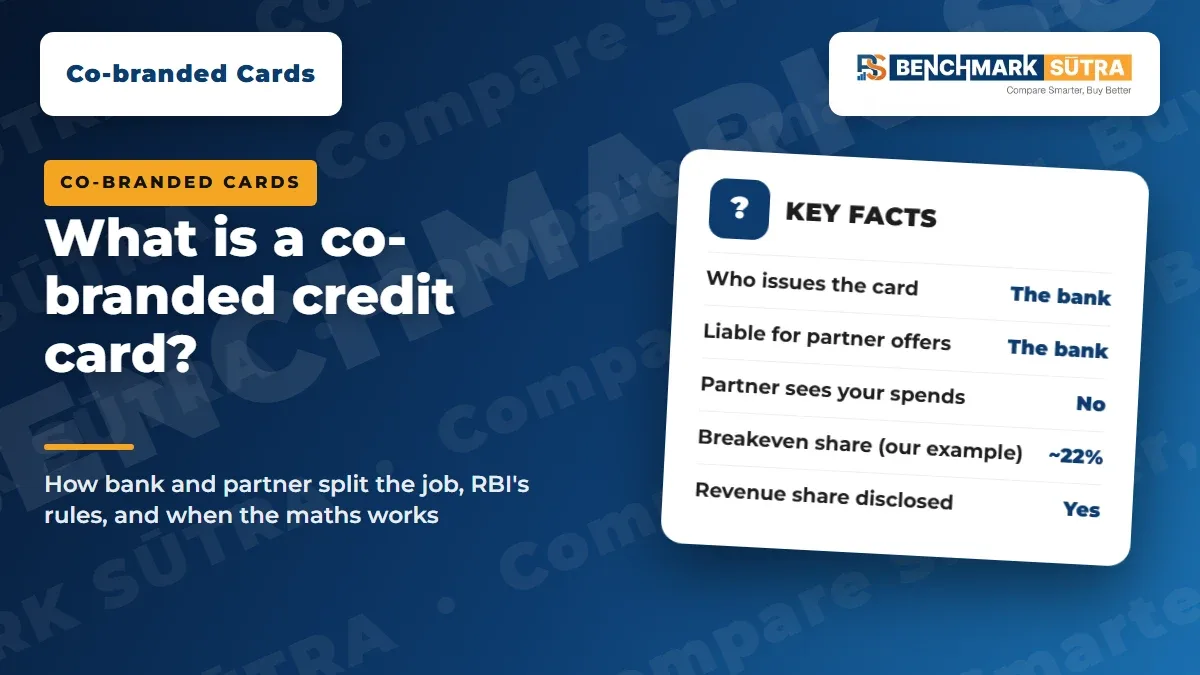
A co-branded credit card is issued jointly by a bank and a partner brand. How it works, RBI's co-branding rules, pros and cons, and the maths to tell if one is worth it.
Quick Verdict
A co-branded credit card is a card issued jointly by a bank and a partner brand, such as an airline, hotel chain, retailer or app, and it carries both their names. The bank lends you the money and runs the card. The partner gives you extra rewards or perks when you spend with it.
That is also how the Reserve Bank of India defines it. A co-branded card works well when one brand takes a large, steady share of your spending. It works badly when the partner rewards look big but most of your money goes elsewhere.
Question | Short answer |
|---|---|
Who issues the card? | The bank (card-issuer). The partner only markets it and gives access to its goods or services |
Who is responsible if a partner offer is not delivered? | The bank, under RBI rules |
Can the partner see my transactions? | No. RBI bars partners from accessing your card transaction data |
Best for | People who spend a large, steady share with one brand |
Main risk | Partner rewards are cut or the partnership ends |
What Is a Co-branded Credit Card, Exactly?
RBI's 2025 card directions define a co-branded card as one "issued jointly by a card-issuer and a co-branding entity bearing the names of both the partnering entities". The card-issuer is the bank. The co-branding entity is the partner brand.
Here is how the roles split:
The bank approves you, sets your limit, sends the bill, charges interest and fees, handles disputes and reports to credit bureaus.
The partner markets the card and gives you its benefits, such as bonus points on its app, airline miles or member status.
You deal with the bank for your money and with the partner for the perks you redeem.
A plain, non-co-branded card earns the bank's own reward points or cashback. A co-branded card usually earns the partner's currency, or extra rewards on that partner's spends.
Common Types of Co-branded Credit Cards in India
Partner type | What you usually earn | Works best if |
|---|---|---|
Airline | Airline miles or points, sometimes status or vouchers | You fly the same airline often |
Hotel chain | Hotel points, free nights or member tiers | You stay in that chain's hotels several times a year |
Shopping app or retailer | Higher cashback or points on that platform | You shop there every month |
Food delivery or quick commerce | Cashback or app credits on orders | You order several times a week |
Fuel company | Fuel points or savings at partner pumps | You fill up at one fuel brand |
Travel booking platform | Travel credits or points on bookings | You book trips through that platform |
The rewards on any specific card change often. Always check the bank's current product page and terms before you apply.
RBI Rules for Co-branded Credit Cards
Chapter V of RBI's Commercial Banks – Credit Cards and Debit Cards: Issuance and Conduct Directions, 2025 covers co-branding. Updated as on 1 October 2026, the key rules are:
The bank's name must be clear. The card must show it is issued under a co-branding arrangement and must prominently carry the bank's branding.
The partner cannot sell it as its own product. All marketing must name the bank.
The partner's role is limited. It may market and distribute the card and give you access to its goods and services. After issue, it may only be your first point of contact for complaints.
Your data stays with the bank. The partner cannot access your card transaction data. If the partner's app shows your card data for convenience, only you may see it, and the partner may not access or store it.
The bank answers for the partner. Banks are liable for the partner's acts, and for any delay or non-delivery of cashback, discounts and offers the partner advertises.
Revenue sharing must be disclosed. Information on revenue sharing between the bank and the partner must be indicated to cardholders and shown on the bank's website.
One card can have several partners. A bank can partner with more than one brand on a single card.
Every other card rule still applies, including interest, fees, billing, closure and complaints.
Pros of a Co-branded Credit Card
Higher rewards where you already spend. If one brand takes a big share of your money, its co-branded card often beats a general card there.
Partner perks money cannot easily buy. Examples include airline or hotel status, priority services or member-only offers.
Simple to use. You know which card to use at that brand.
Bank-backed protection. You keep all RBI cardholder rights, and the bank is liable if partner offers are not delivered.
Cons of a Co-branded Credit Card
Weak rewards elsewhere. Spends outside the partner often earn far less.
Rewards locked to one brand. Points may only be usable with the partner, or convert at a low rate.
Caps and exclusions. Bonus rewards often stop after a monthly cap, and some categories earn nothing. See The Truth About 5% Cashback Cards and Monthly Caps.
Partner changes hit you directly. If the partner cuts its programme, your card loses value even if the bank changes nothing.
The partnership can end. When it does, the bank may stop issuing the card or remove benefits.
What happens when a co-brand partnership changes?
Official notices show how this plays out. SBI Card's customer notices say it stopped issuing new Club Vistara SBI Credit Cards from 28 September 2024. Renewal and milestone ticket benefits were discontinued for cards renewing after 1 April 2025, and the renewal fee was waived in those cases. SBI Card also stopped issuing the Etihad Guest SBI cards from 11 March 2025 and the Yatra SBI card from 28 March 2025.
Partner programmes also change on their own. Our news post on the IndiGo EazyDiner BluChip dining devaluation shows one example.
Is a Co-branded Card Worth It? Do the Maths
Judge a co-branded card on your blended reward rate across all spending, not on the partner rate alone. Read Reward Rate vs Effective Reward Rate for the full method.
The example below is illustrative. The rates are round numbers we chose, not any bank's offer.
Monthly spend ₹20,000 | Co-branded card: 5% on partner, 0.5% elsewhere | General card: 1.5% everywhere |
|---|---|---|
₹2,000 at partner, ₹18,000 elsewhere | ₹100 + ₹90 = ₹190 (0.95%) | ₹300 (1.5%) |
₹6,000 at partner, ₹14,000 elsewhere | ₹300 + ₹70 = ₹370 (1.85%) | ₹300 (1.5%) |
₹10,000 at partner, ₹10,000 elsewhere | ₹500 + ₹50 = ₹550 (2.75%) | ₹300 (1.5%) |
In this example, the co-branded card wins only once about ₹4,450 of the ₹20,000 (roughly 22%) goes to the partner. Now add the real-world limits:
a monthly cap on partner rewards
the annual fee, after GST
the value of the partner's points when you actually redeem them
categories that earn nothing, such as rent, fuel or wallet loads on many cards
How should you value partner points?
Use the lowest realistic redemption value, not the best case. An airline mile that is worth more only on a rare premium booking is worth less to you if you mostly fly economy on short routes. Also check whether the points expire and whether redeeming costs a fee.
Co-branded vs Regular Credit Card
Factor | Co-branded card | Regular bank card |
|---|---|---|
Reward currency | Often the partner's points, miles or credits | Bank points or cashback |
Where it earns most | On one partner brand | Spread across categories |
Flexibility | Lower; tied to one brand | Higher |
Exposure to partner changes | High | Bank changes only |
RBI protections | Same, plus the bank is liable for partner offers | Same |
Who Should Get a Co-branded Credit Card?
Get one if a single brand takes a large, regular share of your spending and you will use the partner's rewards.
Get one as a second card if you already have a good general card. Use the co-branded card only at the partner.
Skip it if your spending is spread thinly across many brands, or if you are not sure you will stay loyal to the partner.
Be careful as a first card. A beginner usually gets more from a simple, low-fee card. Use How to Compare Credit Cards in India to weigh options.
Checklist
What share of your monthly spending goes to the partner brand?
What does the card earn outside the partner?
Is there a monthly or yearly cap on partner rewards?
What is a partner point worth on the redemptions you will actually make?
Do points expire, and is there a redemption fee?
What is the annual fee after GST, and what spend waives it?
Which categories earn nothing (rent, fuel, wallet loads, government payments)?
Does the bank's site show the bank's name and the co-branding disclosure clearly?
Common Mistakes to Avoid
Mistake 1: Judging the card by its headline partner rate
A high partner rate means little if most of your spending earns the low base rate.
Mistake 2: Using the co-branded card everywhere
Use it at the partner. Use a general card for the rest.
Mistake 3: Ignoring the cap
Once the monthly cap is hit, extra partner spending may earn only the base rate.
Mistake 4: Valuing points at the best possible rate
Value points at what you will realistically redeem them for.
Mistake 5: Assuming the partnership lasts forever
Partners change programmes, and banks stop issuing cards. Redeem points regularly instead of hoarding them.
Mistake 6: Complaining only to the partner
The partner can be your first point of contact, but the bank is liable. If an advertised partner offer is not delivered, complain to the bank and use RBI's complaint route if needed.
FAQs
What is a co-branded credit card?
It is a credit card issued jointly by a bank and a partner brand, carrying both their names. The bank runs the credit, and the partner adds rewards or perks on its own products.
Who is responsible for a co-branded credit card, the bank or the partner?
The bank. RBI rules make the card-issuer liable for the partner's acts, including delays in delivering advertised cashback, discounts and offers.
Can the co-brand partner see my credit card transactions?
No. RBI rules say the partner cannot access information on transactions made with the co-branded card.
Are co-branded credit cards worth it?
They are worth it when a large, regular share of your spending goes to the partner. If your spending is spread out, a general card often earns more overall.
What happens to my co-branded card if the partnership ends?
The bank may stop issuing the card, remove partner benefits or move you to another card. It must give you prior notice of changes in terms and charges.
Is a co-branded card good as a first credit card?
Usually not, unless one brand dominates your spending. A simple, low-fee card is easier to manage while you build a credit history.
Does a co-branded card affect my credit score differently?
No. The bank reports it to credit bureaus like any other credit card. Your score depends on how you repay and use your limit.
Official Sources and Editorial Note
Data checked as of: 4 November 2026
RBI (Commercial Banks – Credit Cards and Debit Cards: Issuance and Conduct) Directions, 2025, updated as on 1 October 2026 (definition and Chapter V on co-branding)
https://www.rbi.org.in/Scripts/BS_ViewMasDirections.aspx?id=13155
SBI Card customer notices (discontinued co-branded cards and benefits)
https://www.sbicard.com/en/customer-notices.page
Important source note:
This article is written from official sources and does not rely on third-party wording. The reward rates in the worked example are illustrative round numbers, not any bank's offer.
Editorial note:
Co-branded card benefits change often. Check the issuing bank's current product page, MITC and notices before applying.

