A charge card must be paid in full every month; a credit card can revolve. RBI definitions, Amex charge card fees and late penalties, and which suits professionals.
Quick Verdict
A charge card must be paid in full every month. A credit card lets you pay as little as the minimum amount due and carry the rest forward with interest. That is the core difference in the charge card vs credit card question, and it comes straight from RBI's definitions.
RBI defines a charge card as "a type of credit card where the user has to pay the billed amount in full on due date ... and no rolling over of credit to the next billing cycle is permitted." A credit card is issued "with a pre-approved revolving credit limit". In India, the best-known personal charge cards are American Express's Gold Card and Platinum Card.
Feature | Charge card | Credit card |
|---|---|---|
Bill payment | Full amount, every month | Anything from minimum due to total due |
Revolving credit | Not allowed | Allowed, with interest |
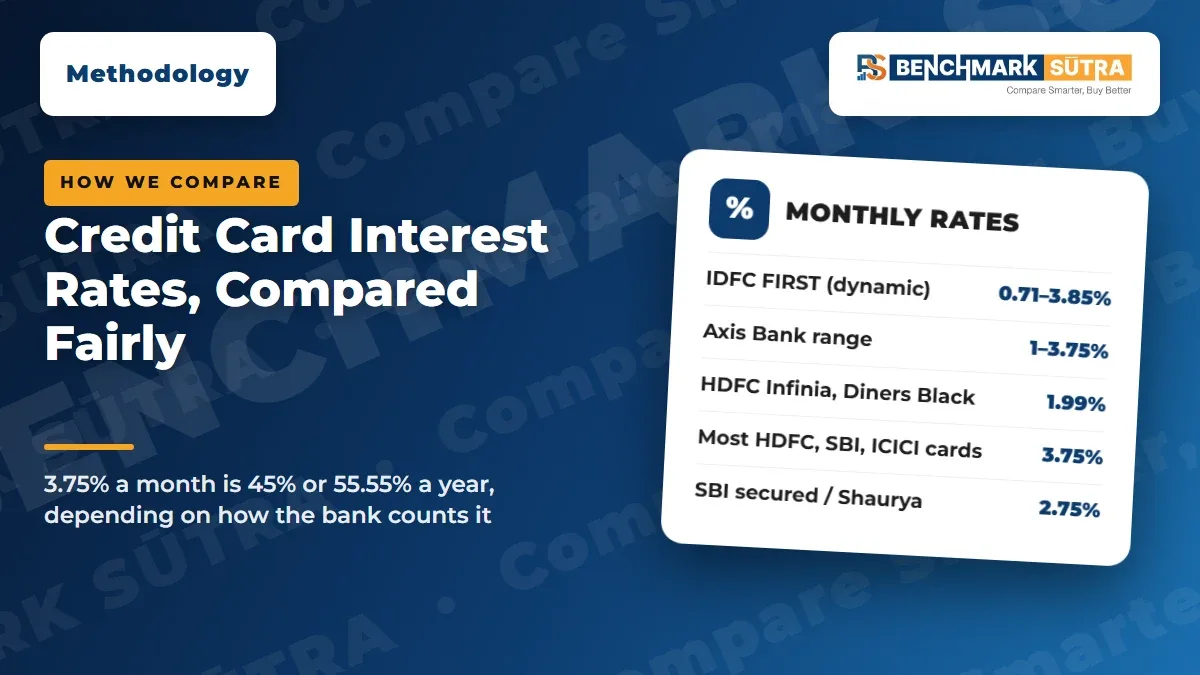
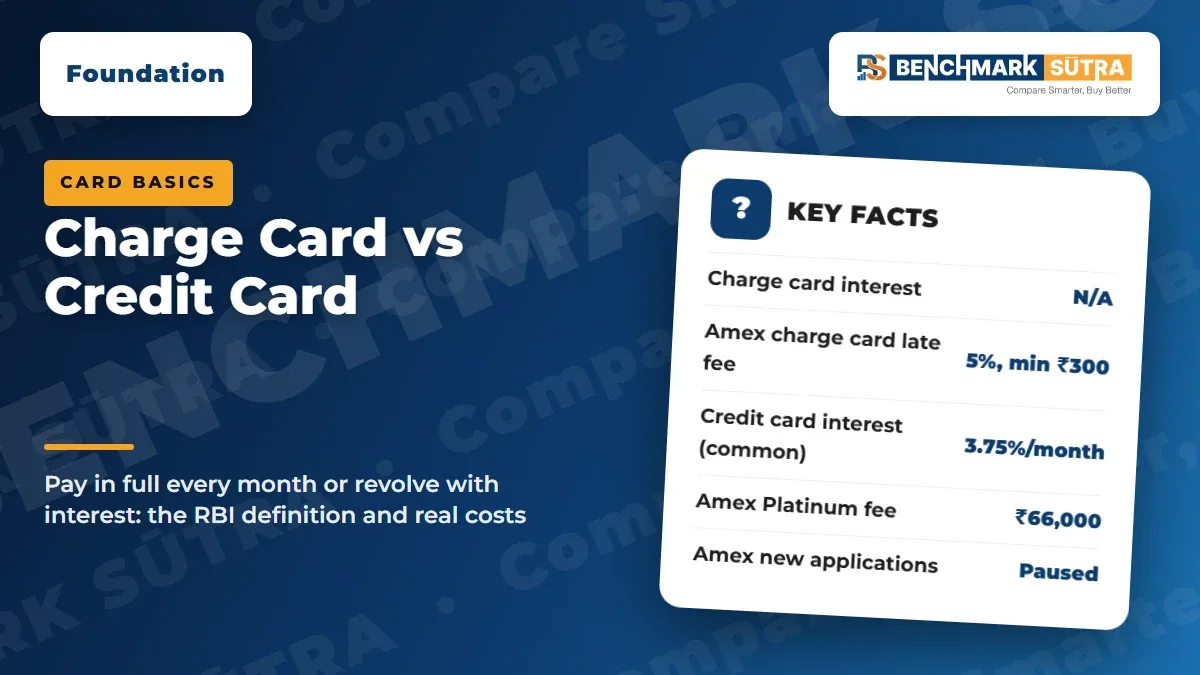
Interest rate | Not applicable (Amex lists "N/A") | Commonly up to 3.75% a month (45% a year) |
Spending limit | Amex: "no pre-set spending limit" | Fixed credit limit |
Penalty for paying late | Amex: 5% of outstanding, minimum ₹300 | Slab-based late fee plus interest |
Typical user | High earners who pay in full anyway | Everyone, from first-time users up |
For most people, a credit card paid in full each month gives the same discipline with more flexibility. A charge card suits high-income professionals who never revolve and want a large, flexible spending room.
What Is the Difference Between a Charge Card and a Credit Card?
Both cards look the same and swipe the same. The difference sits in the repayment rules.
How a credit card works
The bank gives you a credit limit. Each month you get a statement with a total amount due and a minimum amount due. Pay the total by the due date and you pay no interest. Pay less and the rest rolls over, with interest charged from the transaction date and the interest-free period lost.
For a refresher on these terms, see Credit Card 101.
How a charge card works
There is no minimum amount due in the usual sense. The whole bill is due by the due date. American Express's schedule of fees lists the interest rate on its charge cards as "N/A", because you are not allowed to carry a balance.
What replaces interest is a delinquency fee. American Express says this fee is charged "if American Express does not receive full payment of the Amount Due ... by the due date."
What Does "No Pre-Set Spending Limit" Really Mean?
American Express markets its charge cards with "no pre-set spending limit". It is not the same as unlimited spending.
Amex explains that your charges "are approved basis your spending pattern, financials, credit record and account history" and adds that "'no pre-set limit' does not mean your spending is unlimited". In practice, a large purchase can still be declined, and you may be asked to pay part of your balance before a big transaction goes through.
A credit card works the other way. You know your limit, and a transaction above it is declined or attracts an over-limit charge if you have opted in.
Charge Cards in India: What Is on Offer
Here is what American Express Banking Corp. publishes for its personal and corporate charge cards. The schedule of fees is updated as on 31 August 2025; the Platinum Card fee was checked on Amex's product page in November 2026.
Card | Annual fee | Interest | Late fee (delinquency charge) |
|---|---|---|---|
American Express Gold Card | ₹1,000 first year; ₹4,500 from year 2 | N/A | 5% of outstanding, minimum ₹300 |
American Express Platinum Card | ₹66,000 + taxes | N/A | 5% of outstanding, minimum ₹300 |
American Express Corporate Cards (Corporate, Gold, Platinum) | ₹2,100, ₹3,100 and ₹40,000; can vary by company | N/A | 3.5% of outstanding, minimum ₹100 |
The Platinum Card's eligibility rules on Amex's page: employed with a personal annual income of ₹25 lakh or more, or self-employed with ₹15 lakh or more. If self-employed, your company must have been trading for more than 12 months. You also need a good credit history and an Indian savings or current account.
Important as of November 2026: the Amex Platinum Card page says American Express is "temporarily pausing the acceptance of new card applications in India" while it updates its technology platforms. Check the page before you plan around a new charge card.
RBI also allows business cards to be issued as charge cards. So some company and business cards work on the pay-in-full rule even if they are not branded as charge cards. Read the card's terms to be sure.
Which Costs More If You Slip Up?
A charge card has no interest, but its late fee is a percentage of your whole balance. A credit card's late fee is a slab, but interest starts running.
Take a ₹1 lakh bill that you pay 10 days late, in full.
Cost | Amex charge card | SBI Card credit card |
|---|---|---|
Late fee | ₹5,000 (5% of ₹1 lakh) | ₹1,300 (balance above ₹50,000) |
Interest | None | Charged on the ₹1 lakh from each transaction date until payment, at up to 3.75% a month |
GST at 18% on fee (and interest) | ₹900 | ₹234 on the fee, plus 18% on the interest |
For a short delay on a large bill, the charge card's 5% fee is usually the more expensive mistake. Charge cards punish lateness harder because they are built for people who pay in full on time.
See how interest builds on a credit card in Credit Card Interest Calculation Explained, and every fee in Every Credit Card Fee Explained.
Charge Card or Credit Card: Which Suits Professionals?
Doctors, CAs and lawyers often earn well but unevenly, with fees arriving in lumps. That shapes the choice.
A charge card may suit you if
You always pay the full bill and want a hard rule that stops you from revolving.
You make occasional very large payments, such as clinic equipment, that would exceed a normal credit limit.
You meet the high income bar and value the travel and hotel benefits enough to pay the fee.
A credit card is the better choice if
Your income comes in uneven months and you want a buffer, even if you rarely use it.
You want a low or zero annual fee.
You are building your credit history or meet only an entry-level income bar.
You want features such as UPI payments on a RuPay credit card.
Whichever you choose, compare the total cost, not just the perks. Our guide on how to compare credit cards in India walks through the steps, and the Benchmarksutra Credit Card Score explains how we weigh fees against benefits.
Do Charge Cards Affect Your Credit Score Differently?
Both are credit products reported to credit bureaus, and missed payments hurt either way. One practical difference: a credit card has a fixed limit, so your utilisation (balance as a share of limit) is easy to see. A charge card has no pre-set limit, and how bureaus and lenders read that can vary. Paying on time, in full, is what protects your score on either card.
Checklist
Ask yourself honestly whether you have ever paid less than the full bill.
Check the card's terms for the words "charge card" or "pay in full".
Read the late fee rule: slab amount or a percentage of the balance.
Check whether the issuer is accepting new applications.
Confirm the income bar and documents needed.
Set up auto-debit for the total amount due, not the minimum.
Add 18% GST to the annual fee when working out the cost.
Common Mistakes to Avoid
Treating "no pre-set limit" as unlimited. Amex says it is not.
Paying a charge card bill late by a few days. A 5% fee on a large balance is a steep penalty.
Picking a charge card to avoid interest while still running short each month. You need cash flow to pay in full.
Assuming a business card can revolve. RBI allows business cards to be issued as charge cards; check yours.
Paying a premium fee for perks you will not use. ₹66,000 plus GST needs heavy travel and hotel use to make sense.
FAQs
What is the difference between a charge card and a credit card?
A charge card must be paid in full every month and cannot carry a balance. A credit card lets you pay part of the bill and roll over the rest with interest.
Does a charge card charge interest?
No. American Express lists interest on its charge cards as not applicable, but it charges a late fee of 5% of the outstanding, minimum ₹300, if you do not pay in full on time.
Does a charge card have a credit limit?
Amex charge cards have no pre-set spending limit, but Amex says that does not mean unlimited spending. Each charge is approved based on your history and finances.
Which charge cards are available in India?
American Express issues the Gold Card and Platinum Card as personal charge cards, plus corporate charge cards. As of November 2026, Amex says it has temporarily paused new applications in India.
Is a charge card better than a credit card?
Only for people who always pay in full and can use the card's benefits. For most users, a credit card paid in full each month is cheaper and more flexible.
What happens if I pay a charge card late?
You pay a delinquency fee, which for Amex personal charge cards is 5% of the outstanding balance with a ₹300 minimum, plus GST.
Official Sources and Editorial Note
Data checked as of: 5 November 2026
RBI (Commercial Banks – Credit Cards and Debit Cards: Issuance and Conduct) Directions, 2025
RBI Directions
American Express Platinum Card and charge cards (India)
Platinum Card
Charge cards
American Express schedule of fees and charges
Schedule of fees (PDF)
SBI Card Most Important Terms and Conditions
Official page
This article is written from official sources and does not rely on third-party wording.
Editorial note:
Fees, eligibility and application status can change. Check the issuer's current terms before applying.