

 By
By R32 vs R410A vs R290 AC is one of the most common refrigerant-label comparison questions Indian buyers now face when shortlisting air conditioners.
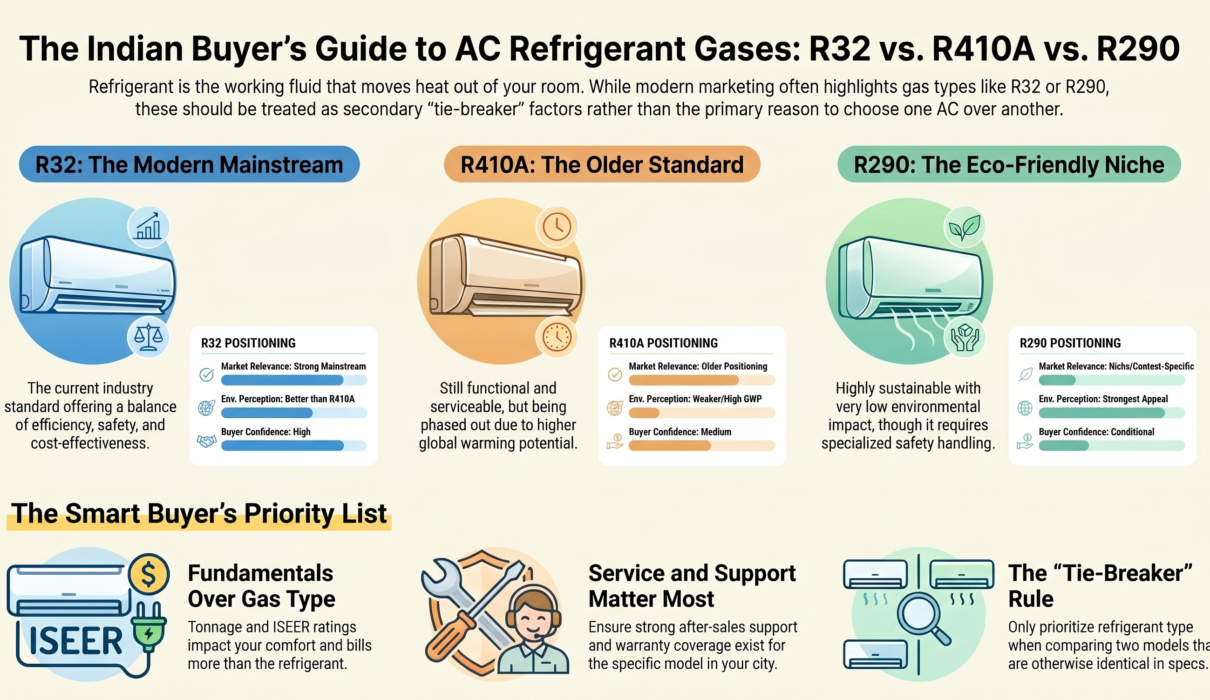
Many Indian buyers notice refrigerant gas type in AC listings but do not know how much weight to give it. That creates two common mistakes: either ignoring it completely or overvaluing it as if gas type alone decides which AC is better.
Both mistakes are wrong.
This page is a practical Indian guide to understanding what R32, R410A, and R290 actually mean in real AC ownership terms. It is not a chemistry lecture and it is not a climate-policy essay. The goal is simpler: explain what these refrigerant types usually signal, where they matter, and where buyers should stop overthinking them. Panasonic explains refrigerant as the working compound that helps an AC absorb heat and deliver cool air, while Carrier describes refrigerant as the substance that transfers heat through the cooling cycle.
Table of Contents
Quick Answer Box
Short answer:
- R32 is now the practical mainstream choice in many current residential AC conversations and is positioned by Daikin as a balanced refrigerant on environmental impact, efficiency, safety, and cost-effectiveness.
- R410A still exists, but it is older in positioning and is being phased out in many markets because of its higher global warming impact.
- R290 has strong environmental appeal because it is a natural refrigerant with very low GWP, but it also requires more careful safety interpretation because it is flammable.
- Refrigerant type matters, but usually less than tonnage, ISEER, warranty, service support, and overall model value.
Practical buyer takeaway:
Treat refrigerant gas as a useful secondary factor. It can affect ownership confidence, market relevance, and service comfort. But for most buyers, it should not outweigh the core purchase fundamentals.
What does refrigerant gas actually do in an AC?
Refrigerant gas is the working fluid that helps the AC move heat from inside the room to the outside environment. In plain language, it is one of the core substances that makes cooling possible. Panasonic describes refrigerant as the compound that helps the AC absorb heat and deliver cool air, and Carrier explains that refrigerant circulates in a closed loop to absorb indoor heat and release it outdoors.
For buyers, the important point is not the chemistry detail. The important point is that refrigerant type can influence:
- current market relevance
- service familiarity
- ownership confidence
- environmental positioning
- how future-ready the model feels
That still does not mean refrigerant type alone decides AC quality. It is one part of the system, not the whole system.
R32 vs R410A vs R290: what is the real difference?
This is the core buyer comparison.
R32
R32 is now the practical mainstream reference point in many modern residential AC discussions. Daikin describes R-32 as “the most balanced refrigerant” across environmental impact, energy efficiency, safety, and cost-effectiveness, and notes that R-32 products have been launched widely across many regions.
Practical buyer meaning:
- widely seen in current residential ACs
- feels like the modern default reference point
- easier to compare within today’s mainstream market
For most buyers, that is the simplest way to think about it: R32 is often the current normal, not a special premium signal by itself.
R410A
R410A still exists, but in many residential comparisons it feels older in positioning compared with R32. Carrier states that R-410A was widely used between 2010 and 2023 and is being phased out because of its high global warming potential. Panasonic also groups R-32 and R-410A as HFC refrigerants but presents the overall refrigerant shift as part of a move toward lower environmental impact.
Practical buyer meaning:
- not automatically unusable
- not automatically a bad sign
- but less future-facing in many new residential comparisons
So the correct buyer reading is not “avoid every R410A AC.” The better reading is: it often feels like the older side of the market unless the full model still makes a strong case.
R290
R290 needs the most careful interpretation.
It often gets attention because of its stronger environmental appeal. Panasonic describes R-290 as a hydrocarbon refrigerant with zero ozone-depletion potential and very low greenhouse impact, while Mitsubishi Heavy Industries notes that R290 has extremely low GWP but is highly flammable and requires strict safety management.
Practical buyer meaning:
- attractive from an environmental-positioning angle
- worth noticing, especially for buyers who care about sustainability
- still needs context around servicing comfort, market familiarity, and model implementation
So R290 deserves attention, but not blind hype.
Why R32 became the practical standard in many Indian ACs
R32 became common because it sits in a practical middle ground for today’s residential market. Daikin positions it as strong on efficiency, lower environmental impact than R-410A, and cost-effectiveness, while Carrier also highlights lower environmental impact and good efficiency when comparing R-32 to R-410A in its R-32 transition materials.
That does not mean every R32 AC is better than every non-R32 AC. It means buyers will often find R32 sitting at the center of current residential comparison.
So the correct buyer reading is:
- R32 is often the practical mainstream benchmark
- it is not an automatic “best AC” stamp
- the full model still matters more than gas type alone
Is R410A outdated now?
In many residential comparisons, it can feel older. But avoid blanket dismissal.
Carrier’s own consumer guidance says R-410A is being phased out because of its high GWP, but also makes clear that existing R-410A systems can still be used and serviced. That is the correct tone for buyers too: older in positioning, yes; automatically unusable, no.
The practical answer is:
- yes, it can feel less future-facing in newer residential buying
- no, that does not automatically make every R410A AC a weak product
- yes, buyers should be more cautious when comparing it directly against otherwise strong current R32 options
What about R290?
This section needs the most nuance.
R290 often looks attractive because it has a strong environmental story. Panasonic calls hydrocarbon refrigerants like R-290 the most eco-friendly currently available, but it also notes that they are highly flammable. Mitsubishi Heavy Industries makes the same practical point in a more technical way: R290 has extremely low GWP but requires strict safety management.
So buyers should still ask:
- how common is it in the product segment I am shopping?
- how comfortable is the service ecosystem around it?
- is this improving my real buying decision, or am I overvaluing one technical angle?
That is why R290 should be treated as interesting and relevant, but still context-dependent.
R32 vs R410A vs R290 AC: Quick Comparison
| Comparison factor | R32 | R410A | R290 |
| Current market relevance | Strong mainstream relevance in many residential AC comparisons | Older residential positioning | More niche or context-specific for many buyers |
| Buyer confidence | High | Medium | Medium, but more conditional |
| Service familiarity | Strong practical familiarity | Still known, but less future-facing in newer comparisons | More context-dependent |
| Environmental positioning | Better-positioned than older residential R410A in buyer perception | Weaker current perception versus R32 / R290 | Strong environmental appeal |
| Weightage | Moderate as a secondary factor | Low to moderate | Moderate only for buyers who specifically care about this angle |
| Refrigerant | Safety Class | Efficiency vs R410A | 2026 Status |
| R410A | A1 (Non-flammable) | Baseline | Phasing Out |
| R32 | A2L (Mildly flammable) | +10-20% Better | Recommended |
| R290 | A3 (Highly flammable) | +5-15% Better | Growing Popular |
This is the buyer lens that matters:
refrigerant type is not meaningless, but it is rarely the primary decision driver for most buyers.
Key Takeaway: R32 offers the best balance of efficiency and safety for most homes, while R290 leads in environmental friendliness. Meanwhile, R410A is being phased out due to its high global warming potential.
| Refrigerant | Cooling SEER (W/W) | Heating SCOP (W/W) | Energy Savings |
| R410A | 6.27 | 3.50 | Baseline |
| R32 | 6.94 | 3.87 | Up to 10% |
| R290 | 6.80 | 4.00 | 5-15% |
What is Cooling SEER?
Seasonal Energy Efficiency Ratio (SEER) measures AC efficiency over a season, calculated as total cooling output divided by total electrical energy input. A higher SEER indicates greater efficiency. When in W/W (Watt/Watt), it represents the ratio of thermal power generated to electricity consumed.
Benefits of higher SEER
- Energy Savings: Higher efficiency systems consume less electricity.
- Lower Operating Costs: Reduced energy usage results in lower utility bills.
- Environmental Impact: Lower electricity consumption leads to reduced greenhouse gas emissions.
What is heating SCOP?
Seasonal Coefficient of Performance (SCOP) measures a heat pump’s heating efficiency over an entire season by dividing total heat output (kWh) by total energy input (kWh). A higher SCOP means lower energy bills; modern air-source pumps typically range from 3.0 to over 5.0. It is more accurate than COP as it includes temperature fluctuations.
Range of SCOP
- 3.0–4.0: Average efficiency for standard modern air-source heat pumps.
- >4.0–5.0+: High efficiency, often found in top-tier air-source or geothermal units.
Interpretation of SCOP
- SCOP 3.0: 300% efficiency (1 kWh input = 3 kWh heat output).
- SCOP 4.0: 400% efficiency (1 kWh input = 4 kWh heat output).
- SCOP 5.0: 500% efficiency (1 kWh input = 5 kWh heat output).
Does refrigerant gas affect cooling and electricity bill?
Potentially yes, but do not overclaim it.
Daikin and Carrier both argue that R-32 can support strong energy-efficiency outcomes relative to R-410A in certain system designs, but that is still not the same as saying gas type alone decides your bill. Real running cost depends far more on the total AC implementation, ISEER, room conditions, and usage pattern.
The correct buyer rule is:
- refrigerant type is one part of the overall system design
- cooling quality still depends much more on total AC implementation
- electricity cost should be judged through ISEER and annual electricity-consumption data, not gas type alone
So do not buy an AC assuming refrigerant gas by itself guarantees stronger cooling or lower bills.
What matters more than refrigerant type?
This is the most important section.
In real Indian buying decisions, these factors usually matter more than refrigerant gas:
Tonnage
Wrong tonnage hurts comfort faster than the wrong gas label ever will.
ISEER
For running-cost comparison, ISEER matters more than refrigerant excitement.
Installation quality
A badly installed AC does not become a smart purchase because it uses a newer refrigerant.
Warranty
A more current refrigerant with weak warranty confidence is not automatically the better buy.
Service support
After-sales support in your city matters more than technical label appeal.
Overall model value
The strongest AC is usually the one that gets size, efficiency, warranty, service, and price right, not the one that only wins on gas type.
So the smart buyer mindset is simple:
notice refrigerant type, but do not let it outrank the fundamentals.
When should a buyer care more about refrigerant gas?
Give this factor more attention when:
- you are comparing closely matched models
- you have a longer ownership horizon
- you care specifically about future-readiness
- you care specifically about environmental positioning
- service familiarity in your city or product segment matters to you
That is where refrigerant type becomes a useful tie-breaker.
How to evaluate refrigerant type without falling for jargon
Use this checklist:
- Check tonnage first
- Check ISEER / annual power consumption
- Check warranty and service support
- Check whether the model is actually strong in its price band
- Treat refrigerant type as one signal, not the whole decision
This is the cleanest way to use the information without over-indexing on it.
Final verdict
Refrigerant type matters.
But for most Indian buyers, it is a secondary factor, not a primary one.
The practical summary is:
- R32 is often the mainstream current reference point
- R410A is older in positioning and often feels less future-facing
- R290 can be attractive, especially from an environmental angle, but it needs more context
So the smart buying rule is:
- do not ignore refrigerant type
- do not obsess over it
- do not choose an AC mainly because of gas type
Overall suitability still matters far more.
An R32 vs R410A vs R290 AC comparison matters most when buyers want to understand refrigerant labels without letting them override tonnage, efficiency, and overall model value.
Climate-Specific Performance
Different refrigerants perform better in different climates. For example, R290 shines in cold weather applications. Additionally, R32 maintains consistent performance across various temperatures. Furthermore, both outperform R410A in extreme conditions. Consequently, your local climate should influence your refrigerant choice.
Long-Term Efficiency Trends
Efficiency improvements continue over time with newer refrigerants. Moreover, R32 and R290 systems maintain their performance better than R410A. Additionally, advanced system designs optimize these refrigerants further. Therefore, investing in newer refrigerants provides lasting efficiency benefits.
Cost Breakdown: Upfront vs Long-term
Initial Installation Costs
Installation costs vary significantly between refrigerants. Currently, R410A systems cost least upfront, but availability is limited. Meanwhile, R32 systems cost 10-15% more initially. Additionally, R290 systems require 20-30% higher investment due to safety equipment. However, long-term savings often offset higher upfront costs.
Operating Cost Comparisons
Monthly energy bills reveal the true cost differences. Specifically, R32 reduces electricity costs by 5-10% compared to R410A. Similarly, R290 can lower bills by up to 15% in cold climates. Furthermore, both newer refrigerants require less frequent maintenance. Therefore, operating savings add up quickly over time.
Maintenance and Repair Costs
Long-term maintenance costs favor newer refrigerants. For instance, R410A repair costs are rising 50% due to phase-out restrictions. Conversely, R32 systems need 20-30% less refrigerant for refills. Moreover, R290 has minimal environmental taxes and fees. Consequently, total ownership costs shift toward newer refrigerants over time
FAQ
Which refrigerant gas is best for AC: R32, R410A, or R290?
There is no universal winner for every buyer. In current Indian residential buying, R32 is often the most practical mainstream reference point, while R290 needs more contextual interpretation and R410A often feels older in positioning.
Is R32 better than R410A?
In many current residential comparisons, R32 feels more future-facing and more mainstream. But that does not automatically make every R32 AC better than every R410A AC.
Is R290 safe in an AC?
Buyers should not jump to alarmist conclusions. R290 should be understood in context: model design, handling, and service ecosystem familiarity all matter.
Does refrigerant gas affect cooling performance?
It can influence system context, but cooling quality should not be judged by gas type alone. Full model design matters more.
Is R410A outdated now?
In many residential buying contexts, it can feel older and less future-facing. But it should not be dismissed automatically without looking at the full AC.
Should I choose an AC based on gas type?
Usually no, not as the main decision driver. It is a useful secondary factor.
Which refrigerant is more future-ready in India?
In many current residential comparisons, R32 is the more practical future-facing mainstream reference point.
Related reads
If you want the broader framework for choosing the right AC, use our AC buying guide for Indian buyers.
If you want to compare running cost more intelligently, read our guide on what ISEER means in an AC and how it affects your electricity bill.
If you also care about outdoor-unit build quality, read our guide on copper vs alloy condenser ACs.
If you want to understand real ownership cost beyond the sticker price, read our guide on the hidden costs of buying an AC in India.
If you are comparing actual models, see our guides to the best 1 ton inverter AC in India, best 1.5 ton 3-star inverter AC in India, and best 1.5 ton 5-star inverter AC in India.
If your budget is capped, see our guide to the best AC under ₹40,000 in India.