

 By
By 4 way swing vs 2 way swing AC is one of the most common comfort-feature comparison questions buyers face when shortlisting air conditioners.
When buyers compare ACs in India, feature lists often start looking similar. That is where brands begin highlighting comfort features like 4-way swing, 2-way swing, uniform cooling, or wider airflow distribution.
The problem is that many buyers still do not know how much this feature actually matters. Is 4-way swing a real comfort advantage? Is 2-way swing enough? Should you pay extra for it? This page is a practical Indian guide to those questions. It is not a glossary page and it is not a product roundup. The goal is simpler: help you understand what swing direction features do in real rooms and how much buying weight they deserve.
Table of Contents
What does AC swing actually do?
The swing function controls the direction in which the AC throws air.
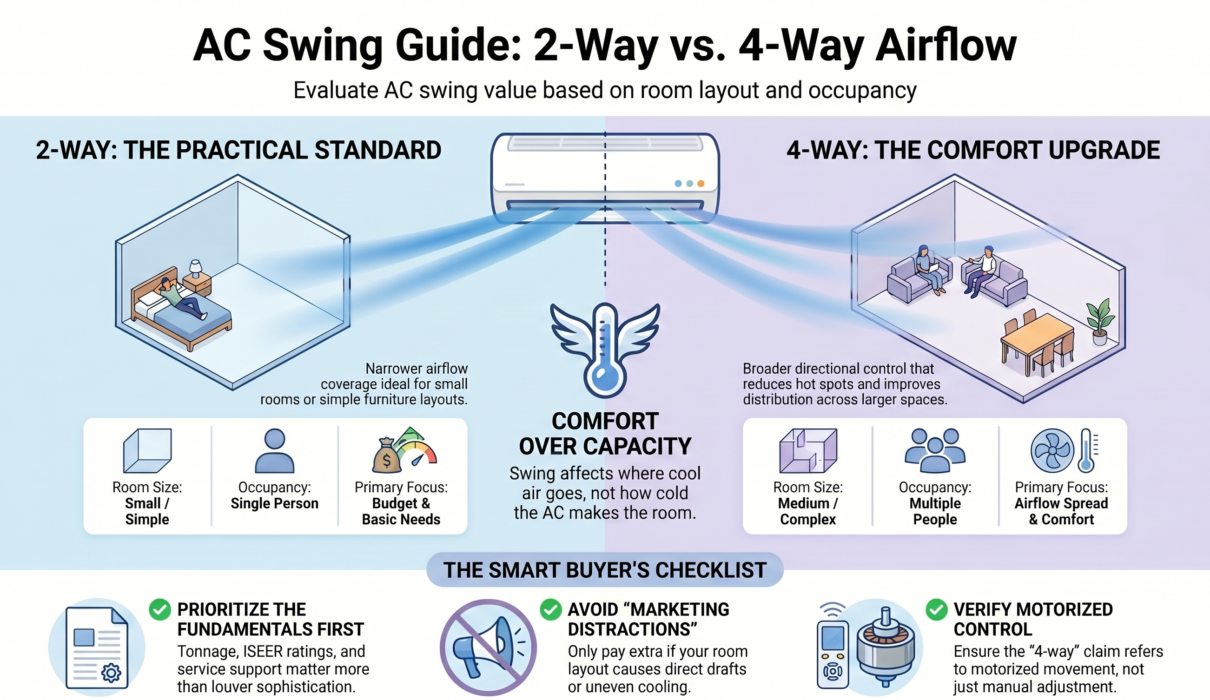
In simple buyer language, it affects where the cool air goes and how broadly it gets distributed inside the room.
That matters because cooling comfort is not only about whether the room becomes cold. It is also about:
- whether one side of the room feels colder than the other
- whether the bed or sofa gets direct cold draft
- whether some parts of the room stay warmer longer
- whether airflow reaches occupants more evenly
So swing control is mainly a comfort-distribution feature, not a core cooling-capacity feature.
2-way swing vs 4-way swing: what is the real difference?
This is the part buyers care about.
2-way swing
In practical terms, 2-way swing usually means airflow movement is more limited. In many buyer-facing listings, this generally refers to one major motorized direction plus a simpler secondary manual or fixed direction behavior.
At buyer level, the practical effect is:
- more limited directional control
- narrower airflow coverage
- usually enough for simpler room layouts
4-way swing
4-way swing usually means the AC can distribute air more broadly in both major airflow directions – typically giving better coverage across the room instead of concentrating airflow in a narrower pattern.
At buyer level, the practical effect is:
- broader airflow spread
- better chance of reducing hot or cold spots
- more flexibility in how air reaches different parts of the room
That does not mean 4-way swing guarantees perfect cooling. It means the AC has better airflow-direction capability than a simpler swing setup.
Does 4-way swing really improve uniform cooling?
Sometimes yes. Not always dramatically.
This depends on:
- room size
- room shape
- AC placement
- furniture and airflow obstruction
- tonnage fit
- how well the blower and louver logic are implemented
Where it can help
4-way swing can help more when:
- the room is a bit larger
- multiple people use the room
- bed, sofa, or seating position makes draft control important
- the room has a more awkward layout
- you want better airflow spread rather than a narrow cold stream
Where the difference may be smaller
The difference may matter less when:
- the room is small
- the AC is well positioned already
- occupancy is simple
- tonnage and cooling load are already matched well
- buyer budget is tight and bigger priorities still exist
So the real buyer rule is:
4-way swing can improve comfort distribution, but it is not a magic feature.
2-way swing vs 4-way swing: quick comparison table
| Feature angle | 2-Way Swing | 4-Way Swing |
| Airflow control | More limited | Broader directional control |
| Room coverage tendency | Narrower | Wider spread |
| Comfort benefit | Usually enough for simpler setups | More useful in rooms where airflow distribution matters more |
| Hot-spot reduction potential | Limited | Better chance, but not guaranteed |
| Who should care more | Budget-first buyers, smaller rooms, simpler use | Buyers with medium rooms, multiple occupants, comfort-detail focus |
| Purchase weight | Low to moderate | Moderate, but still secondary to core factors |
This is the correct buying lens:
4-way swing is usually a comfort upgrade, not a core buying foundation.
When 4-way swing matters more
Give this feature more weight in these situations:
Medium rooms
As the room becomes more demanding, broader airflow distribution can become more useful.
Multiple occupants
If two or more people regularly use the room, airflow direction and spread can matter more.
Seating or bed placement issues
If direct cold draft is a concern, better directional control can help.
Avoiding uneven cooling feel
If one corner feels cooler and another stays warmer, broader swing capability can help reduce that effect.
Buyers sensitive to direct cold air
Some people dislike a strong cold stream directly on the bed or seating area. Better airflow spread can improve comfort here.
When 2-way swing is usually enough
2-way swing is often enough when:
The room is small
In smaller rooms, broad airflow distribution matters less because the AC can already cover the room more easily.
The use case is simple
A straightforward bedroom or compact room with simple seating/sleeping placement often does not need premium airflow control.
The budget is tight
In many buying decisions, tonnage, ISEER, warranty, and service support deserve more importance than airflow-direction refinement.
The price gap is hard to justify
If 4-way swing is adding cost without enough real-world benefit in your room, it becomes a low-priority feature.
Why this feature should not distract from bigger buying factors
This is the most important section.
Even if 4-way swing is useful, these factors usually matter more:
Tonnage
Wrong tonnage hurts comfort far more than a weaker swing feature ever will.
ISEER / running cost
If you want better long-term electricity efficiency, ISEER and annual power consumption matter more.
Warranty
A feature-rich AC with weaker warranty confidence is not automatically the better buy.
Service support
After-sales reliability in your city matters more than louver sophistication.
Overall value
A stronger overall model in the right size and price band is usually the better decision, even if its airflow feature list looks simpler.
Room suitability
A well-matched AC in the right room beats a poorly matched AC with a more attractive swing label.
So the smart buyer mindset is: notice this feature, but do not over-index on it.
How to evaluate this feature without falling for marketing
Use this checklist:
- Check whether the airflow direction is actually motorized
- Check your room size and room layout
- Check bed / seating / occupancy position
- Check whether the price gap is reasonable
- Treat it as a comfort feature, not a core buying criterion
- Make sure tonnage, ISEER, warranty, and service are already right first
That is the cleanest way to decide whether this feature is useful for your room or just attractive on the spec sheet.
Final verdict
4-way swing can be useful.
2-way swing is often enough.
That is the practical answer.
If your room is small, your layout is simple, and your budget is tight, 2-way swing is usually not a deal-breaker.
If your room is a bit more demanding, airflow distribution matters to your comfort, or you dislike uneven cooling feel and direct draft, 4-way swing can be worth paying some attention to.
But buyers should still treat this as a secondary feature. Proper tonnage, efficiency, warranty, service, and overall value matter more.
A 4 way swing vs 2 way swing AC difference matters mainly when airflow distribution and comfort coverage are part of the buying decision.
Related Reads
If you want the broader framework for choosing the right AC, use our AC buying guide for Indian buyers.
If you are comparing actual products, see our guides to the best 1 ton inverter AC in India, best 1.5 ton 3-star inverter AC in India, and best 1.5 ton 5-star inverter AC in India.
If your budget is capped, see our guide to the best AC under ₹40,000 in India.
If you are still deciding what capacity fits your room, read our 1 Ton vs 1.5 Ton AC guide.
If the bedroom-use version of this topic matters more to you later, read our Best AC for Bedroom in India.
For broader AC efficiency and labeling context, buyers can also review Bureau of Energy Efficiency resources where relevant.
FAQ
What is 4-way swing in an AC?
4-way swing usually means the AC can distribute air more broadly across the room using wider directional airflow control.
What is 2-way swing in an AC?
2-way swing usually means more limited airflow-direction control and narrower distribution compared with 4-way swing.
Is 4-way swing better than 2-way swing?
It can be better for airflow spread and comfort in some rooms, but it is not automatically better for every buyer or every room.
Does 4-way swing improve cooling?
It can improve cooling distribution and comfort feel in some setups, but it does not replace correct tonnage or overall AC quality.
Is 2-way swing enough for a bedroom?
Often yes, especially in smaller or simpler bedrooms where airflow-distribution demands are modest.
Should I pay extra for 4-way swing AC?
Only if the room setup, comfort need, and price gap make sense. It is usually a secondary feature, not a primary buying criterion.
Does swing type matter more than tonnage?
No. Tonnage matters much more. Wrong tonnage hurts comfort far more than a simpler swing feature.
Can 4-way swing reduce hot spots in a room?
Sometimes yes, but only conditionally. It can help airflow reach more areas of the room, but room layout, placement, and AC fit still matter.