

 By
By Inverter vs dual inverter vs triple inverter AC is now one of the most common label-comparison questions Indian buyers face on AC listings.
Buyers in India now see a growing pile of compressor labels on AC listings: Inverter, Dual Inverter, Triple Inverter, and sometimes even AI-flavored variants. The problem is not that these labels are useless. The problem is that buyers often do not know how much weight to give them.
This page is a practical Indian guide to that question. It is not a product roundup, and it is not a dry compressor engineering paper. The goal is simpler: explain what these labels usually mean, where the engineering signal is real, where the brand language gets fuzzy, and what should matter more before you pay extra.
Table of Contents
What is an inverter AC in the first place?
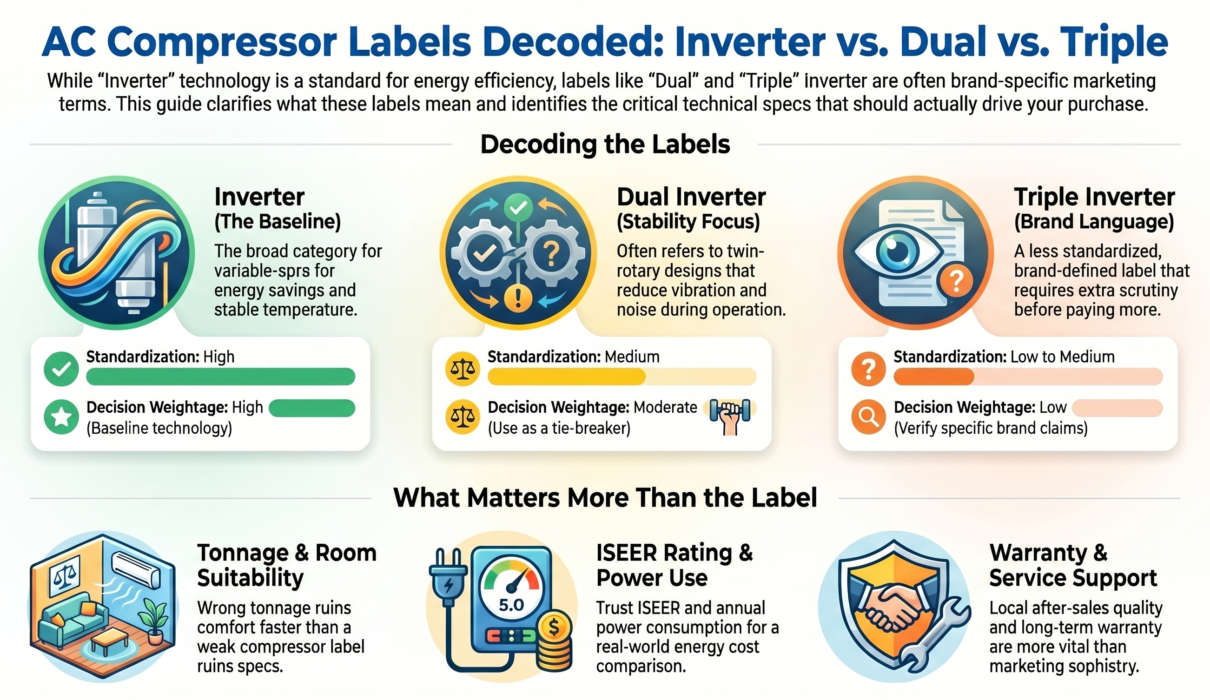
An inverter AC is the broad technology category. The basic idea is that the compressor does not behave like an older fixed-speed system that mainly runs full power and cycles on and off. Instead, it can adjust speed according to cooling demand, which supports more stable temperature control and can reduce energy use. LG explains inverter air conditioning exactly in that broad way: an inverter-controlled compressor adjusts speed to meet the desired temperature, which helps maintain a more consistent temperature with less energy consumption.
For buyers, that is the real baseline definition.
Everything else – dual inverter, triple inverter, AI inverter – sits on top of that broader inverter concept.
Dual inverter AC: what does it usually mean?
This is where the term starts to become more specific.
In buyer language, dual inverter usually suggests a more specific compressor-design claim than plain “inverter.” LG’s business-side materials explicitly describe its Dual Inverter Compressor as having a structure optimized for stability, allowing low vibration and low noise. LG also separately explains the twin rotary compressor concept as a compressor with two compression chambers, also called a dual rotary compressor. That does not prove every dual inverter claim across the market means exactly the same thing, but it does support the common buyer interpretation that dual inverter is often tied to a twin-rotary / smoother-operation pitch.
That is why the label can matter a bit in real buying decisions. If a brand is genuinely using a compressor design that improves stability, lower vibration, or smoother control, there may be a real engineering difference behind the marketing. But the weight you give that difference should still depend on the rest of the AC.
Triple inverter AC: what does this label usually imply?
This label needs more caution.
Unlike plain “inverter,” and unlike dual inverter where the twin-rotary connection is often easier to interpret, triple inverter appears to be less standardized and more brand-defined. Haier, for example, uses Triple Inverter Plus / Triple Inverter+ prominently across several India AC listings and older launch communication. In one India release, Haier said Triple Inverter Plus reaches the desired temperature quicker and adjusts DC voltage for stable operation between 140V and 264V, while current product pages keep the label but do not always explain it in the same structured way. That is exactly why buyers should treat the term carefully.
So the practical reading is:
- triple inverter may reflect a real internal design or control approach
- but it is often more brand-language-dependent
- and it deserves more interpretation than blind trust
In other words, triple inverter is not a universal industry definition in the way buyers often assume. It is closer to a brand framing that may bundle compressor, control, or power-management claims together. That is an inference from how brands currently present it, especially in Indian product language.
Inverter vs Dual Inverter vs Triple Inverter AC: Quick Comparison
| Term | What it generally means | Standardization | What buyers should verify | Weightage |
| Inverter AC | Broad variable-speed compressor category | High | Tonnage, ISEER, annual power consumption, warranty | High as a baseline technology category |
| Dual Inverter AC | Usually a more specific compressor-design pitch, often linked to twin-rotary / stability / low-vibration claims | Medium | Whether the brand explains a real compressor or performance difference | Moderate, mostly as a tie-breaker |
| Triple Inverter AC | Usually a brand-defined premium label, often less standardized | Low to medium | What the brand actually means by it in that model family | Low to moderate unless the rest of the AC is already strong |
That is the buyer lens that matters.
Not all three labels deserve equal trust or equal decision weight.
What difference can these labels make in real use?
Potentially useful differences can show up in areas like:
- smoother compressor operation
- noise or vibration behavior
- cooling-speed claims
- stability claims
- electricity-use claims
But the correct word here is potentially.
LG’s own language around Dual Inverter focuses on stability, low vibration, low noise, and efficient cooling. Haier’s older Triple Inverter Plus messaging linked the label to quicker pull-down, voltage stability, and energy-saving claims. Those are real brand positions – but they are still not the same as universal guarantees.
So the buyer rule is:
- these labels can reflect meaningful engineering choices
- but the real-world value still depends on model implementation, room conditions, runtime, and how strong the whole AC is
What matters more than the label?
This is the critical section.
In real Indian buying decisions, these factors usually matter more than whether the box says inverter, dual inverter, or triple inverter:
Tonnage
Wrong tonnage ruins comfort faster than a weak compressor label ruins the spec sheet.
ISEER / electricity efficiency
If you want to compare running cost more intelligently, ISEER and annual power consumption matter more than a buzzier compressor phrase.
Warranty
A stronger compressor label with weaker warranty support is not automatically the smarter buy.
Service support
After-sales quality in your city can matter more than label sophistication.
Budget fit
A big price jump needs a clearer real-world benefit than branding alone.
Room suitability
A well-matched AC in the right room beats a poorly matched AC with a more impressive label.
Overall model value
The strongest choice is often the model that gets the full package right – size, efficiency, warranty, service, and price – not the one with the most dramatic compressor branding.
When should a buyer care about dual or triple inverter claims?
These labels deserve more attention when:
- you are comparing premium segment models
- two models are otherwise closely matched
- you are comparing within the same brand language ecosystem
- the label is supported by a clearly stronger total package
That is where compressor branding can function as a tie-breaker.
When should a buyer care about dual or triple inverter claims?
These labels deserve more attention when:
- you are comparing premium segment models
- two models are otherwise closely matched
- you are comparing within the same brand language ecosystem
- the label is supported by a clearly stronger total package
That is where compressor branding can function as a tie-breaker.
When should a buyer mostly ignore the label?
Mostly ignore it when:
- Check tonnage first
- Check ISEER / annual power consumption
- Check warranty and service support
- Check whether the model is actually strong in its price band
- Treat compressor branding as one signal, not the whole decision
That is the cleanest way to avoid over-indexing on label inflation.
Final Verdict
Inverter AC is the real broad technology category.
Dual inverter can matter in some implementations, especially where it reflects a real twin-rotary / stability / noise-control design choice.
Triple inverter needs more skepticism and more context because brand usage is less standardized.
So the smartest buyer rule is simple:
- do not ignore these labels completely
- do not worship them either
- prioritize overall value, efficiency, warranty, service, and room suitability first
That is how much weight these labels deserve in a real Indian AC purchase decision.
An inverter vs dual inverter vs triple inverter AC decision should be treated as a label-interpretation question, not as a shortcut for overall model quality.
Related Reads
If you want the broader framework for choosing the right AC, use our AC buying guide for Indian buyers.
If you want to compare running cost more intelligently, read our guide on what ISEER means in an AC and how it affects your electricity bill.
If you are still deciding between efficiency tiers, read our 3-Star vs 5-Star AC guide.
If you are comparing actual products, see our guides to the best 1 ton inverter AC in India, best 1.5 ton 3-star inverter AC in India, and best 1.5 ton 5-star inverter AC in India.
If your budget is capped, see our guide to the best AC under ₹40,000 in India.
FAQ
What is dual inverter AC?
In practical buyer language, dual inverter usually refers to a more specific inverter-compressor design pitch than plain inverter AC, often tied to smoother, lower-vibration operation. But the exact meaning can still depend on brand usage.
What is triple inverter AC?
Triple inverter is usually a brand-defined marketing label rather than one single universal industry definition. Haier’s India materials are a clear example of that kind of usage.
Is dual inverter better than normal inverter AC?
Sometimes, but not automatically. It can reflect a more refined compressor design, but it should not outweigh tonnage fit, ISEER, warranty, or overall model value.
Is triple inverter just marketing?
It is not safe to dismiss it completely, but it is safer to treat it as a less standardized brand label that needs more context and more scrutiny.
Does dual inverter save more electricity?
It can help in some implementations, but electricity-use differences should be judged through ISEER and annual power consumption, not through label excitement alone.
Which matters more: inverter label or ISEER?
For running-cost comparison, ISEER matters more. The inverter label tells you broad technology or compressor-branding language; ISEER tells you more directly how efficient the AC is in the labeling framework.
Should I pay extra for dual inverter AC?
Only if the overall model is already strong and the price gap is reasonable. It is usually a tie-breaker factor, not the first reason to buy an AC.
Does triple inverter mean better cooling?
Not automatically. Cooling quality still depends more on tonnage fit, implementation, room conditions, and overall model strength than on the label alone.