

 By
By This inverter AC buying guide India buyers can use in 2026 is designed to help you choose the right tonnage, star rating, budget, and installation setup before shortlisting models.
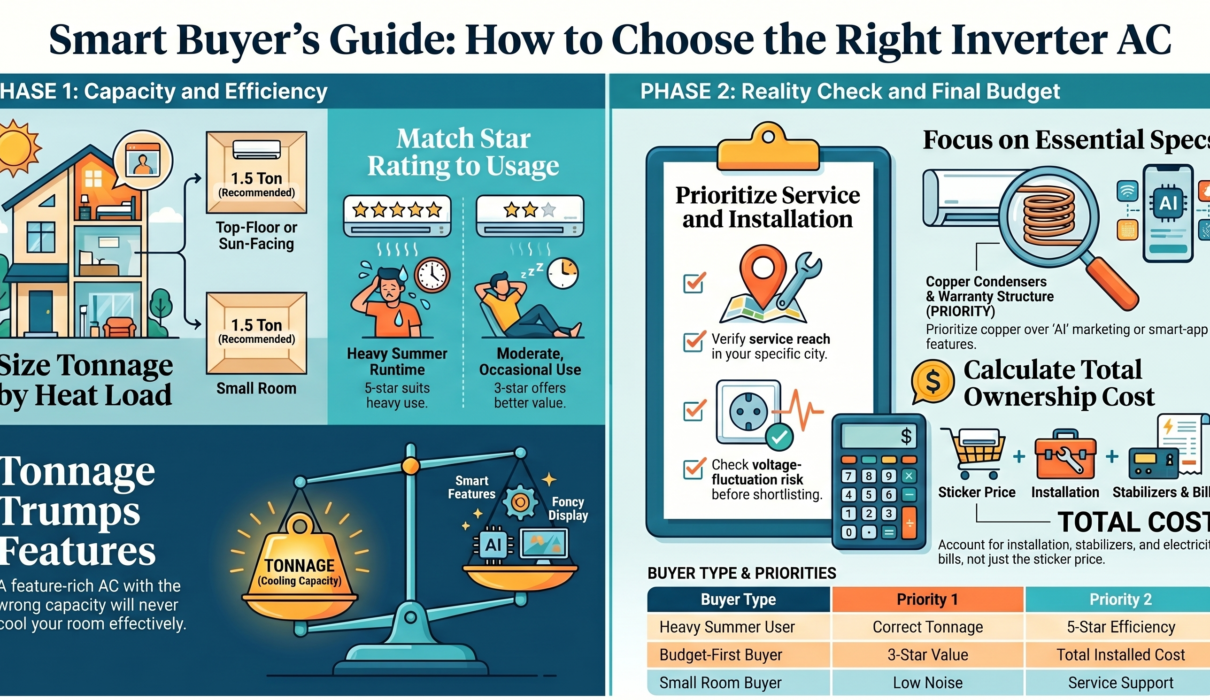
Buying an inverter AC in India is not just about choosing a brand or the newest feature list. A better buying decision starts much earlier: with room conditions, usage pattern, electricity-bill sensitivity, service practicality, and total ownership cost.
This page is not another product roundup. It is a practical selection framework for buyers who want to understand how to choose the right inverter AC before narrowing down models.
This guide is based on structured secondary research, market and usage analysis, and editorial guidance rather than hands-on testing. Where the answer depends on room, climate, usage, or model quality, that dependence is stated directly.
Quick-Start Answer
If you want the shortest useful version, this is it:
- Choose the right tonnage first
- Then decide whether 3-star or 5-star suits your usage
- Then shortlist models by budget and use case
- Then check service support, voltage conditions, and installation realities
Do not start with feature hype.
Do not start with the cheapest listed price.
Do not assume star rating alone decides the best AC.
Table of Contents
Inverter AC Buying Checklist
Use this checklist before you shortlist any model:
- room size and room conditions
- whether you need 1 ton or 1.5 ton
- whether 3-star or 5-star suits your usage
- daily runtime in peak summer
- top-floor or sun-facing exposure
- service reach in your city
- installation conditions in your home
- stabilizer or voltage-fluctuation risk
- total budget ceiling
- total ownership cost, not just AC sticker price
This checklist matters because a good model can still be the wrong purchase if the sizing, usage, or installation reality is wrong.
Step 1: Choose the Right Tonnage
Tonnage comes before everything else. A feature-rich AC with the wrong capacity is still the wrong AC.
Why room size alone is not enough
Square feet is only a starting point. It does not fully capture how demanding the room actually is. A small shaded room and a small top-floor west-facing room do not behave the same way.
When 1 ton makes sense
A 1 ton inverter AC usually makes sense when:
- the room is genuinely small
- heat load is moderate
- sunlight exposure is not severe
- usage is moderate
- the room is a study, compact bedroom, or guest room
When 1.5 ton is safer
A 1.5 ton inverter AC becomes safer when:
- the room is medium-sized
- the room is top-floor or sun-facing
- the room traps heat
- daily runtime is long
- you want more cooling margin in peak summer
AC Tonnage Calculator
AC Tonnage Calculator
Estimate AC tonnage based on room size, occupancy, and real-world heat load factors.
Basic Room Details
AC Running Cost Calculator
AC Running Cost Comparison Calculator
Compare the estimated running cost of two AC options based on your usage pattern.
Usage Assumptions
Option A
Option B
Estimated Cost Breakdown
Option A
Option B
If you are still confused between the two, read our dedicated 1 Ton vs 1.5 Ton AC in India guide.
If you already know a 1 ton AC is enough for your room, see our guide to the best 1 ton inverter AC in India.
If you need more cooling capacity, see our guides to the best 1.5 ton 5-star inverter AC in India and best 1.5 ton 3-star inverter AC in India.
Step 2: Decide Between 3-Star and 5-Star
Once tonnage is clear, the next decision is efficiency tier.
Think in terms of usage, not prestige
A 5-star AC is not automatically the right answer for every buyer. A 3-star AC is not automatically the compromise either.
3-star usually makes more sense when
- upfront budget matters more
- daily usage is moderate
- you want stronger value at purchase time
- the room is not heavily demanding
5-star usually makes more sense when
- the AC will run for long hours
- electricity-bill sensitivity is high
- the room is used heavily in summer
- you plan to keep the AC for years
The right question is not “which rating is better?”
The right question is “which rating fits my usage better?”
If you want the dedicated comparison, read our 3-Star vs 5-Star AC in India guide.
Step 3: Focus on the Factors That Actually Matter
This is where buyers often get distracted. Not every feature deserves equal weight.
Essential factors
These are the things that matter most:
- correct tonnage for the room
- suitable star rating for your usage
- warranty structure
- service support in your city
- copper condenser
- voltage tolerance or stabilizer compatibility
- installation practicality
Useful but secondary factors
These can improve ownership, but they should not override the basics:
- convertible modes
- app control and smart features
- better air swing patterns
- noise refinement
- indoor filter convenience
- display and timer usability
Mostly marketing-heavy features
These often sound larger than their real value:
- exaggerated AI language
- overloaded filter branding
- too many convertible-step labels
- flashy app features you may never use
- feature-count wars that do not change comfort much
A buyer who gets tonnage, star rating, service, and installation right will usually make a better decision than a buyer who gets distracted by feature clutter.
Step 4: Set the Right Budget
Budget does not just change which brand you buy. It changes what kind of AC decision is realistic.
What budget affects
Your budget influences:
- tonnage options
- 3-star vs 5-star feasibility
- smart-feature availability
- warranty strength
- whether you buy a current-label model or a stronger older-label value model
What to expect under ₹40,000
In this budget, buyers often need to balance:
- 1 ton vs 1.5 ton
- 3-star vs 5-star
- features vs raw cooling
- budget certainty vs sale-dependent value
The cheapest sticker price is not always the best buy. Installation, extra copper piping, stabilizer cost, and long-term satisfaction matter too.
If your budget is capped, read our guide to the best AC under ₹40,000 in India.
Step 5: Shortlist by Your Use Case
Once the basics are locked, shortlist by the kind of buyer you are.
Small bedroom buyer
Start with:
- 1 ton if the room genuinely fits
- balanced efficiency
- lower noise
- practical warranty and service
Then move to the best 1 ton inverter AC in India page.
Medium bedroom buyer
Start with:
- 1.5 ton
- room heat load first
- then star rating
- then shortlist by value or premium-efficiency
Then move to the best 1.5 ton 5-star inverter AC in India or best 1.5 ton 3-star inverter AC in India depending on your usage and budget.
Heavy-use summer buyer
Start with:
- correct tonnage
- 5-star consideration
- stronger cooling margin
- long-term bill sensitivity
Then move to the 1.5 ton 5-star page and the 3-star vs 5-star page.
Budget-first buyer
Start with:
- correct tonnage
- realistic star-rating choice
- value-led shortlist
- total installed cost
Then move to the best AC under ₹40,000 in India page.
Efficiency-first buyer
Start with:
- correct tonnage
- 5-star if usage justifies it
- check whether the efficiency gain matters for your runtime
- avoid paying for the label alone
Common Mistakes to Avoid When Buying an Inverter AC
These are the mistakes that create regret even when the AC itself is decent.
Picking tonnage by guess
Buying 1 ton or 1.5 ton without checking room conditions is one of the most common mistakes.
Over-focusing on star rating alone
Star rating matters, but it does not replace correct sizing, good installation, or strong service support.
Ignoring room heat load
Top-floor exposure, strong sunlight, poor insulation, and trapped heat can change the right answer completely.
Buying on feature hype
Too many buyers overpay for smart features or AI branding they will barely use.
Not checking service support
A good spec sheet is not enough if service quality is weak where you live.
Ignoring installation and voltage conditions
Bad installation can damage the ownership experience faster than a weak spec sheet. Voltage instability also matters more in India than many buyers assume.
Buying purely on lowest listed price
A low listing price can hide a weaker fit, weaker model, or extra ownership costs later.
Inverter AC Buying Guide India : Final Verdict
A good inverter AC buying decision usually works like this:
- First choose the right size
- Then choose the right star rating
- Then set the right budget band
- Then shortlist specific models
That order matters.
Do not buy by brand first.
Do not buy by feature count first.
Do not buy by discount first.
A smarter Indian buyer asks:
- What size does my room really need?
- How much do I actually use the AC?
- Do I care more about upfront cost or long-term efficiency?
- Can I support this purchase with proper installation and reliable service?
That is how you choose the right inverter AC without getting trapped by marketing noise.
Related Reads
- Best 1 Ton Inverter AC in India
- Best 1.5 Ton 5-Star Inverter AC in India
- Best 1.5 Ton 3-Star Inverter AC in India
- 3-Star vs 5-Star AC in India
- Best AC Under ₹40,000 in India
- 1 Ton vs 1.5 Ton AC in India
FAQ block
What should I check before buying an inverter AC?
Check tonnage, star rating, room conditions, runtime, service support, installation reality, and total ownership cost before you compare specific models.
How do I choose the right inverter AC in India?
Start with room suitability and tonnage, then decide between 3-star and 5-star, then shortlist by budget and use case.
Is inverter AC always better than non-inverter AC?
For most mainstream split-AC buyers today, inverter AC is usually the default better fit. But model quality, room fit, and usage still matter.
Should I buy 1 ton or 1.5 ton inverter AC?
Choose 1 ton for genuinely smaller rooms with moderate heat load. Choose 1.5 ton for medium or more demanding rooms, especially in Indian summer.
Should I buy 3-star or 5-star inverter AC?
Choose 3-star when upfront value matters more and usage is moderate. Choose 5-star when runtime is long and electricity-bill sensitivity is high.
Which inverter AC features actually matter?
Tonnage, star rating, warranty, service support, copper condenser, voltage tolerance, and installation practicality matter more than most smart-feature marketing.
Does inverter AC need a stabilizer?
Not always, but local voltage conditions matter. In unstable-supply areas, stabilizer decisions should not be ignored.
What mistakes should I avoid while buying an AC?
Avoid guessing tonnage, over-focusing on star rating, buying on feature hype, ignoring service support, and choosing by lowest listed price alone.