

 By
By Copper vs alloy condenser AC is one of the most misunderstood durability questions Indian buyers face, especially in coastal, humid, and pollution-heavy cities.
When buyers compare ACs in India, they usually notice tonnage, star rating, and price first. But one of the most ignored long-term ownership factors sits quietly in the spec sheet: condenser material and corrosion protection.
That matters because outdoor AC units in India deal with exactly the things buyers worry about later: humidity, heat, pollution, salty coastal air, corrosion, and repair bills. This page is a practical guide to understanding what the condenser actually is, why brands talk about copper, alloy, Blue Fin, Ocean Black, or Gold Fin, and when these differences matter enough to influence your buying decision.
This is material-level buyer guidance, not hands-on lab testing. Where a claim is a brand’s coating label or durability promise, it is treated as a manufacturer claim, not a universal truth.
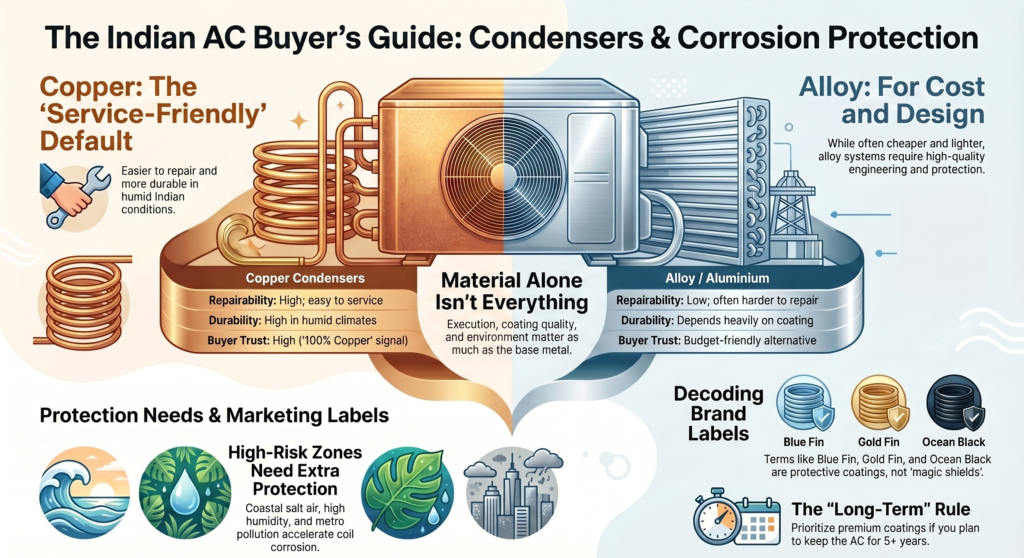
Table of Contents
What is the condenser in an AC?
The condenser sits in the outdoor unit of an air conditioner. Its job is to release the heat that the AC removes from your room. If the condenser coil struggles, cooling efficiency and overall performance can suffer. Carrier’s HVAC glossary explains the condenser as the outdoor part of the cooling system that releases absorbed heat and helps the refrigerant return to liquid form.
The practical takeaway is simple:
the condenser is not a decorative spec-sheet part. It is one of the core components that affects cooling, durability, and long-term ownership confidence.
Copper vs Alloy Condenser AC: What Is the Real Difference?
This is where buyer language matters more than metallurgy jargon.
Copper is usually framed as more service-friendly
In mainstream buyer guidance, copper is usually seen as the more repair-friendly and service-friendly choice. Haier’s India blog explicitly frames copper as longer-lasting and easier to repair than aluminium in humid Indian conditions, while Carrier commercial materials also describe copper as durable and easy to maintain in coil applications.
That is why many Indian buyers instinctively trust “100% copper” wording. It signals:
- easier repairability
- more confidence around long ownership
- less fear around costly coil-related problems later
Alloy / aluminium-based solutions are often chosen for cost and design reasons
Aluminium or alloy-based coil systems are not automatically poor. They are often used because they can reduce cost, weight, or support a particular coil design. Carrier’s coastal HVAC materials are a useful reminder that engineered aluminium solutions can be designed specifically for corrosion resistance in harsh coastal environments.
So the right interpretation is:
- copper is often the safer default for serviceability
- alloy/aluminium-based solutions are not automatically inferior
- the execution matters a lot
What buyers should really compare
Do not reduce the decision to a single line like “copper good, alloy bad.”
A smarter buyer asks:
- what is the base material?
- what corrosion protection is applied?
- what environment will this AC live in?
- how long do I plan to keep it?
- how easy would repair be if something goes wrong?
Does copper always mean better?
No. That would be too simplistic.
Copper is often the safer long-term default, especially for buyers who care about repairability and want fewer durability question marks. But copper alone does not guarantee excellent long-term performance. A poorly protected copper system in a harsh coastal environment can still suffer.
At the same time, not every aluminium or alloy-based solution should be dismissed. Carrier’s coastal product guidance is a useful counterexample: the company explicitly shifted some coastal systems to welded aluminum coil designs with added corrosion protection because coastal exposure changes the problem.
So the correct buyer rule is:
- copper usually deserves a positive bias
- but material alone is not enough
- coating quality, local environment, and build execution still matter
What do Blue Fin, Ocean Black, Gold Fin, and anti-corrosion coatings actually do?
These are usually brand marketing labels for protective coatings applied to coil surfaces, fins, or nearby metal parts. The names differ, but the practical idea is broadly similar: reduce corrosion risk from moisture, salt, pollutants, and harsh outdoor exposure.
Examples:
- Ocean Black Protection from LG is described as protection against salt, sand, pollutants, and corrosion in Indian conditions.
- Blue Fin or blue-coated condenser protection is commonly described by Haier as helping resist salt, acid deposits, and water droplets.
- Gold Fin is used by some brands, including Carrier in some markets, as a denser anti-corrosive coating claim for harsher environments.
- Hydrophilic blue fins and anti-corrosive U-bend coatings are also used in Voltas product language.
The practical meaning is this:
- these coatings are meant to slow corrosion
- they can help the coil deal better with salt, moisture, pollutants, and grime
- they are useful, especially in harsher environments
- they are not magic shields
That last point matters. Buyers should treat coating labels as meaningful protective features, not lifetime immunity promises.
Why coating matters more in coastal India, humid cities, and polluted metros
This is where the topic becomes very India-specific.
Coastal air
Salt in coastal air is one of the clearest reasons to care about corrosion protection. LG explicitly links Ocean Black Protection to resistance against salt particles and coastal exposure, while Haier’s India content highlights salt-heavy air as a major durability challenge.
High humidity
Humidity increases corrosion pressure over time, especially on outdoor components that stay exposed for long seasonal stretches. Haier’s India monsoon and humid-climate content repeatedly emphasizes how moisture and damp exposure affect coils.
Pollution-heavy cities
LG and Haier both tie their protective-coating messaging to industrial smoke, dust, and airborne pollutants. That matters for polluted metros because corrosion and grime are not just coastal problems.
Long seasonal exposure
In Indian summer usage, the outdoor unit spends long periods dealing with heat, dirt, moisture, and environmental wear. That is why coatings and material quality matter more in India than many buyers initially assume.
How condenser quality affects long-term ownership
This is where the buyer decision becomes practical.
Gas-leakage fear
Many Indian buyers worry about gas leakage. Some of that fear is exaggerated, but corrosion-related wear is one of the reasons coil durability matters. The right framing is not “this coating guarantees no leakage.” The right framing is “better material and better protection can reduce durability risk in harsher environments.”
Maintenance burden
A better-protected outdoor unit can reduce the chances of faster degradation and can support easier long-term ownership, especially in difficult environments.
Repairability
This is where copper still carries real buyer weight. If long-term repairability matters a lot to you, copper remains easier to trust than a vague alloy spec.
Whether paying more may make sense
If you live in Mumbai, Chennai, Goa, Visakhapatnam, Kochi, or another humid/coastal/polluted environment – or you plan to keep the AC for years – paying more for stronger material and coating protection can be rational. If you live in a lower-risk environment and have a shorter ownership horizon, this factor still matters, but it may not deserve top priority.
When buyers should care most about copper + coating
Give this factor more weight if you are in one of these buckets:
- coastal-city buyer
- humid-region buyer
- pollution-heavy metro buyer
- long ownership horizon buyer
- premium segment buyer
- heavy summer user
- buyer who worries about serviceability and long-term repair risk
This is the group most likely to benefit from treating condenser material and anti-corrosion protection as a serious buying factor, not just brochure language.
When this factor matters less
It still matters, but it may deserve less weight if:
- you are a budget-first buyer
- your ownership horizon is relatively short
- you live in a lower-risk environment
- the room/use case makes other decisions more important first
- the better-coated model comes at a price premium that does not match your use case
So the correct decision is not “ignore it” or “obsess over it.”
It is “weight it according to your local risk and ownership horizon.”
How to read this feature on an AC spec sheet without falling for marketing
Use this checklist:
Check the base material
Does the product clearly say 100% copper, copper tubes, or something more vague?
Check what is actually coated
Is the claim about fins, tubes, U-bends, heat exchanger parts, or only selected surfaces?
Check whether the coating name is just branding
Blue Fin, Gold Fin, Ocean Black, Shield Blu, and similar terms are usually marketing names. Do not assume they all mean the same thing.
Check your environment
If you are not in a coastal or humid risk zone, the premium for protection may matter less.
Check the ownership horizon
If you plan to keep the AC many years, durability factors deserve more weight.
Do not isolate this from the rest of the AC
Material and coating matter, but so do:
- service support
- warranty
- price
- tonnage fit
- efficiency
- overall product quality
That is the right way to read the feature.
Final verdict
Copper plus credible corrosion protection is generally the stronger long-term proposition for Indian buyers who care about serviceability, durability, and harsher local conditions.
But not every buyer needs to overpay for coating language alone.
And not every alloy/aluminium-based design should be dismissed automatically.
The smarter decision is:
- give this factor more weight in coastal, humid, polluted, and long-ownership scenarios
- give it some weight in normal city use
- do not treat material or coating as a standalone verdict
Local environment, ownership horizon, and build execution should decide how much importance you assign to condenser material and anti-corrosion protection.
A copper vs alloy condenser AC comparison matters most when durability, corrosion risk, and long-term serviceability are part of the buying decision.
Related Read
- AC Buying Guide
- Best 1.5 Ton 3-Star Inverter AC
- Best 1.5 Ton 5-Star Inverter AC
- Best AC Under ₹40,000
- Does AC Need Stabilizer
- Aluminum vs Copper Pipes
FAQ
Is copper condenser better than alloy in AC?
Usually, copper is the safer default for repairability and long-term service confidence. But alloy or aluminium-based solutions can still work well when build execution and corrosion protection are strong.
What is Blue Fin coating in an AC?
Blue Fin is usually a brand term for an anti-corrosion coating applied to coil surfaces or fins to help resist moisture, salt, and environmental exposure. It is useful, but it is not a guarantee against future corrosion.
Does anti-corrosion coating really matter?
Yes, especially in coastal, humid, or polluted Indian environments. In lower-risk environments it still matters, but it may not deserve top billing over tonnage, efficiency, or price.
Which condenser is best for coastal areas in India?
In coastal conditions, buyers should generally prefer stronger durability signals: good condenser material, credible anti-corrosion protection, and a brand/model that clearly addresses salty-air exposure. LG, Haier, and Carrier all explicitly connect coating protection to salt-heavy or coastal conditions in their own materials.
Can alloy condensers cause more gas leakage?
Do not treat that as a universal rule. The better buyer interpretation is that corrosion resistance, build quality, and environment affect long-term risk more than a single metal label alone.
Does copper condenser mean longer life?
Often it supports a stronger long-term durability case, especially when paired with good protection. But it does not guarantee longer life by itself.
Should I pay more for Blue Fin or Ocean Black protection?
Sometimes yes – especially if you live in coastal, humid, or pollution-heavy conditions, or plan to keep the AC for many years. In lower-risk conditions, do not overpay blindly for the label alone.
Is condenser material important for normal city use too?
Yes. It just matters more in harsher environments. Even in normal city use, serviceability and long-term durability still have value.