

 By
By Best AC temperature for sleep is one of the most common night-time comfort questions Indian AC users ask, especially when deciding between 24°C and 18°C.
A lot of Indian AC users do the same thing at night: set the remote to 18°C and assume that means faster cooling, better sleep, or stronger comfort.
Usually, it does not.
This page is a practical Indian guide to choosing the right AC setting for sleep. It is not a medical lecture, and it is not a generic electricity-saving article. The goal is simpler: explain why 24°C is often a smarter overnight reference point than 18°C, what sleep mode actually does, and how to balance comfort with lower electricity waste.
Table of Contents
Why people keep setting AC to 18°C
The logic is easy to understand:
colder setting = faster cooling = better comfort
That is the habit. The problem is that the logic is weak.
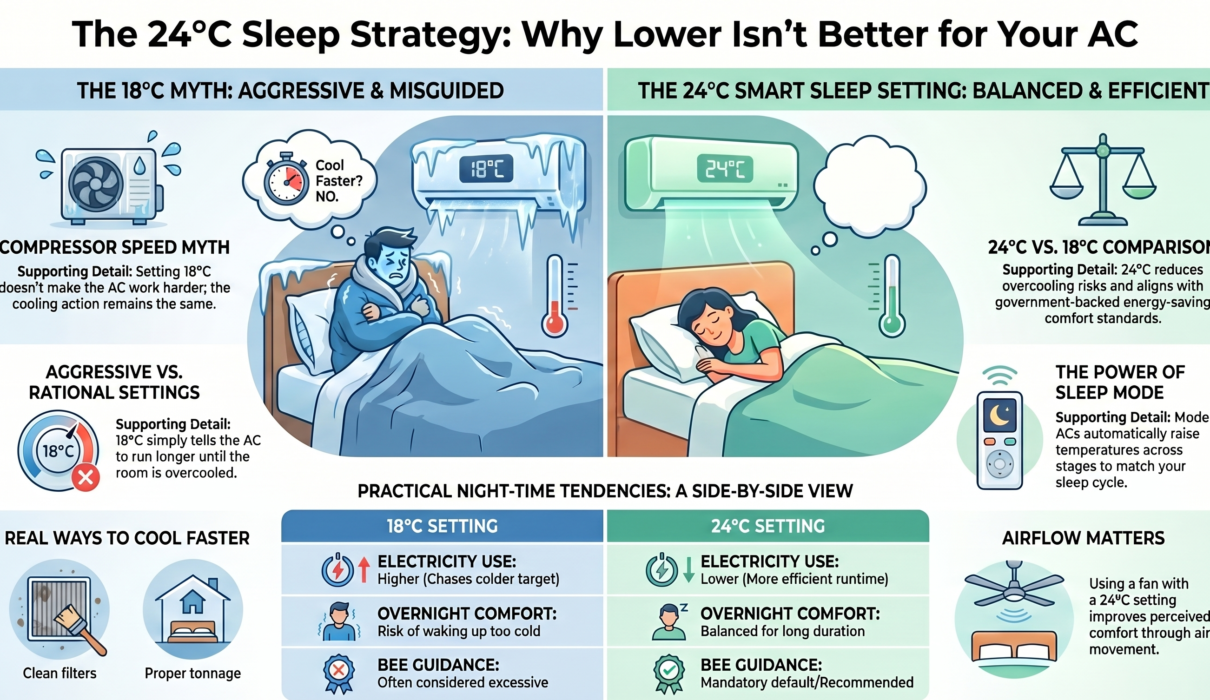
BEE’s FAQ on AC temperature settings says it is a common misconception that setting an AC to 18–21°C indicates better cooling performance. The same FAQ says technically this is not true and that the cooling action of the compressor is the same at other settings as well. PIB used the same explanation in its public communication around India’s 24°C AC setting push.
So the main reason people use 18°C is not because it is the smartest sleep setting. It is because it feels like the most aggressive one.
24°C vs. 18°C: what is the real difference at night?
This is the part that matters.
18°C at night
In many real bedrooms, 18°C is simply more aggressive than necessary for a full night. BEE/PIB guidance says 18–21°C often creates very cool indoor conditions and wastes energy.
Practical night-time tendency:
- stronger chance of overcooling later in the night
- higher electricity-use tendency
- more likely to feel good only in the first part of the cooling cycle, then excessive
- often used as a habit, not because the full-night comfort logic is sound
24°C at night
24°C is closer to the government-backed comfort reference point for AC defaults in India. BEE/PIB material says comfort conditions can sit around 24–25°C with proper humidity and air movement, and India made 24°C the mandatory default setting for room ACs from 2020 onward.
Practical night-time tendency:
- lower chance of overcooling
- more sensible for long overnight runtime
- better aligned with energy-conscious use
- easier to fine-tune up or down depending on room and sleeper comfort
That does not mean 24°C is perfect for every person. It means it is often a more rational starting point than 18°C.
Does a lower AC setting cool the room faster in a useful way?
Usually, not in the way people think.
BEE’s published FAQ says the belief that 18–21°C means better cooling performance is technically not true, and that the compressor’s cooling action is the same at other settings as well.
The practical meaning is:
- setting 18°C does not turn the AC into a stronger machine
- it mainly tells the AC to keep running until the room gets much colder
- that can increase runtime and waste, especially at night
So if the room feels hot when you first enter, the useful solutions are usually:
- let the AC start cooling early enough
- use proper tonnage
- keep filters clean
- reduce heat load
- use sleep mode or reasonable setpoints instead of overcorrecting to 18°C
Best AC setting for sleep in India
For many Indian bedrooms, the practical starting band is:
24°C to 26°C as a starting range
That range is more aligned with India’s energy-comfort guidance than aggressive low settings. BEE/PIB material places comfort around 24–25°C, while Samsung’s India sleep-mode guidance recommends 25–27°C in cooling mode for supported models.
A practical rule
- Start around 24°C
- If that feels slightly warm, move gradually rather than jumping to 18°C
- If your room is already well-sized, sealed, and not badly heat-loaded, you often do not need an extreme setting to sleep comfortably
Sleep mode, timer, and fan use: what actually helps?
This is the most useful ownership section.
Sleep mode
Sleep mode is often more sensible than holding one harshly low number all night.
Samsung’s India support explains that good sleep mode changes temperature across stages:
- first easing you into sleep by dropping the temperature slightly
- then raising it a bit during sound sleep
- then increasing again toward wake-up stage
- It also recommends 25–27°C as the cooling set temperature for this mode on supported models.
That is an important clue: even manufacturer sleep-mode design is not centered around holding 18°C all night.
Timer use
A timer can help if:
- your room cools quickly
- outside temperature drops later in the night
- you tend to wake up cold after a few hours
Fan + AC combination
A fan can make a moderate AC setting feel more comfortable because airflow matters to perceived comfort. BEE’s comfort framing itself refers not just to temperature, but also to humidity and air movement values.
So in many bedrooms, moderate AC + sensible fan use works better than forcing the AC to 18°C.
What changes the ideal sleep temperature?
This is where the nuance comes in.
The right night setting depends on more than one number.
Room insulation
A better sealed room may stay comfortable at a higher setting.
Tonnage fit
If the AC is undersized, users often try to compensate by setting the temperature lower than necessary.
Top-floor heat
Hotter top-floor rooms may need stronger early cooling, but that still does not automatically mean 18°C is the right overnight setting.
Humidity
Humid rooms can feel warmer even when the temperature is not extreme.
Bedding and clothing
Heavy bedding can make moderate settings feel warmer than expected.
Number of sleepers
Two people in one bedroom usually create a different comfort profile than one person.
Fan use
Air movement can change how comfortable the same temperature feels.
So the right takeaway is:
24°C is often the smarter starting point, but the final comfort setting can still vary by room and person.
What matters more than choosing between 18°C and 24°C
This is the reality check.
Even though sleep setting matters, these things often matter more:
Correct tonnage
A wrongly sized AC creates bad comfort that users often try to “solve” by pushing the setpoint too low.
Proper installation
Weak airflow, poor sealing, or installation issues can distort how the room cools.
Clean filters
Dirty filters make good settings feel weak.
Room sealing and heat load
A room fighting heavy heat gain will behave differently from a better-controlled bedroom.
Overall AC efficiency
A stronger overall AC in the right size is better than trying to fix a weak fit with an extreme temperature setting.
So the smart ownership rule is:
do not use 18°C to compensate for a room or AC problem that should be fixed elsewhere.
| Comparison factor | 24°C | 18°C |
| Comfort tendency | Often a more balanced overnight starting point | Often more aggressive than necessary for full-night use |
| Electricity-use tendency | Lower than very aggressive settings | Higher tendency because the AC keeps chasing a colder target |
| Overnight suitability | Usually better for long sleep duration | More likely to cause overcooling later in the night |
| Overcooling risk | Lower | Higher |
| Who it suits | Most sleepers as a starting point, then adjust if needed | Only specific comfort cases, not a smart default for most users |
This is the practical lens that matters:
24°C is usually the smarter starting point. 18°C is usually the habit, not the answer.
Final verdict
For most Indian bedrooms, 24°C is often the smarter overnight starting point than 18°C.
That does not mean 24°C is perfect for every sleeper.
It does mean 18°C is usually colder than necessary for many people and often creates extra electricity waste without meaningfully improving full-night comfort.
So the practical sleep-setting rule is:
- start around 24°C
- adjust gradually if needed
- use sleep mode, timer logic, or airflow support more intelligently
- do not assume lower is automatically better
That is the more sensible way to use an AC at night.
Best AC temperature for sleep depends on room conditions, humidity, fan use, bedding, and how aggressively the room is being cooled through the night.
Related Reads
If you want the broader framework for choosing the right AC, use our AC buying guide for Indian buyers.
If you want to understand running-cost impact better, read our guide on what ISEER means in an AC and how it affects your electricity bill.
If you are still deciding what capacity fits your room, read our 1 ton vs 1.5 ton AC guide.
If you are comparing actual products, see our guides to the best 1 ton inverter AC in India, best 1.5 ton 3-star inverter AC in India, and best 1.5 ton 5-star inverter AC in India.
If bedroom-specific product fit matters more to you later, read our Best AC for Bedroom in India page when it goes live.
FAQ
What is the best AC temperature for sleep?
For many Indian bedrooms, 24°C to 26°C is a sensible starting band. BEE comfort guidance centers around 24–25°C, while Samsung’s sleep-mode guidance recommends 25–27°C for supported cooling-mode use.
Is 24°C the best AC setting at night?
It is often a strong starting point, but not a universal answer. The best setting still depends on room conditions, humidity, fan use, bedding, occupancy, and personal comfort.
Is 18°C too cold for sleeping?
For many sleepers, yes. It is often colder than necessary for a full night and can increase overcooling risk and electricity waste.
Does setting AC to 18°C cool faster?
Not in the useful way many people think. BEE’s FAQ says the belief that 18–21°C means better cooling performance is technically not true and that compressor cooling action is the same at other settings as well.
Does sleep mode save electricity?
It often can help because it adjusts temperature through the night instead of holding one aggressive low point. Samsung also explicitly says good sleep mode can reduce energy consumption versus conventional cooling mode on supported models.
Should I use a fan with AC at night?
In many rooms, yes. Air movement can help moderate AC settings feel more comfortable. BEE’s own comfort framing includes air movement alongside temperature and humidity.
What AC temperature saves electricity while sleeping?
Moderate settings usually make more sense than extreme low ones. In practical Indian use, around 24°C is often a more sensible starting point than 18°C.
Does the ideal sleep temperature depend on room size or tonnage?
Yes. Room heat load, top-floor exposure, insulation, humidity, number of sleepers, and AC sizing can all change what feels comfortable overnight.