India has two hotel co-brand cards: Marriott Bonvoy HDFC at ₹3,000 and HSBC Taj at ₹1,10,000 plus GST. How they work, the maths, and who should get one.
Quick Verdict
A hotel co-branded credit card is worth it in India only if you already stay with that one hotel group several nights a year. The card pays you in the hotel's own points and status, so its value depends almost entirely on how often you check in.
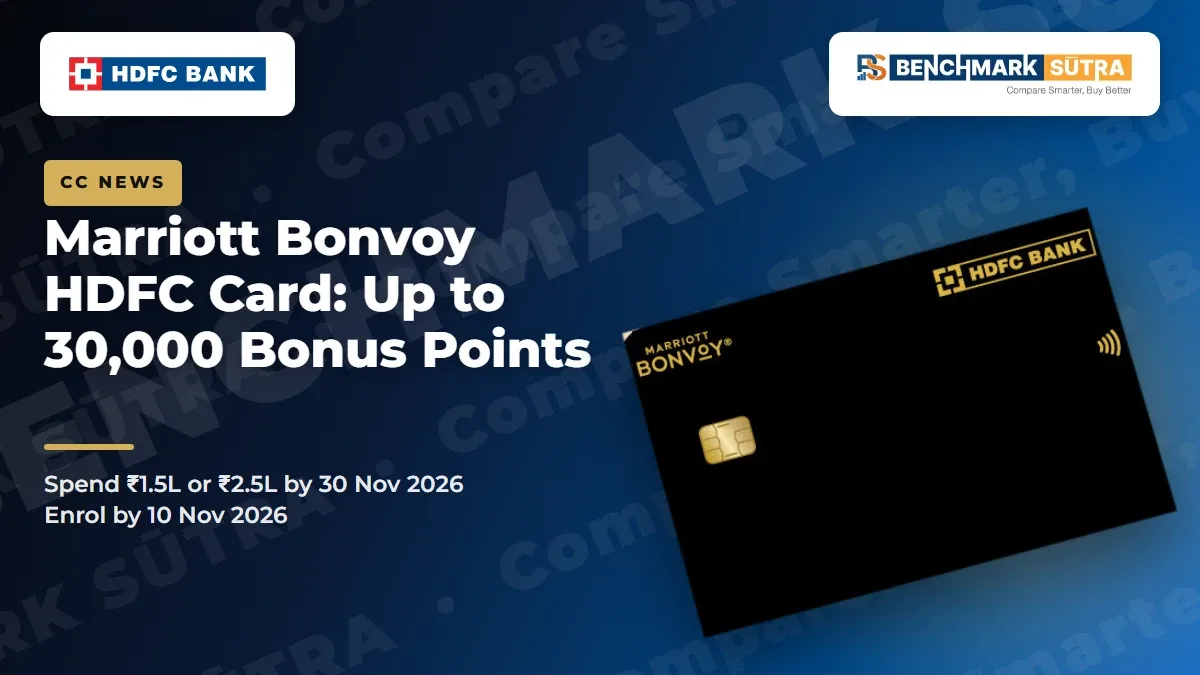
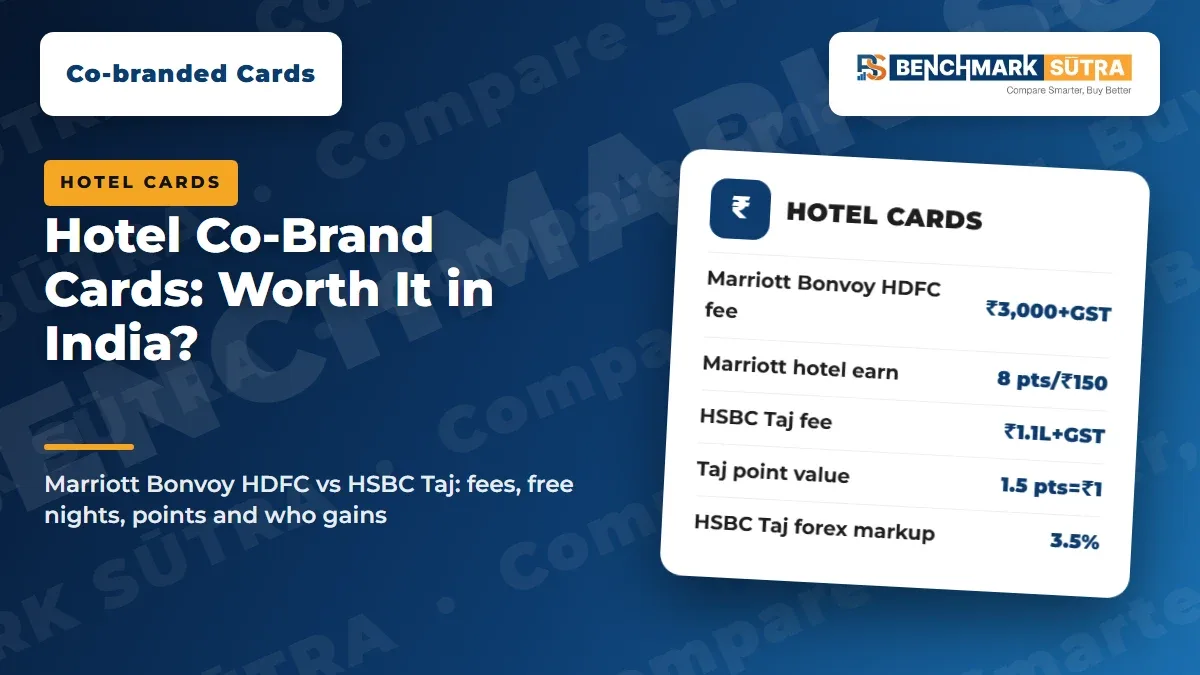
As of November 2026, there are two hotel credit card India options with a hotel's name on them: the Marriott Bonvoy HDFC Bank Credit Card at ₹3,000 plus GST a year, and the HSBC Taj Credit Card at ₹1,10,000 plus GST a year. One is a mid-range card for Marriott guests. The other is a luxury package for heavy Taj users.
Question | Marriott Bonvoy HDFC | HSBC Taj |
|---|---|---|
Annual fee | ₹3,000 + GST, no spend waiver | ₹1,10,000 + GST, no spend waiver |
What you earn | Marriott Bonvoy points | HSBC Taj points, 1.5 points = ₹1 at IHCL |
Hotel earn rate | 8 points per ₹150 at Marriott hotels | 5 points per ₹100 at Taj and IHCL brands |
Everyday earn rate | 2 points per ₹150 | 1.5 points per ₹100 |
Status | Silver Elite + 10 Elite Night Credits | NeuPass Taj InnerCircle Platinum |
Who it suits | Professionals who stay at Marriott hotels a few times a year | Very high earners who stay and dine at Taj often |
Benchmarksutra Score | 70/100 (B Tier) | 63/100 (C Tier) |
Apply with HDFC: Check HDFC credit cards
Disclosure: this is an affiliate link. BenchmarkSutra may earn a commission if you apply through it, at no extra cost to you. It does not change our analysis.
Apply with Axis: Check Axis credit cards
Disclosure: this is an affiliate link. BenchmarkSutra may earn a commission if you apply through it, at no extra cost to you. It does not change our analysis.
How Do Hotel Co-Branded Credit Cards Work?
A bank issues the card and runs the account. The hotel group supplies the loyalty programme. Every eligible spend earns the hotel's own currency, and the card adds hotel perks that a normal card does not have.
Most hotel cards give value in four layers:
Points: a higher rate at the hotel's own properties and a lower rate everywhere else.
Status: an elite tier in the hotel programme, which can mean upgrades, late check-out or discounts.
Stay vouchers: a free night or stay voucher when you pay the fee, and sometimes more at spend milestones.
On-property discounts: money off rooms, dining or spa at the hotel group.
The catch is that all four layers only pay out at one hotel group. If you stay at a different chain each trip, most of the value goes unused.
Marriott Bonvoy HDFC Bank Credit Card
This is the lower-cost hotel card. HDFC's page lists these core features, as of November 2026.
Fee: ₹3,000 plus taxes, charged on the 45th day after issue, and again each year. HDFC's MITC lists no spend-based waiver.
Earn: 8 Marriott Bonvoy points per ₹150 at participating Marriott Bonvoy hotels, 4 per ₹150 on travel, dining and entertainment, and 2 per ₹150 on other eligible spends.
Welcome benefit: 1 Free Night Award (up to 15,000 points), 10 Elite Night Credits and Silver Elite status. For cards onboarded from 1 October 2026, these come on payment of the fee.
Lounges: complimentary lounge access outside India each year. HDFC's page does not state the count, so check your card's terms.
Point expiry: HDFC's MITC says points do not expire as long as your Marriott Bonvoy account has earning or redemption activity at least once every 24 months.
HDFC's page headlines "up to 4 Free Night Awards". The welcome night is one of them; check the current milestone terms for the rest. A limited-period Anniversary Special Offer is also running until 30 November 2026, covered in our Marriott Bonvoy HDFC anniversary offer explainer.
Benchmarksutra Score: 70/100 — B Tier
HSBC Taj Credit Card
This is a luxury card built around Indian Hotels Company (IHCL) brands such as Taj, SeleQtions, Gateway and Vivanta.
Fee: ₹1,10,000 plus GST, charged after activation and on each anniversary. At 18% GST that is ₹1,29,800 a year.
Earn: 1.5 reward points per ₹100 on standard spends and 5 per ₹100 at Taj, SeleQtions, Gateway, Vivanta and amã Stays & Trails.
Point value: 1.5 points = ₹1 in the Taj Credit Card Wallet, usable for stays, food and beverages and spa at participating IHCL hotels.
Stays: two nights' breakfast-inclusive stays plus a one-night Taj Palace stay on activation. An extra Palace voucher comes with every new or renewed card until 31 December 2026.
Status and discounts: NeuPass Taj InnerCircle Platinum, 25% off the Best Available Rate on rooms, and 25% off food and beverages at participating hotels.
Forex: 3.5%, as per HSBC's MITC.
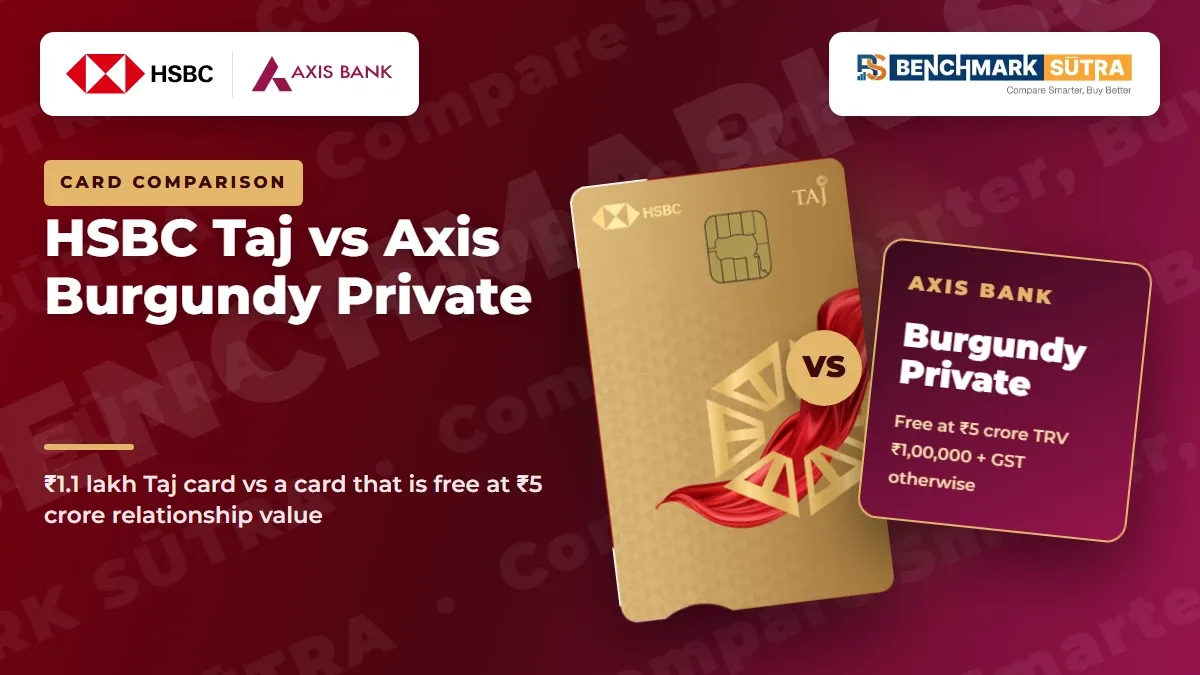
Eligibility is the real barrier. HSBC's product page lists ₹36 lakh a year for salaried and ₹45 lakh for self-employed applicants, in 21 listed cities. Its MITC still shows higher figures and says the card is offered on invitation. Confirm with HSBC before you apply. Our HSBC Taj vs Axis Burgundy Private comparison goes deeper.
Benchmarksutra Score: 63/100 — C Tier
Are Hotel Co-Branded Credit Cards Worth It? Do the Maths
The test is simple: do the hotel benefits you will really use cover the yearly fee plus GST? Count only nights you would have booked anyway.
Card | Yearly cost with 18% GST | What must cover it |
|---|---|---|
Marriott Bonvoy HDFC | ₹3,540 | One Free Night Award at a Marriott hotel you would have paid for, plus points |
HSBC Taj | ₹1,29,800 | Stay vouchers, 25% discounts on Taj spends, spa, lounges and points |
Example 1: a CA who stays at Marriott hotels twice a year
Say you would otherwise pay ₹9,000 for a night at a Marriott hotel that can be booked with your Free Night Award. That one night alone covers the ₹3,540 cost. Everyday spends of ₹40,000 a month, half on travel and dining, then add about 6,400 points a year at 4 per ₹150 and 3,200 at 2 per ₹150, or 9,600 in all. The ₹9,000 room rate is our illustrative assumption; check the real cash and points price before you count it.
Example 2: a doctor who dines at a Taj hotel once a month
Say you spend ₹3 lakh a year at IHCL hotels on rooms and dining. A 25% discount, if every bill qualified, would save ₹75,000. The 5-point earn on ₹3 lakh adds 15,000 points, worth ₹10,000 in the Taj wallet. That is ₹85,000 against a ₹1,29,800 cost, before vouchers, spa and lounges. The card works only if you will use those extras too. HSBC's terms also exclude certain dates from the dining discount.
New to points maths? Read Reward Rate vs Effective Reward Rate.
The Alternative: Bank Points You Can Move to Hotels
If you stay at different chains, a card with transferable bank points may suit you better. You earn bank points and move them to a hotel programme only when you have a booking.
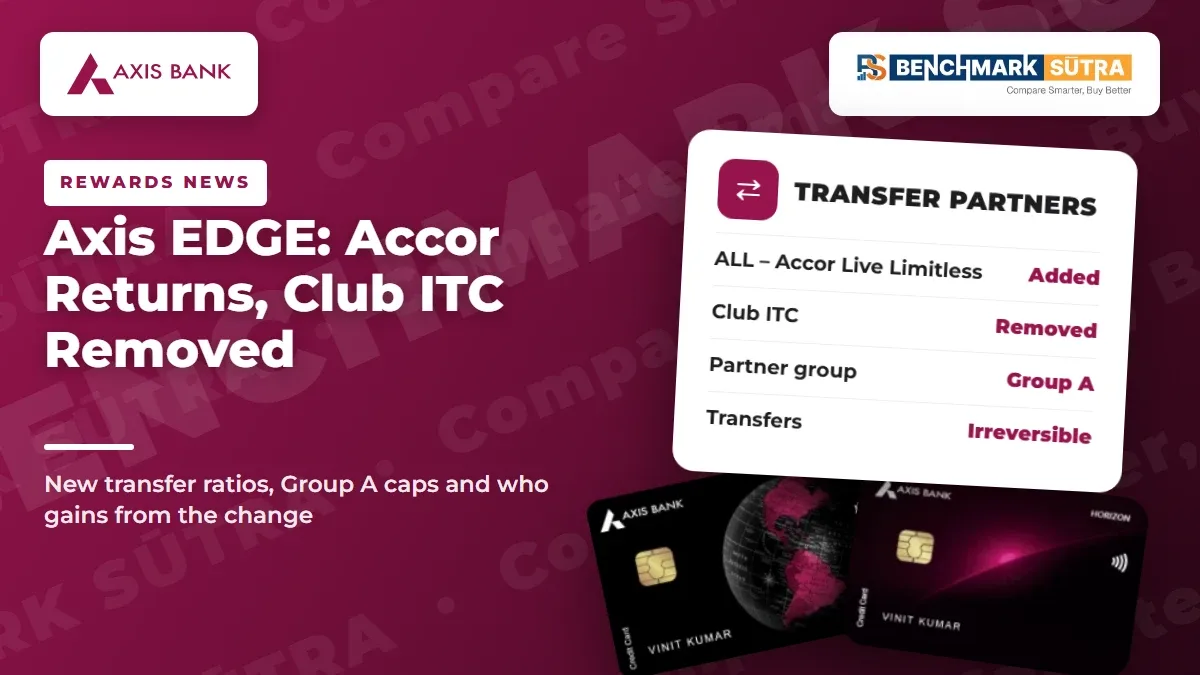
Axis Bank EDGE: Accor's ALL programme is back on Axis's transfer list. Atlas EDGE Miles move to ALL at 2:1, and Atlas allows 30,000 miles a year across all Group A partners, which include Accor. Axis charges ₹199 per transfer, and transfers cannot be reversed. Our Axis EDGE Accor update has the full ratio table.
Club ITC: no longer an Axis transfer partner as of October 2026.
Transfer ratios and caps change, so the flexible route has its own risk. Read Reward Points 101 before moving points.
Who Should Get a Hotel Co-Branded Card?
Your situation | Better choice |
|---|---|
You stay at Marriott hotels 2 or more times a year | Marriott Bonvoy HDFC |
You stay and dine at Taj hotels often and earn ₹36 lakh+ | HSBC Taj, if you will use the vouchers |
You travel for conferences and stay wherever the venue is | A bank-points travel card instead |
You spend a lot abroad | Check forex first: HSBC Taj charges 3.5% |
You rarely stay in hotels | Neither |
For professionals such as CAs, lawyers and doctors, the deciding factor is who books the hotel. If your firm or the conference organiser books and pays, you will not earn the hotel points on the card.
Hotel Co-Branded Card Benchmarksutra Scores
These are the scores we have already published, on our fixed 100-point framework using official bank data. See how the Benchmarksutra Credit Card Score works.
Card | Score | Tier | Best for |
|---|---|---|---|
Marriott Bonvoy HDFC Bank Credit Card | 70/100 | B Tier | Marriott regulars who want status at a modest fee |
HSBC Taj Credit Card | 63/100 | C Tier | Heavy Taj and IHCL users with very high income |
Neither reaches A Tier, because both lock their value to one hotel group.
Checklist
Count the nights you stayed with each hotel group in the last 12 months.
Check whether you, not your employer, pay for those stays.
Work out the yearly fee with 18% GST.
Check the cash and points price of a room you would really book.
Note when the free night or stay vouchers expire.
Check the forex markup if you travel abroad.
Check income, city and invitation rules before applying.
Compare with a transferable-points travel card.
Common Mistakes to Avoid
Mistake 1: Counting the free night at its highest value
A free night is worth what you would have paid for a room you needed, not the costliest room it can book.
Mistake 2: Using the hotel card for everything
At 2 points per ₹150, the Marriott card's everyday rate is low. Use it for hotel, travel and dining spends.
Mistake 3: Ignoring point expiry
Marriott Bonvoy points stay alive only with activity at least once every 24 months, per HDFC's MITC.
Mistake 4: Assuming every Taj bill gets 25% off
HSBC's terms exclude certain dates and need the physical card at the hotel. Check before you count the discount.
Mistake 5: Forgetting the fee has no waiver
Neither card lists a spend-based fee waiver. Plan to pay it every year.
FAQs
Are hotel co-branded credit cards worth it in India?
Only if you stay with that hotel group several nights a year. The value is locked to one chain, so occasional or mixed-chain travellers get little back.
Which hotel co-branded credit cards are available in India?
As of November 2026, the Marriott Bonvoy HDFC Bank Credit Card and the HSBC Taj Credit Card.
What is the annual fee of the Marriott Bonvoy HDFC card?
₹3,000 plus taxes, with no spend-based waiver listed in HDFC's MITC.
What is the annual fee of the HSBC Taj card?
₹1,10,000 plus GST, which is ₹1,29,800 a year at 18% GST.
Do Marriott Bonvoy points expire?
HDFC's MITC says they do not expire as long as your Marriott Bonvoy account has earning or redemption activity at least once every 24 months.
Can I move bank points to hotel programmes instead?
Yes, on some cards. Axis Bank lists Accor's ALL programme as a transfer partner, with card-wise ratios and yearly caps.
Official Sources and Editorial Note
Data checked as of: 5 November 2026
Marriott Bonvoy HDFC Bank Credit Card page
https://www.hdfc.bank.in/credit-cards/marriott-bonvoy-credit-card
Marriott Bonvoy HDFC Bank Credit Card fees and charges
https://www.hdfc.bank.in/credit-cards/marriott-bonvoy-credit-card/fees-and-charges
HDFC Bank Credit Card MITC, updated 31 October 2026 (fee waiver, point expiry)
https://www.hdfc.bank.in/content/dam/hdfcbankpws/in/en/personal-banking/discover-products/cards/credit-cards/personal-mitc/mitc-in-english.pdf
HSBC Taj Credit Card product page
https://www.hsbc.bank.in/credit-cards/products/taj/
HSBC Taj Important Terms and Conditions (MITC)
https://www.hsbc.bank.in/content/dam/hsbc/in/documents/credit-cards/taj/hsbc-taj-important-terms-and-conditions.pdf
HSBC Taj vouchers and benefits terms
https://www.hsbc.bank.in/content/dam/hsbc/in/documents/credit-cards/taj/hsbc-taj-offer-tnc.pdf
Axis Bank Travel EDGE transfer terms (partners, ratios, caps)
https://traveledge.axis.bank.in/travel/common/termsandcondition
Axis Bank Atlas Credit Card
https://www.axis.bank.in/cards/credit-card/axis-bank-atlas-credit-card
This article is written from official sources and does not rely on third-party wording.
Editorial note:
Room prices, spend splits and the share of Taj bills that qualify for discounts are our illustrative assumptions. HSBC's product page and MITC show different income rules. Fees, earn rates and hotel benefits can change; confirm with HDFC Bank, HSBC and Axis Bank before applying.