

 By
By Quick decision summary
Choose a 1 ton AC if your room is genuinely small, the heat load is moderate, and you want a more cost-conscious setup without overspending on unused capacity.
Choose a 1.5 ton AC if your room is medium-sized, the heat load is high, the room is top-floor or sun-facing, or you want more cooling headroom in Indian summer.
If your room is borderline, do not decide by square feet alone. Sunlight, top-floor exposure, ceiling height, daily runtime, and comfort expectations can change the right answer.
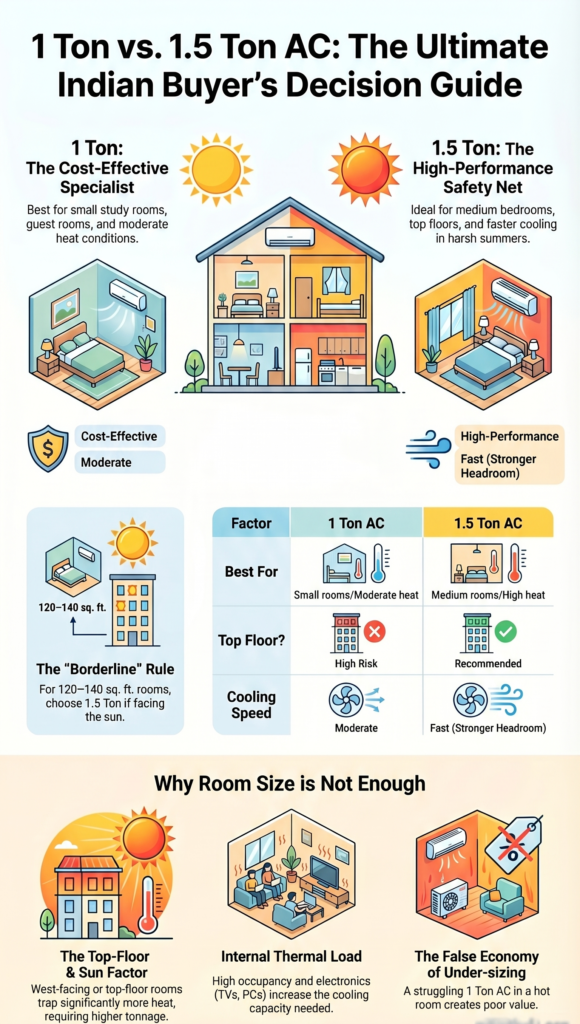
Table of Contents
1 Ton vs 1.5 Ton AC in India (2026): Which Size Should You Buy?
If you are confused between a 1 ton AC and a 1.5 ton AC, the right answer is not simply “bigger is better” or “smaller saves money.” The right answer depends on your room, your heat load, your usage pattern, and how much cooling margin you want.
This page is not a generic AC theory article. It is a practical Indian buyer guide for people trying to make one specific decision: Should I buy 1 ton or 1.5 ton AC for my room?
This draft is based on structured secondary research, usage logic, and editorial guidance rather than hands-on testing. It does not assume that square feet alone decides the right size, and it does not pretend one tonnage is universally better.
Quick Answer
Buy 1 ton AC when:
- the room is genuinely small
- sunlight and heat load are moderate
- usage is moderate rather than extreme
- you want to avoid overspending on extra cooling capacity
- the room is a study, compact bedroom, or guest room
Buy 1.5 ton AC when:
- the room is a proper medium-sized bedroom
- the room is top-floor, west-facing, or gets strong afternoon sun
- the AC will run for long hours
- you want stronger cooling headroom and faster pull-down
- you prefer a safer capacity margin instead of a tighter fit
The answer becomes less obvious in borderline rooms, especially around the point where a room is not clearly small but not clearly large either. That is where conditions matter more than labels.
1 Ton vs 1.5 Ton AC: Practical Comparison
| Factor | 1 Ton AC | 1.5 Ton AC |
| Ideal room type | Smaller bedroom, study room, guest room | Medium bedroom, warmer room, more demanding room |
| Heat load tolerance | Better for moderate heat load | Better for high heat load |
| Best for | Compact spaces and cost-conscious buyers | Buyers wanting stronger cooling margin |
| Who should avoid | Buyers with hotter borderline rooms | Buyers with truly small rooms and low usage |
| Upfront cost tendency | Usually lower | Usually higher |
| Electricity consumption tendency | Usually lower if correctly sized | Usually higher, but can be better than an undersized 1 ton struggling in a hotter room |
| Comfort margin | Tighter | Safer |
| Top-floor suitability | Often risky in borderline rooms | Safer choice |
| Long-hour usage suitability | Fine in the right room | Better for demanding rooms and longer runtime |
This is the core logic of the page. A 1 ton AC is not “weaker” in the wrong way. It is simply the right tool for a smaller, less demanding room. A 1.5 ton AC is not automatically “wasteful.” In hotter Indian conditions, it is often the safer choice.
When 1 Ton AC Is the Right Choice
A 1 ton AC works best when the room and usage pattern genuinely support it.
Smaller bedrooms
If the room is clearly on the smaller side and does not trap excessive heat, a 1 ton AC is often the more sensible choice. In these cases, paying more for 1.5 ton does not always improve the ownership experience enough to justify it.
Study rooms and guest rooms
Rooms that are used for shorter periods, have lower occupancy, or are not the hottest room in the home are natural candidates for 1 ton. This is especially true when the room is not exposed to harsh afternoon heat.
Lower heat load
A room with less direct sunlight, lower ceiling height, fewer appliances, and moderate occupancy places less pressure on the AC. That makes 1 ton more realistic.
Moderate daily use
If the AC is used for moderate hours rather than all-day runtime, 1 ton becomes easier to justify in the right room.
Tighter budget
When the room genuinely fits 1 ton, using the smaller size can help control both upfront cost and overall purchase logic. But this only works when the room really suits it. Under-sizing to save money is false economy.
If you already know a 1 ton AC is enough for your room, see our guide to the best 1 ton inverter AC in India.
When 1.5 Ton AC Is the Right Choice
A 1.5 ton AC is the safer choice when the room is more demanding than it first appears.
Hotter rooms
Some rooms look average on paper but feel much hotter in real use. If the room absorbs heat throughout the day, 1.5 ton usually makes more sense.
Top-floor rooms
Top-floor rooms in Indian summer are one of the clearest reasons to avoid overconfidence with 1 ton. Even when the room is not huge, the heat load can change the answer completely.
Sun-facing rooms
West-facing or strongly sunlit rooms build heat differently from shaded rooms. This is why square feet alone can mislead buyers.
Larger bedrooms
A proper medium-sized bedroom is more naturally a 1.5 ton use case, especially if more than one person uses the room regularly.
Longer daily runtime
If the AC will run for long hours, especially in peak summer, a 1.5 ton AC offers more cooling headroom and usually a more comfortable ownership experience in demanding rooms.
Buyers who want a safer cooling margin
Some buyers simply do not want the AC to feel “just enough.” If you value faster room pull-down and less strain in harsher conditions, 1.5 ton is the safer side of the decision.
If you need more cooling capacity and want a premium-efficiency option, see our guide to the best 1.5 ton 5-star inverter AC in India.
If you want a stronger value pick in the higher-capacity segment, see our guide to the best 1.5 ton 3-star inverter AC in India.
When the Answer Is Not Obvious
This is the part most buyers actually struggle with.
Borderline rooms
A room that is neither clearly small nor clearly medium is where mistakes happen. Many buyers treat these rooms like simple square-footage cases, but that is exactly where conditions start to matter more.
120–140 sq ft rooms
This is one of the most common confusion zones. In a shaded, well-insulated room with moderate use, 1 ton may still be enough. In a top-floor or west-facing room, 1.5 ton becomes much safer.
Medium rooms with heavy afternoon sun
A room that looks manageable on paper can behave like a larger one if the afternoon heat load is strong.
Average-size rooms on top floors
Top-floor exposure is often the deciding factor that pushes the answer toward 1.5 ton.
Buyers who want silence and faster pull-down
Even when the room is technically manageable for 1 ton, some buyers care more about faster cooling and lower perceived effort. Those buyers usually feel better with 1.5 ton in borderline conditions.
Buyers using AC only at night
Night-only use changes the logic slightly, especially if the room cools down naturally after sunset. But if the room stores a lot of heat from the day, that benefit may be smaller than expected.
This is why borderline buyers should think in terms of risk tolerance. If you want the tighter, more cost-conscious fit, 1 ton can work in the right conditions. If you want less regret in hot conditions, 1.5 ton is the safer side.
Why Room Size Alone Is Not Enough
This is the biggest mistake in AC sizing.
Many buyers reduce the decision to square feet. That is too simplistic. These factors can change the right answer:
Sunlight
A shaded room behaves differently from a room that gets direct western sun.
Top-floor exposure
Top-floor rooms usually carry more heat and stay hotter longer.
Insulation
Poor insulation and leaky rooms make even a decent AC feel weaker than it should.
Ceiling height
A taller room increases the volume that needs cooling.
Number of people
More people means more heat load.
Appliance heat load
TVs, PCs, desktops, routers, and lighting add to the room’s thermal load.
Local climate
Dry heat, humid heat, and long summer periods change how forgiving sizing can be.
Daily usage pattern
A room used occasionally behaves differently from a room used heavily every day.
This is why square feet can only be a starting point. The real answer comes from room conditions plus usage, not room volume alone.
Cost and Efficiency Tradeoff
A 1 ton AC usually costs less upfront. That part is simple.
But the right decision is not just about sticker price. A cheaper 1 ton AC that struggles in a hotter or borderline room can become poor value because the comfort is weaker, cooling takes longer, and satisfaction drops. In that situation, “saving money” upfront may not feel like a smart decision later.
A 1.5 ton AC usually costs more, but it also gives more cooling headroom. That does not make it automatically better. It makes it better only when the room and usage pattern actually justify it.
The key point is this: wrong sizing can reduce both comfort and value. The cheapest purchase is not always the cheapest mistake.
If your budget is capped, read our guide to the best AC under ₹40,000 in India.
If you are still deciding whether long-term efficiency matters more than upfront price, read our 3-star vs 5-star AC guide.
How to Choose Between 1 Ton and 1.5 Ton AC
Use this simple decision framework.
Step 1: Start with room size
Ask whether the room is clearly small, clearly medium, or borderline.
Step 2: Check room conditions
Ask whether the room is top-floor, west-facing, poorly insulated, or heat-trapping.
Step 3: Check daily runtime
Ask whether the AC will run moderately or for long hours in peak season.
Step 4: Decide your comfort expectation
Ask whether you are okay with a tighter fit or want safer cooling headroom.
Step 5: Check budget flexibility
Ask whether the higher upfront spend of 1.5 ton is acceptable if it reduces the risk of under-sizing.
Step 6: Think about future summers
If you expect the room to feel more demanding over time, erring slightly on the safer side can make sense.
A practical rule is simple:
- choose 1 ton when the room is clearly small and the conditions are moderate
- choose 1.5 ton when the room is borderline or clearly more demanding
Final Verdict
Choose 1 ton AC if your room is small, your heat load is moderate, and you want a smarter, cost-conscious fit without buying extra tonnage you do not need.
Choose 1.5 ton AC if your room is medium-sized, top-floor, sun-facing, used for long hours, or if you want a safer comfort margin in Indian summer.
If you are stuck in the middle, do not rely on square feet alone. Look at the room conditions, runtime, and your comfort expectations. That is what actually decides the right answer.
If you already know a 1 ton AC is enough for your room, see our guide to the best 1 ton inverter AC in India.
If you already know you need more capacity, move directly to the best 1.5 ton 5-star inverter AC in India or best 1.5 ton 3-star inverter AC in India, depending on whether you want premium efficiency or stronger value.
AC Tonnage Calculator
AC Tonnage Calculator
Estimate AC tonnage based on room size, occupancy, and real-world heat load factors.
Basic Room Details
Related Reads
- Best 1 Ton Inverter AC in India
- Best 1.5 Ton 5-Star Inverter AC in India
- Best 1.5 Ton 3-Star Inverter AC in India
- 3-Star vs 5-Star AC in India
- Best AC Under ₹40,000 in India
- Inverter AC Buying Guide
FAQ
Which is better: 1 ton or 1.5 ton AC?
Neither is universally better. A 1 ton AC is better for smaller, less demanding rooms. A 1.5 ton AC is better for medium rooms, hotter conditions, and buyers who want more cooling margin.
Is 1 ton AC enough for a bedroom?
Yes, if the bedroom is genuinely small and the heat load is moderate. If the room is top-floor, sun-facing, or borderline in size, 1.5 ton may be safer.
Is 1.5 ton AC too much for a small room?
It can be more than you need in a truly small room with moderate heat load. But the better question is whether the room is actually small in real thermal terms, not just on paper.
Which AC size is better for Indian summer?
That depends on room conditions. Indian summer makes heat load more important, especially in top-floor and sun-facing rooms. In harsher conditions, 1.5 ton becomes easier to justify.
Does top-floor heat change whether I should buy 1 ton or 1.5 ton?
Yes. Top-floor heat is one of the strongest reasons to lean toward 1.5 ton in a borderline room.
Should I choose 1 ton or 1.5 ton if I use AC only at night?
Night-only use can make 1 ton more workable in the right room, but it does not cancel out top-floor heat, trapped heat, or poor insulation.
Is 1 ton AC cheaper to run than 1.5 ton?
Usually, yes, if both are correctly sized for their rooms. But a poorly sized 1 ton AC in a demanding room can still feel like bad value.
Can room size alone decide the right AC tonnage?
No. Room size is only the starting point. Sunlight, top-floor exposure, ceiling height, insulation, runtime, and comfort expectations also matter.